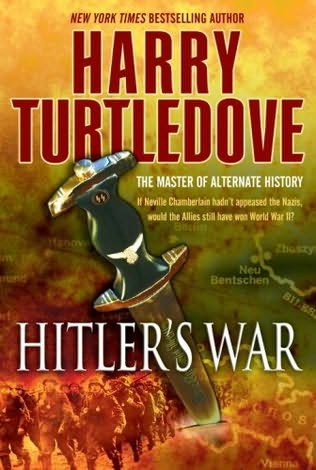
Hitler's war
- Автор: Тертлдав Гарри Норман
- Серия: The War that came early #1
- Язык: английский
- Жанр: Альтернативная история

Электронная книга - «Hitler's war». Краткое содержание книги:
Now, in this thrilling, provocative, and fascinating alternate history by Harry Turtledove, another scenario is played out: What if Chamberlain had not signed the accord? What if Hitler had acted rashly, before his army was ready-would such impatience have helped him or doomed him faster? Here is an action-packed, blow-by-blow chronicle of the war that might have been-and the repercussions that might have echoed through history-had Hitler reached too far, too soon, and too fast.
Turtledove uses dozens of points of view to tell this story: from American marines serving in Japanese-occupied China to members of a Jewish German family with a proud history of war service to their nation, from ragtag volunteers fighting in the Abraham Lincoln Battalion in Spain to an American woman desperately trying to escape Nazi-occupied territory-and witnessing the war from within the belly of the beast.
A novel that reveals the human face of war while simultaneously riding the twists and turns that make up the great acts of history, Hitler's War is the beginning of an exciting new alternate history saga. Here is a tale of powerful leaders and ordinary people, of spies, soldiers, and traitors, of the shifting alliances that draw some together while tearing others apart. At once authoritative, brilliantly imaginative, and hugely entertaining, Hitler's War captures the beginning of a very different World War II-with a very different fate for our world today.
He wore an Iron Cross First Class. Nobody could accuse him of being a coward or a defeatist…but he sounded like one. Hans-Ulrich wanted to take him aside and talk some sense into him. But when he tried to do that, the people he was talking to had a way of getting angry instead of appreciating his advice. He didn’t like it, which didn’t mean he hadn’t noticed it. He kept his mouth shut.
Caroling some more would have been nice, but nobody seemed to want to. That made a certain amount of sense: if you were listening for airplane engines, you didn’t want to be noisy yourself. Rudel missed the music all the same.
Sergeant Dieselhorst had come in with the rest of them. He was drinking schnapps. Soon enough, he was laughing and joking with the rest of the men. Hans-Ulrich wished he could fit in so easily-or at all.
Chapter 8
Achilly wind whipped snow through the air almost horizontally. A good coal stove heated the officers’ barracks outside of Drisa. All the same, Anastas Mouradian shivered. “I’ll never be warm again,” he said in his deliberate Russian. “Never, not till July and the five minutes of summer they have here.”
Sergei Yaroslavsky and the other men in the barracks were all Russians. They hooted at the effete southerner. They’d all seen plenty of weather worse than this. “Hell, we could fly in this if we had to,” Sergei said.
“And we might, too,” somebody else added. “Is it five o’clock yet?”
After a glance at his watch, Sergei said, “A couple of minutes till.”
“Good,” the other flyer said. “Turn on the radio. Let’s hear the news.”
Mouradian was closest to the set. He clicked it on. It made scratchy, flatulent noises as it warmed up. There were better radios-Yaroslavsky had seen, and heard, that in Czechoslovakia. He didn’t say anything about it. Things weren’t so bad as they had been during the purges the year before, but a careless word could still make you disappear.
Or you could disappear for no reason. Plenty of people had.
“Comrades! The news!” the announcer said. “In the West, the capitalists and Fascists continue to murder one another.” He gave a summary of the day’s fighting-or rather, the claims and counterclaims about the day’s fighting, finishing, “Plainly, by the lies and contradictions on display, neither side in this struggle of reactionary decadence is to be believed.”
“May the Devil’s grandmother eat them all up,” another pilot said. The sentiment was unexceptionable. The way the man put it wasn’t. Russians talked about the Devil and his relations all the time. When the Soviet Union was aggressively atheist, though…Such talk could land you in trouble if someone who didn’t like you reported it.
Anything could land you in trouble. Sergei’d just been thinking about that.
“In the Far East, Japanese imperialists continue to encroach on the territory of the fraternal socialist Mongolian People’s Republic,” the announcer said. “The Foreign Commissar, Comrade Litvinov, has stated that such incursions cannot and will not be tolerated indefinitely.”
“Wonder if that’s where we go next,” Mouradian said. Sergei had wondered the same thing when he was ordered to fly their SB-2 out of the Ukraine. But they’d ended up at the other end of the USSR instead, about as far from the trouble in Mongolia as they could get.
And there might have been reasons for that, because the next words out of the newsreader’s mouth were, “The semifascist Smigly-Ridz regime in Poland has once more rejected the Soviet Union’s just and equitable demands for an adjustment of the border in the northeast. The Poles still cling to their ill-gotten and illegal gains from the war they waged against the USSR in the early 1920s.”
Everybody leaned toward the radio. In portentous tones, the announcer went on, “Comrade Stalin has spoken with grave concern of the way the Polish regime mistreats the ethnic Byelorussians in the area in question. How long the peace-loving Soviet people can tolerate these continued provocations, only time will tell.”
He went on to talk about the overfulfillment of the norms for the current Five-Year Plan. Yaroslavsky listened to all that with half an ear; it didn’t directly affect him. The other did. When Stalin said he didn’t like the way somebody did something, that somebody was commonly very sorry very soon. And hardly anything could make a country sorrier faster than flight after flight of SB-2 bombers.
“I didn’t think we’d go,” Sergei said. “If the Poles yelled to the Nazis for help, that would put German troops right on our border, and-” He didn’t say and that wouldn’t be so good. Most of the men in the barracks had served in Czechoslovakia. They knew what rough customers the Hitlerites were.
Anastas Mouradian picked up where he left off: “If the Nazis get bogged down against England and France, they’ll be too busy to do anything about what goes on here.”
Several flyers nodded. Sergei was one of them; it looked that way to him, too. He would have said it if his crewmate hadn’t. “Soldiers are moving up toward the border. So…” The pilot who said that let his voice trail off. He wasn’t a general, and he wasn’t a prophet. You didn’t want to come out with anything that might be remembered too well.
“We aren’t going to fly right this minute,” another officer said, and produced a bottle of vodka. Despite what Sergei had said before, he was obviously right. The bottle went round. Pretty soon, another one followed it. One more after that and they wouldn’t have been able to walk or see, let alone fly. The Red Air Force ran on vodka as surely as it ran on aviation gasoline.
They got their orders the next day. Sergei still felt the drinking bout. Like the other flyers Lieutenant Colonel Borisov summoned to his office, he did his best not to show it. “We are going to liberate our Byelorussian brethren from the yoke of the Polish semifascist regime,” the squadron commander declared. “Marshal Smigly-Ridz has refused to be reasonable and democratic, and so we must persuade him.”
He’s refused to do what we want, and so we must pound the shit out of him. Sergei had no trouble translating Communist jargon into what went on in the real world. By the knowing grunts that came from several other men, neither did anyone else.
“Red Army units will enter the territory to be liberated at 0700 tomorrow morning,” Borisov declared. His eyes were cat-green but set on a slant; like so many Russians, he likely had some Tatar in the woodpile. “Your assignment will be to strike at Polish troops, and to bomb the rail junction at Glubookoje to prevent the Smigly-Ridz regime from bringing up reinforcements. Questions?”
“What if the weather doesn’t let us fly, Comrade Lieutenant Colonel?” Sergei asked.
“Then we will stay on the ground,” Borisov answered. “But our superiors do not believe that is likely.”
What exactly did he mean there? Did higher-ups in the Red Army and Red Air Force have reliable forecasts of good weather? Or would the SB-2s take off no matter how rotten the weather was? Yaroslavsky suspected the latter. With air-cooled engines, the bombers wouldn’t freeze up the way they might with liquid cooling. And they’d had skis installed instead of landing wheels, so they could deal with snow pretty well. Even so…
Sergei suspected a plan somewhere said, Air support will be laid on at such and such a time in such and such places with so many bombers and so many escorting fighters. Bad weather? Plans like that didn’t worry about such mundane details. Come what might, the air support would be laid on.
“Other questions?” Borisov asked.
His tone said he didn’t really want any more, but Anastas Mouradian raised his hand anyway. Frowning, Borisov nodded at him. “What do we do if the Nazis come in on the Poles’ side, Comrade Lieutenant Colonel?” Mouradian asked.
Several people inhaled sharply. That was a question with teeth, all right. Borisov didn’t look happy. “The hope and expectation are that this will not occur.”