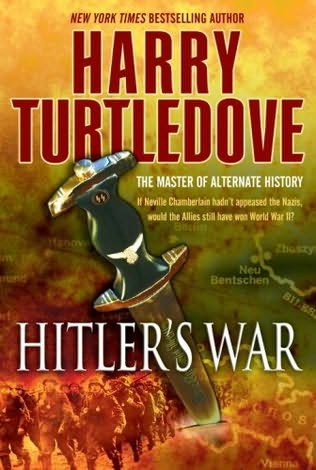
Hitler's war
- Автор: Тертлдав Гарри Норман
- Серия: The War that came early #1
- Язык: английский
- Жанр: Альтернативная история

Электронная книга - «Hitler's war». Краткое содержание книги:
Now, in this thrilling, provocative, and fascinating alternate history by Harry Turtledove, another scenario is played out: What if Chamberlain had not signed the accord? What if Hitler had acted rashly, before his army was ready-would such impatience have helped him or doomed him faster? Here is an action-packed, blow-by-blow chronicle of the war that might have been-and the repercussions that might have echoed through history-had Hitler reached too far, too soon, and too fast.
Turtledove uses dozens of points of view to tell this story: from American marines serving in Japanese-occupied China to members of a Jewish German family with a proud history of war service to their nation, from ragtag volunteers fighting in the Abraham Lincoln Battalion in Spain to an American woman desperately trying to escape Nazi-occupied territory-and witnessing the war from within the belly of the beast.
A novel that reveals the human face of war while simultaneously riding the twists and turns that make up the great acts of history, Hitler's War is the beginning of an exciting new alternate history saga. Here is a tale of powerful leaders and ordinary people, of spies, soldiers, and traitors, of the shifting alliances that draw some together while tearing others apart. At once authoritative, brilliantly imaginative, and hugely entertaining, Hitler's War captures the beginning of a very different World War II-with a very different fate for our world today.
Stukas peeled off one by one and bombed enemy positions. One of the dive-bombers didn’t rise into the sky again. It added its funeral pyre to the rest of the stinking, choking smoke in the air. Nobody was using gas, but sometimes it hardly seemed to matter.
Someone not far from Joaquin started shrieking for his mother. That only made him dig harder. More bullets snarled past him. The English seemed to have all the ammunition in the world. As he dug, he realized he had yet to see his first British soldier.
Chapter 9
Alistair Walsh was alive and breathing and somewhere in France. He heartily approved of the first two. The last wasn’t so good. He couldn’t remember just when the BEF got driven back over the border. They gabbled away in French in the western part of Belgium, so he couldn’t tell by any shift in language. But this was France, all right, and the Germans were still doing their damnedest to break through.
They hadn’t managed yet. Walsh remembered the black days in the spring and early summer of 1918, when whole British regiments-Christ, divisions!-got swallowed up in the Kaiser’s last offensive. This was worse. Then storm troops with submachine guns had spearheaded the German attacks. They were right bastards, but they went at the speed of shank’s mare, like everybody else in the Great War.
Nowadays, the Nazis had tanks. They sliced through infantry like a hot knife through lard. The BEF and the French had tanks, too. Officers swore on a stack of Bibles-and swore profanely-that they had as many tanks as the Germans, maybe more. They sounded as if they knew what they were talking about. But whether they did or not, they never seemed to have enough of them at the places were it counted.
And so the bastards in field-gray-funny how the mere sight of that color, and the beetling shape of that helmet, could put your wind up-kept carving slices out of the Allies, forcing them to retreat if they didn’t want to get cut off and surrounded. The Nazis made it over the Dyle in rubber boats. Machine guns knocked out the first boats, but German tanks and antiaircraft guns on the far side of the river silenced the machine guns. As soon as the Germans won a bridgehead, they ran pontoon bridges over the Dyle and got their tanks across. Things went downhill from there.
“Hey, Puffin!” Walsh said. “Got a fag on you?”
“Sure, Sergeant.” Puffin Casper looked like hell. His greatcoat was filthy and torn. His tin hat sat at an anything but jaunty angle on his head. He hadn’t shaved since God only knew when, and he hadn’t bathed since a while before that. Walsh couldn’t very well gig him-he was no lovelier, and no cleaner, himself. And he’d smoked his last cigarette an hour earlier.
He took a couple from the packet Puffin held out. “Thanks,” he said, and cupped his hands in front of his mouth to get one lit in spite of the cold, nasty wind. It wasn’t raining right this minute, and it wasn’t snowing, either. Dirty gray clouds clotted the sky. Before long, it would be doing one or the other. Or maybe it would split the difference with sleet, which was worse than rain or snow.
Somebody not far away started cussing. The vile words held no special heat, as they might have if the swearer had mashed his thumb with a spanner. No, his fury was cold and disgusted. Walsh knew what that meant: he’d just heard bad news. If everyone around him was lucky, he’d found out his fiancee was having it on with the corner greengrocer. If not…
“What’s buggered up now?” Walsh asked. Knowing was better than not knowing-he supposed.
“Bloody Belgies have packed it in,” came the reply. “King Leopold’s asking Hitler for an armistice.”
“What? They can’t do that!” Under other circumstances, the outrage in Walsh’s voice would have set him laughing. True, the Allies had agreements not to seek separate peaces. But it wasn’t as if the Dutch hadn’t already done it. And it wasn’t as if everybody didn’t already know Leopold was a weak reed and halfway toward liking the Germans, either.
All the same, the news was a jolt. A corner of Belgium had stayed free all through the last war. The Belgian army had stayed in the field all through the last war, too. Now the whole country was spreading its legs for the Germans after three weeks.
“I know they can’t,” said the soldier with the news. “Sods are doing it anyway. And wherever they’re holding the line, the Nazis can pour right on through.”
“Christ!” Walsh hadn’t thought of that. “Sweet suffering Jesus Christ!” Sweet suffering Jesus Christ had had a birthday not long before, not that anyone let it get in the way of the serious business of slaughter. Walsh found a real question to ask: “What are we doing about it?”
“Chamberlain’s deplored it, the wireless said,” the other soldier answered.
“Oh, that’ll set Adolf’s mustache quivering, that will. Deplored it, has he? Bleeding hell!” Walsh could have gone on for some time, but what was the point? Chamberlain had survived two votes of confidence since the war broke out, by a diminishing margin. One more might sink him. That wouldn’t have broken Walsh’s heart. He also feared it wouldn’t have much effect on the way the BEF was fighting.
A British machine gun up ahead started barking. A moment later, another joined in. “Oh, bleeding hell,” Walsh muttered again. He’d hoped things would stay quiet for a while. The weather was bad enough to have made any push in the last war bog down in mud and slush. But there were many more paved roads for wheels to use now, while tracks could force a way where even men on foot had trouble going.
To his glad surprise, he heard engines coming up from the southwest. “Matildas!” somebody yelled. The British tanks waltzed up to the line a few minutes later. Waltz was about all they could do; they made eight miles an hour on roads, and were slower off. They had thick armor-German antitank shells mostly bounced off of them. But they carried only a single rifle-caliber machine gun. Walsh would have wished for French machines that had some hope of keeping up with German panzers…and of knocking them out in a stand-up fight.
Still and all, any tanks were better than none. If panzers came after you and you couldn’t hope to fight them, what choice did you have but to fall back? Walsh waved to the tank commanders, who rode head and shoulders out of their cramped turrets. “Give ‘em hell!” he shouted.
“That’s what we’re here for,” a tank commander answered in elegant Oxbridgian tones. Walsh’s own accent was decidedly below the salt. After mixing with men of every class in the last war and since, he could make sense of all kinds of accents, from Received Pronunciation to Cockney to broad Yorkshire to Scots burr. They reminded him the whole country was in the fight.
The Matilda’s rattled forward. Walsh dug his foxhole deeper and wider, and built up the earthwork in front of it. He also looked around to decide where he’d go if he had to get out in a hurry. You didn’t want to have to worry about that at the last minute. He who hesitated then was lost.
A cannon barked-one of the Germans’ 37mm antitank guns. They were small and light enough to keep up with advancing troops. A split second later, the shell whanged off a Matilda. The British tank’s machine gun never hesitated. Walsh grinned. Sure as hell, Matildas were tough old gals.
But then a bigger gun boomed. This time, the noise of the impact was Whang! Blam! That Matilda brewed up. So did another one a moment later. Hitler’s boys had an 88mm antiaircraft gun. In their thoroughness, they’d also seen fit to stock it with armor-piercing ammunition. Walsh didn’t think a tank in the world could keep out an 88mm shell.
Puffin knew that report for what it was, too. “Bad luck they’ve got an 88 here,” he said.
“Too fucking right it is,” Walsh agreed. He wondered if the German monster had taken out the tank commander with the posh accent. He hoped not, for whatever that was worth.