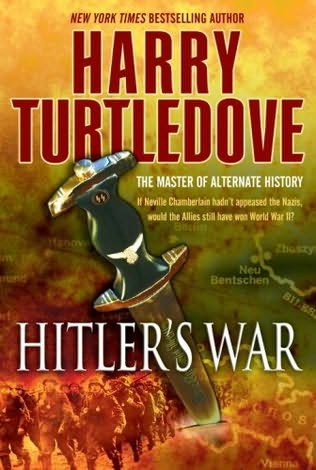
Hitler's war
- Автор: Тертлдав Гарри Норман
- Серия: The War that came early #1
- Язык: английский
- Жанр: Альтернативная история

Электронная книга - «Hitler's war». Краткое содержание книги:
Now, in this thrilling, provocative, and fascinating alternate history by Harry Turtledove, another scenario is played out: What if Chamberlain had not signed the accord? What if Hitler had acted rashly, before his army was ready-would such impatience have helped him or doomed him faster? Here is an action-packed, blow-by-blow chronicle of the war that might have been-and the repercussions that might have echoed through history-had Hitler reached too far, too soon, and too fast.
Turtledove uses dozens of points of view to tell this story: from American marines serving in Japanese-occupied China to members of a Jewish German family with a proud history of war service to their nation, from ragtag volunteers fighting in the Abraham Lincoln Battalion in Spain to an American woman desperately trying to escape Nazi-occupied territory-and witnessing the war from within the belly of the beast.
A novel that reveals the human face of war while simultaneously riding the twists and turns that make up the great acts of history, Hitler's War is the beginning of an exciting new alternate history saga. Here is a tale of powerful leaders and ordinary people, of spies, soldiers, and traitors, of the shifting alliances that draw some together while tearing others apart. At once authoritative, brilliantly imaginative, and hugely entertaining, Hitler's War captures the beginning of a very different World War II-with a very different fate for our world today.
After what seemed like forever but probably wasn’t, another soldier stumbled out of the house. “Go back to sleep,” he said. “I’ve got it.” A moment later, he added, “Damn Sergeant Demange anyway,” under his breath.
“Sure,” Luc said. He went back inside, wondering whether Demange ever slept. On all the evidence, he seemed a piece of well-made machinery rather than a man. Maybe he ran on cigarette smoke and coffee.
Come to think of it, maybe I do, too. Luc found the blanket he’d so sorrowfully abandoned. He took off boots and helmet and lay down again. The blanket didn’t seem to do a thing to get him any warmer. He wondered if he’d lie there till dawn finally came. Next thing he knew, he was asleep.
“Wake up, you bum. You snore.”
“I do not,” Luc answered automatically, even before his eyes opened. Twenty minutes later, with some kind of mush and strong coffee inside him, he was marching again.
Refugees from Namur and Charleroi crowded the road. Some of them cheered the soldiers in their odd Walloon French. Others swore at them: “If we weren’t in the way between the Germans and your damned country, they’d leave us alone!”
“As far as I’m concerned, Hitler’s welcome to Belgium,” Sergeant Demange retorted. “And you cocksuckers deserve him, too. Now get the hell out of our way before we open up on you!”
He would have done it. Not only that, he would have laughed while he did it. The Belgians must have figured that out, because they tumbled off the road with haste that would have been funny if this were a film and not the ruination of their lives.
Then more Belgian soldiers started falling back past the oncoming French. “You can have a taste of those bastards,” a Walloon said. A couple of Flemings added something to that, but Luc didn’t know what it was. If they hadn’t worn Belgian uniform, he would have shot them. Their language sounded too goddamn much like German.
Charleroi had got the bejesus knocked out of it in the first war. Luc supposed it must have been rebuilt since, but it had got pounded again. Some of the wrecked buildings were still smoking. The Nazis had just worked it over, then. Half a rag doll lay in the gutter. At another time, it might have been poignant enough to move Luc to tears. But he’d seen men who looked like that. He glanced at the doll and marched on.
Out beyond Charleroi, some of Colonel de Gaulle’s tanks were firing at the enemy. German shells landed around them. Without waiting for orders, Luc yanked the entrenching tool off his belt and started digging in. If Sergeant Demange didn’t like it, he’d say so. A look out of the corner of Luc’s eyes told him the noncom was digging, too. Nodding to himself, Luc made the dirt fly.
* * *
Some French King a long time ago said, “Paris is worth a Mass.” Vaclav Jezek had learned that in history class. As far as he was concerned, Paris was mostly a mess. By steamer from Constanta to Marseille, dodging Italian subs and seaplanes. By train from Marseille to Paris. By taxicab to the Czech embassy, which served as headquarters for the government in exile.
By taxi again to a camp outside Paris. The camp held about a regiment’s worth of Czechoslovakian soldiers: mostly Czechs, with a sprinkling of antifascist Slovaks and Ruthenians. Hardly anyone had his own weapon. The French wasted little time passing out rifles. They were eager to get all their friends into the fight against Hitler’s legions.
Next to none of them spoke any Czech, though. They did the same thing as the Pole who’d interned Vaclav: they used German. It worked-most Czechs knew at least some, and could translate for the ones who didn’t. But speaking the enemy’s language with your friends was humiliating and infuriating.
The Germans seemed to know where the camp was. Their bombers visited it every so often. This wasn’t the first time Vaclav had had to sprint for a trench-far from it. The bombers also visited Paris. On the radio, the Germans claimed to be hitting only military targets. That would have been funny if it didn’t make Jezek want to cry.
Three days before Christmas, his platoon jammed itself into a bus. A generation earlier, buses had hauled French troops from Paris to the war-saving Battle of the Marne. Some of the machines the Czechoslovak regiment used looked to be of vintage close to 1914.
It was cold outside. It didn’t stay cold inside the bus for long, not when it was full of twice as many men as it was supposed to carry. Everybody lit a cigarette. Inside of seconds, the smoke made Vaclav’s eyes sting. He didn’t care. He was smoking furiously himself. Gauloises packed a heftier jolt than the miserable excuses for tobacco he’d got since he was interned.
The driver, a middle-aged Frenchman, chain-smoked with his passengers. A patch covered his left eye but didn’t hide all the damage a bullet or shell fragment had done to his face. He seemed to manage all right with one eye, at least as far as driving went.
Whatever springs the bus might have had once upon a time had long since gone to the big coachwork shop in the sky. Vaclav felt every pothole, every rock. “I wonder if we’ll have any kidneys left by the time we get wherever we’re going,” he said to the soldier sitting next to-half on top of-him.
“Why worry?” the other man replied. His dark, curly hair and hooked nose said he was a Jew. Vaclav normally had little use for Jews, but he supposed you could count on them to fight the Nazis. This fellow went on, “If we’ve still got ‘em when we get there, the Germans’ll blow ‘em out of us, right?”
Vaclav eyed him. Maybe you weren’t so smart if you supposed something like that. “If you don’t think we can beat them, why did you sign up for this?”
“You gotta try.” The Jewish soldier paused to light a Gitane. He spoke Czech like a big-city man; if he wasn’t from Prague, Vaclav didn’t know anything. After sucking in smoke, he added, “Damn Poles don’t like Jews any better than the Germans do.”
“I guess not.” Vaclav hadn’t thought of that; it was nothing he’d ever needed to worry about.
“So how about you, goy?” That wasn’t Czech or German, but Vaclav had no trouble working out what it meant. “How come you’re here? How come you aren’t yelling, ‘Heil Hitler!’?”
Who do you think you are, asking me questions like that? After a moment, Vaclav tried to shrug. Inside the crowded bus, it wasn’t easy. “Fuck Hitler,” he said simply.
“That’ll do.” The Jew nodded. “I’m David. Who the hell are you?”
“Vaclav.” Jezek laughed. “Like everybody else, almost.”
David started singing the Christmas song about Good King Wenceslaus. He knew all the words. Vaclav must have looked flabbergasted, because the Jew started to laugh. “I’ve been hearing it ever since I was born,” David said. “Hell, I must have heard it while I was still inside my mom. I’d better know it.”
“I guess.” Vaclav hadn’t thought about that, either. If you were a Jew, you had your own stuff. But everybody else’s stuff had to land on you, too, whether you wanted it or not. If that wasn’t weird, what was?
After a few seconds, somebody else started singing about Good King Wenceslaus. It was that season of the year. A moment later, the Czech carol filled the bus like cigarette smoke. “Well, I see what you mean,” Vaclav said.
David nodded again. “Bet your ass. It’s always like this.”
The driver didn’t speak any Czech. To him, the carol was just noise. He didn’t need long to get sick of it. He yelled something in French. Not enough of the Czech soldiers spoke enough French for it to do any good. Then the driver screamed, “Shut up, you fucking pigdogs!” auf Deutsch. Maybe he’d learned it in a prison camp or something. That got people’s attention-maybe not in a good way, but it did.
“Ah, your mother,” David said, first in Czech, then in Yiddish.
Vaclav realized things were starting to go wrong when a gendarme-or maybe he was a military policeman-waved the bus onto a detour. The new road was narrow and twisty. The driver started swearing. So did the Czech soldiers as they slid from side to side.