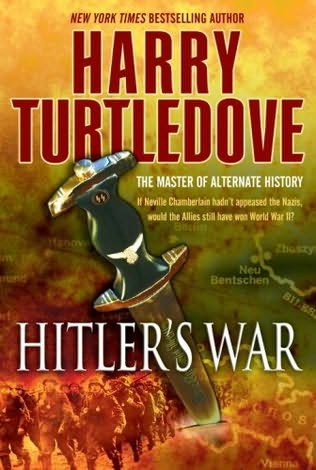
Hitler's war
- Автор: Тертлдав Гарри Норман
- Серия: The War that came early #1
- Язык: английский
- Жанр: Альтернативная история

Электронная книга - «Hitler's war». Краткое содержание книги:
Now, in this thrilling, provocative, and fascinating alternate history by Harry Turtledove, another scenario is played out: What if Chamberlain had not signed the accord? What if Hitler had acted rashly, before his army was ready-would such impatience have helped him or doomed him faster? Here is an action-packed, blow-by-blow chronicle of the war that might have been-and the repercussions that might have echoed through history-had Hitler reached too far, too soon, and too fast.
Turtledove uses dozens of points of view to tell this story: from American marines serving in Japanese-occupied China to members of a Jewish German family with a proud history of war service to their nation, from ragtag volunteers fighting in the Abraham Lincoln Battalion in Spain to an American woman desperately trying to escape Nazi-occupied territory-and witnessing the war from within the belly of the beast.
A novel that reveals the human face of war while simultaneously riding the twists and turns that make up the great acts of history, Hitler's War is the beginning of an exciting new alternate history saga. Here is a tale of powerful leaders and ordinary people, of spies, soldiers, and traitors, of the shifting alliances that draw some together while tearing others apart. At once authoritative, brilliantly imaginative, and hugely entertaining, Hitler's War captures the beginning of a very different World War II-with a very different fate for our world today.
“Close enough. Too damn close.” The other pilot raised his glass again. “And here’s to close enough and too damn close, as long as the bastards miss.”
“Amen!” Hans-Ulrich drank to that, too, even if it was with plain eggnog.
Off in the distance, guns boomed. The ceiling was too low to let planes take off and land, but the war went on. One of the groundcrew men, a graying, wrinkled fellow with only three fingers on his left hand, said, “Wasn’t like this the first Christmas in the last war.”
“I’ve heard about the truce, Franz,” Hans-Ulrich said. “Was it really as big a thing as people say-our Landsers playing football with the Tommies, and all that?”
“I know people who watched the games,” Franz answered. “I know one guy who played. I didn’t see ‘em myself-my regiment was opposite the Frenchmen. We didn’t play football with them. But we did come up out of the trenches and meet in no-man’s-land, damned if we didn’t. We traded cigarettes and rations and stuff you could drink, and we all said what a bunch of assholes our officers were…No offense, sir.”
Everybody laughed. Rudel made sure his laughter was louder than anyone else’s. You couldn’t let the men think you were a stuffed shirt, even if you were-maybe especially if you were. Hans-Ulrich knew he was, at least by most people’s standards.
He shrugged. He had his father’s stern Lutheran God, and he had the Fuhrer (whom he saw as God’s instrument on earth), and he had his Stuka (which was his own instrument on earth). As long as he had them, he didn’t need to worry about anything else.
Or so he thought, till bombs started walking toward the hut where he and his countrymen were celebrating Christmas. The weather might be lousy here, but it was good enough farther west to let planes take off, and the English or French were paying a call.
They were bombing blind, of course, up there above the clouds. Let it fall, and it’s bound to come down on somebody’s head. That had to be what they were thinking, and they were right. The Luftwaffe did the same thing when the weather was bad, as it so often was at this season.
Hans-Ulrich didn’t want to be the first one running for a trench. He also didn’t want to wait too long and go sky-high in case the bombardiers got lucky. The line between courage and foolhardiness could be a fine one.
Franz took the bull by the horns. “I’m never going to go up for the goddamn Ritterkreuz,” he said, and dashed out the door.
Where one man went, others could follow without losing pride. A zigzag trench ran only a few meters outside the hut for such occasions as these. As Hans-Ulrich jumped down into it-his boots squelched in mud-he tried to imagine winning the Knight’s Cross to the Iron Cross himself. He’d got an Iron Cross Second Class a week before: an early Christmas present, his CO called it. But you could win an Iron Cross Second Class just by staying alive at the front for a couple of weeks-oh, not quite, but it seemed that way.
Franz had the ribbon for one, no doubt from the last war. Back then, the Iron Cross Second Class was almost the only medal an enlisted man could win. Hitler had an Iron Cross First Class, which made him an exceptional hero, because he’d never even reached sergeant.
And then Hans-Ulrich stopped worrying about Hitler’s Iron Cross or anything else but living through the next few minutes. The enemy planes up there were bombing blind, but they couldn’t have done better on a sunny, clear summer’s day. They might not have done so well, because high-altitude bombing was turning out to be one of the big disappointments of the war. It was neither as accurate nor as terrifying and intimidating as the experts had claimed it would be.
Which didn’t mean winding up on the wrong end of it was any fun. Now Rudel got a taste of what he gave the foe. The earth shook under him like a blancmange. The noise was impossible, overwhelming. Blast did its best to tear his lungs out from the inside.
After the longest six or eight minutes of Hans-Ulrich’s life, the bombers droned away. “Der Herr Gott im Himmel!” he said. Then he said it again, louder, because he couldn’t hear himself the first time. He stuck his head up and looked over the lip of the trench.
The hut still stood, but it leaned drunkenly Its windows were blown out-or, more likely, in. Bomb craters turned the landscape into a miniature Verdun. Something a few hundred meters away was burning enthusiastically-a truck, Hans-Ulrich saw.
Sergeant Dieselhorst stuck his head up a few meters from Hans-Ulrich. “I wouldn’t mind not doing that again,” the rear gunner remarked, and then, apropos of nothing that presently surrounded him, “Merry Christmas.”
“Merry Christmas,” Rudel echoed automatically. “Where were you? You weren’t singing carols-I know that.”
“I should hope not,” the noncom said. “If you want to waste your time that way, go ahead, but I was doing something more important: I was sleeping, by God.” He pointed to some trees not far away. “I was happy as a clam under there, but then the goddamn bombs started coming down.”
He sounded irate in a particular way. Hans-Ulrich nodded, because he felt that same indignation. When he went out and dropped a fat one on a French truck column, that was business. But when the sons of bitches on the other side tried to blow him to the moon, it felt like dirty pool. How dare they do such a thing? Didn’t they know the Fuhrer and the Reich were going to win any which way? Why were they working so hard in what was bound to be a forlorn hope?
And why were they coming so close to killing him? That was the real question.
“I wonder if we’ve got any fighters up there,” somebody said. “If we do, those Allied shitheads’ll be sorry in a hurry.”
Hans-Ulrich nodded. He’d listened to Me-109 pilots going on about what sitting ducks British and French bombers were. They couldn’t run, they couldn’t hide, and they couldn’t fight back. He would have liked that better if his Stuka weren’t in the same boat. No matter how scary it seemed to the troops on the ground, it couldn’t get out of its own way. If the Messerschmitts didn’t keep enemy fighters away from them, Ju-87s would tumble out of the sky as often as the Western Allies’ bombers did.
“We ought to pay those damned sky pirates back,” someone else said, lifting a phrase popular in German papers.
Dieselhorst’s snort put paid to that. In case it hadn’t, the sergeant went on, “How? We can’t take off. Even if the weather didn’t stink, some of that load came down on the airstrip. They’re going to have to flatten it out again before we can use it. We might as well drink and play skat, because we aren’t flying for a while.”
A sergeant feeling his oats could sound more authoritative than any major ever hatched. Sergeants mysteriously, mystically knew things. Officers could command, but they didn’t have that amazing certainty.
“Anybody think more of those fuckers are coming?” asked a ground-crew man in greasy, muddy coveralls. By his tone, he wanted somebody like Dieselhorst to pat him on the head and say something like, No, don’t worry about it. You’re safe now.
But no one said anything of the kind. Hans-Ulrich realized he wouldn’t have minded some reassurance, either. When the silence had stretched for a bit, the groundcrew man swore again. Maybe that made him feel a little better, anyhow. Rudel didn’t usually grant himself even that safety valve, though some of the close calls he’d had on missions made him slip every now and then. He always felt bad about it afterwards, but coming out with something ripe made him feel better when he did it.
He climbed out of the trench and brushed mud and dirt off of himself. “We might as well go back,” he said. “The best way to get even with the enemy is to have a good time.”
When the Luftwaffe men went back inside their shelter, they found that blast and wind had blown out most of the candles on the Christmas tree. A pilot with a cigarette lighter got them going again. He flicked the lighter closed and put it in his pocket. “God only knows how long I’ll be able to get fuel for it,” he said. “Then it’s back to matches-as long as we have matches.”