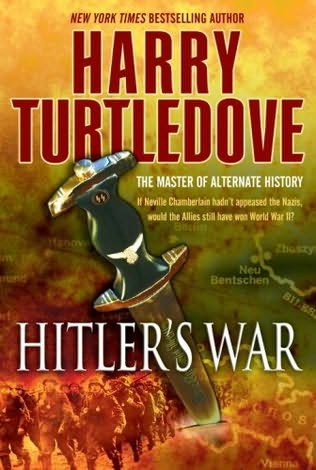
Hitler's war
- Автор: Тертлдав Гарри Норман
- Серия: The War that came early #1
- Язык: английский
- Жанр: Альтернативная история

Электронная книга - «Hitler's war». Краткое содержание книги:
Now, in this thrilling, provocative, and fascinating alternate history by Harry Turtledove, another scenario is played out: What if Chamberlain had not signed the accord? What if Hitler had acted rashly, before his army was ready-would such impatience have helped him or doomed him faster? Here is an action-packed, blow-by-blow chronicle of the war that might have been-and the repercussions that might have echoed through history-had Hitler reached too far, too soon, and too fast.
Turtledove uses dozens of points of view to tell this story: from American marines serving in Japanese-occupied China to members of a Jewish German family with a proud history of war service to their nation, from ragtag volunteers fighting in the Abraham Lincoln Battalion in Spain to an American woman desperately trying to escape Nazi-occupied territory-and witnessing the war from within the belly of the beast.
A novel that reveals the human face of war while simultaneously riding the twists and turns that make up the great acts of history, Hitler's War is the beginning of an exciting new alternate history saga. Here is a tale of powerful leaders and ordinary people, of spies, soldiers, and traitors, of the shifting alliances that draw some together while tearing others apart. At once authoritative, brilliantly imaginative, and hugely entertaining, Hitler's War captures the beginning of a very different World War II-with a very different fate for our world today.
Another Matilda went up in flames. The rest of them started pulling back. They couldn’t even escape in a hurry. Whang! Blam! Another gout of flame, another column of smoke-another pyre.
And here came the German infantry. They loped forward in loose order, diving for cover whenever somebody fired at them. They shot back from their bellies. They had machine guns. Their air-cooled models were lighter and easier to lug along than most of the weapons the British used.
“Panzers!” The shout rang out from half a dozen throats at once.
The German machines were a hell of a lot faster than the poor Matildas. Most of their commanders also drove standing up in the turret. Walsh drew a bead on one. He pressed the trigger. The rifle bucked against his shoulder. The German threw up his hands, then slumped over sideways. It was a Panzer I-if the commander was wounded or dead, the driver couldn’t man the guns. (Well, he could, but then he couldn’t drive.) The machine turned around almost in its own length and got out of there.
Others came on. So did the foot soldiers they shepherded. Bullets thudded into the mud in front of Walsh. None got through. All the same, the neighborhood wasn’t healthy any more.
Walsh scrambled out of his hole and ran for the stone fence he’d spotted not far away. Out in the open, he felt worse than naked-he felt like a snail with its shell pulled off. Bullets cracked past him and stitched the mud near his feet.
With a gasp not far from a wail, he threw himself down behind the fence. Then he popped up and fired at the Germans. Four men threw themselves flat because of one bullet. They were out in the open, too, and knew how vulnerable they were. Walsh shot at one of them. The man twisted, grabbing his leg.
“Sorry, pal,” Walsh said. Most of the time, you didn’t see the enemy you hit. Here he’d done it twice in a few minutes. Instead of making him proud, it just made him hope the Germans wouldn’t do the same thing to him.
* * *
Huddling in a slit trench with half-frozen mud on the bottom wasn’t what Hans-Ulrich Rudel had had in mind when the war started. That didn’t mean he wasn’t doing it. His squadron’s latest airstrip lay a few kilometers west of Oostende, on the Strait of Dover. You could damn near spit from Belgium to England here.
And you could damn near spit from England to Belgium. The RAF had come over every night since Belgium threw in the towel. Night bombing wasn’t very accurate, but you didn’t want to stay in your nice, cozy sleeping bag when the bombs whistled down. A couple of intrepid souls had tried it. One of them was in the hospital, the other dead.
Fragments from a big one that hit much too close whined past overhead. “Those miserable pigdogs!” Hans-Ulrich said around a yawn. He was amazed at how little sleep he could get by with. “We ought to bomb them for a change, keep them up all night.”
“How do you know we aren’t?” somebody else said. There in the chilly darkness, Rudel couldn’t tell who it was.
“We’d hear about it on the radio if we were,” he answered. “They wouldn’t keep something like that quiet-they’d brag about it.”
“Er hat Recht,” another Luftwaffe man said. The rest of the shivering Germans must have thought Hans-Ulrich was right, too, because nobody contradicted him. The Reich boasted about what it did to its enemies. And why not? They deserved what they got for presuming to oppose it.
“And here, we really could do it,” Hans-Ulrich said musingly. He’d spent the war plastering positions on the Continent. That needed doing, of course, but if the English thought they could send bombers out from their island without getting any attention in return they had to be out of their minds.
Another big bomb burst nearby. The English were either good or lucky. “It’ll be a mess come morning,” someone said dolefully.
That proved all too true. The runways were cratered. One Ju-87 was a write-off in spite of the revetments in which the bombers hid. Another had taken enough damage to keep it out of the air for a while. A snorting steamroller and a pick-and-shovel crew started setting the strip to rights. Hans-Ulrich fumed. The day was bright and clear-perfect flying weather, no matter how cold it was-but here he sat, stuck on the ground.
Damn the English anyway!
Without the steamroller, setting things straight would have taken even longer than it did. Three days went by before the strip was flyable again. The British bombers came over by night twice more, but their aim wasn’t so good. The airstrip came away unscathed.
When the fourth morning also promised good weather, the squadron commander summoned his pilots and said, “Wir fahren gegen England.” He paused for a moment, then went on, “No, I’m not throwing a song title at you. We are going to go against England.” He eyed Rudel. “Maybe someone from the High Command was in the trench with you a few nights ago, because I got the order yesterday.”
“Yes, sir,” Hans-Ulrich said. He hoped the tune from “Wir fahren gegen England” wouldn’t get stuck in his head. It was catchy.
“There are airfields near Ramsgate,” Major Bleyle continued. “We are to hit them and the aircraft that use them. The English need to learn they can’t play these games with us. And with our Stukas, we can put our bombs where they do the most good.”
The pilots nodded. A dive-bomber was ever so much more precise than some machine flying five kilometers up in the middle of the night. On the other hand, a bomber five kilometers up was almost impossible to find and even harder to shoot down once found. A Ju-87, by contrast, was a low-flying, lumbering brute. The only way to make it more visible would be to paint it bright red.
“Will we have escorts?” Hans-Ulrich asked.
“Ja,” Bleyle said. “We’ll have some 109s with us. They should hold off the English fighters.” Hans-Ulrich nodded, satisfied. The Messerschmitts had done the job on the Continent. Why wouldn’t they over England, too?
An hour and a half later, he was in the air. Sergeant Dieselhorst sat in the rear-facing seat behind him. If the 109s failed, the sergeant’s machine gun could help keep the RAF away.
As usual, the 109s put Hans-Ulrich in mind of sharks. They were made for one purpose and one only: to go out and kill things. Their leader waggled his wings at the Ju-87s. The Messerschmitts formed up around the dive-bombers. They droned on toward the English coast, plainly visible through the Stuka’s armor-glass windshield.
A short flight: less than half an hour, even cruising. Rudel watched his instruments. Everything was green. The maintenance men did a hell of a job. His thoughts leaped ahead to what needed doing when he reached the target.
He could see Ramsgate not far ahead. The airstrips the Stukas were supposed to hit lay a little west and south of the town. The German air fleet would swing in that direction, and…
And British fighters jumped them. Hurricanes with red-white-and-blue roundels mixed it up with the Messerschmitts. The Luftwaffe had already seen that Hurricanes were at least as good as anything the French flew. Were they as good as 109s? If they weren’t, they came unpleasantly close.
While some of them engaged the German fighters, others bored in on the Ju-87s. One dive-bomber after another fell out of the sky. Hoarse shouts of fear and alarm dinned in Hans-Ulrich’s earphones. So did the shrieks of the dying. “Mother!” someone wailed. “I’m burning, Mother!” Rudel switched frequencies in a hurry. It didn’t help much.
Sergeant Dieselhorst fired at something. A couple of bullets had hit Hans-Ulrich’s Stuka, but only a couple. He feared that was nothing but luck.
He also feared the Germans had made a mistake with this attack. On the Continent, bombing targets close to their own lines, they could generally count on an advantage in numbers. Damaged planes didn’t have far to go to get back to friendly territory. Here, the deep blue sea lay between the raiders and friends. Only it wasn’t blue. It was grayish green, and looked cold.