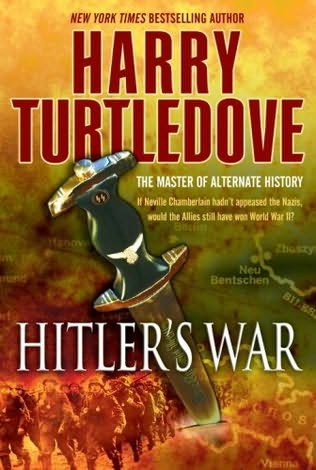
Hitler's war
- Автор: Тертлдав Гарри Норман
- Серия: The War that came early #1
- Язык: английский
- Жанр: Альтернативная история

Электронная книга - «Hitler's war». Краткое содержание книги:
Now, in this thrilling, provocative, and fascinating alternate history by Harry Turtledove, another scenario is played out: What if Chamberlain had not signed the accord? What if Hitler had acted rashly, before his army was ready-would such impatience have helped him or doomed him faster? Here is an action-packed, blow-by-blow chronicle of the war that might have been-and the repercussions that might have echoed through history-had Hitler reached too far, too soon, and too fast.
Turtledove uses dozens of points of view to tell this story: from American marines serving in Japanese-occupied China to members of a Jewish German family with a proud history of war service to their nation, from ragtag volunteers fighting in the Abraham Lincoln Battalion in Spain to an American woman desperately trying to escape Nazi-occupied territory-and witnessing the war from within the belly of the beast.
A novel that reveals the human face of war while simultaneously riding the twists and turns that make up the great acts of history, Hitler's War is the beginning of an exciting new alternate history saga. Here is a tale of powerful leaders and ordinary people, of spies, soldiers, and traitors, of the shifting alliances that draw some together while tearing others apart. At once authoritative, brilliantly imaginative, and hugely entertaining, Hitler's War captures the beginning of a very different World War II-with a very different fate for our world today.
Then the side road petered out-or maybe there was a crater up ahead. “Heraus!” the driver said as the bus’ door wheezed open.
“What do we do now?” Vaclav asked.
“What else?” David said. “We walk.”
Walk they did. Vaclav had lost his conditioning after getting interned. Tramping along with a forty-kilo pack on his back wasn’t his idea of a good time. The road seemed uphill both ways. Despite spatters of sleet, he soon started sweating. He threw down a cigarette butt and heard it hiss to extinction in an icy puddle.
That sparked a thought: “They say smoking is bad for your wind.”
“Screw ‘em,” David replied. He had another cigarette in his mouth.
Airplane motors droned high overhead. Bombs whistled down out of the clouds. They fell at random across the French countryside. The low ceiling grounded the German Stukas. Vaclav didn’t miss them-those bastards could put one right on top of an outhouse if they saw you walk in there to take a crap.
His platoon, of course, wasn’t the only unit on the march. He sometimes wondered if there was anybody in France who wasn’t. They went past a bunch of Frenchmen who’d got hit by one of those randomly falling bombs-a 250-kilo job, or maybe a 500. It wasn’t pretty. If the swine that went through a meat-packing plant wore uniforms, they would have looked a lot like this about halfway through.
Czech medics did what they could to help their French counterparts. You had to hope the French would have done the same for a Czech outfit. The rest of the platoon went around the blood and the moans and the shattered bodies. Vaclav didn’t look closely at them. He’d already seen more death and devastation than he ever wanted to remember.
And now you’re volunteering to be part of it again? he asked himself. You could have sat tight in that internment camp. It wasn’t exciting, but nobody was out to blow your balls off, either.
His shrug made the straps on that heavy pack dig into his shoulders. Too late to worry about it now. He’d been bored in the camp. Maybe he’d been stupid to leave. But if everybody sat tight, if nobody tried to stop Hitler, wouldn’t the little bastard with the ugly mustache end up telling the world what to do?
It looked that way to Vaclav. He glanced over at David, slogging along beside him. David had his own reasons to hate the Nazis, all right. Most of the time, Czech and Jew would have been wary around each other. Not here. The Germans had brought them together. A miracle of sorts, or maybe just proof of the old saying, The enemy of my enemy is my friend.
Bombs turned a roadside meadow into a lunar landscape. Cattle lay sprawled like soldiers. They weren’t bloated and stinking. Some of them still moved and lowed piteously, so they’d gone down in this latest bombardment. Part of the weight Vaclav carried was rations. All the same…
“Fresh meat!” David got the words out before he could.
The platoon commander was a fresh-faced lieutenant named Svabinsky. Maybe he could have kept the soldiers from running into the field, maybe not. But he didn’t even try. “Beefsteaks!” he said happily, and pulled the bayonet off his belt.
They weren’t exactly beefsteaks. No butcher worth half his pay would have given them such a fancy name. They were chunks of meat haggled off the carcasses by hungrily enthusiastic amateurs. Toasted over a roaring fire, Vaclav’s had a charred crust and a bloody interior. He didn’t care. The gobbet was big enough to make his belly shut up. What else mattered in the field?
He rolled himself in a blanket and lay down by the fire. Lieutenant Svabinsky made sure people fed it through the night. Some time in the middle of the long, cold darkness, the blaring of car horns woke Vaclav. People shouted in French and French-accented German and even, once or twice, in Czech. Road damage might have stopped the buses, but the French army had cobbled together this swarm of automobiles to bring the Czechoslovakian soldiers up to the front.
As Vaclav stumbled towards one of them-they showed no lights, of course-he laughed through a yawn. The French were in a fix, the same way his own country had been. But they were trying to muddle through. He couldn’t imagine the efficient Germans coming up with a mad arrangement like this.
He piled into a car. As soon as it was packed, the driver took off. Vaclav hoped the fellow knew where he was going. He must have. Even staying on the road couldn’t have been easy, but the Frenchman did it. Vaclav dozed off again, jerking awake whenever the car hit a pothole.
Somebody outside said something in a language that sounded like German. Vaclav’s eyes flew open. Morning twilight let him see a soldier in a French-looking uniform. What came out of the man’s mouth still sounded like German. A Belgian, Vaclav realized. Are we in Belgium already?
The soldier turned out to speak French, too. That helped the driver, though not Vaclav. The Czech was glad to have a little light. The road was worse than ever, and wound through rugged, heavily wooded country. “What is this place?” Vaclav asked in German.
“They call it the Ardennes,” the driver answered in the same tongue.
“Why do they want us here?” Vaclav said. “You’d have to be crazy to try and push an attack through terrain like this.”
With a magnificent Gallic shrug, the driver said, “With people like the Germans, who can tell?” Somebody yelled and waved. The Frenchman hit the brakes. The car-a battered old Citroen-lurched to a stop. “You get out here.”
Getting out was harder than squeezing in had been. Vaclav stretched and twisted to work the kinks out of his back. He wished he had some coffee.
“Youse is the Czechs?” What the French officer spoke sounded more like bad Polish than Czech, but Vaclav could-barely-follow it. The Frenchman went on, “Come these ways-I will shove you into positions.” He was trying, anyhow.
And maybe the Czechs did need to be shoved into positions. Artillery growled up ahead. It wasn’t too close, but it was there. Maybe the Germans were crazy. Or maybe this was a feint, with the main force up in the north, the way it looked.
His shrug wasn’t so fancy as the driver’s but it would do. He didn’t have to decide whether the Nazis were making a big push here or a little one. All he had to do was go where people told him and shoot at anybody and anything decked out in German field-gray.
He wasn’t the only Czech soldier yawning as a ragged column formed. He figured he could just about manage what they needed from him.
* * *
“Stille nacht! Heilige NACHT!” Hans-Ulrich Rudel sang, along with the rest of the flyers and groundcrew men at the forward base in Holland. They had a tree, brought west from Germany and decorated with gingerbread men and candles and tinsel and ornaments made from scrap metal by mechanics in between patch jobs and other repairs on the Stukas.
Hans-Ulrich had heard that carol and all the others since before the day he first knew what the words meant. With his father a churchman, it couldn’t very well have been any different. But at his father’s house, and at his father’s church, the songs hadn’t seemed to mean so much. People sang them because they’d always sung them, sang them without thinking about what the words really said.
Things were different here. You don’t know what life is worth till you lay it on the line, Rudel thought. Everybody here knew this Christmas might be his last. That made it count for ever so much more than it had back in peacetime.
One of the other pilots raised a glass of schnapps. “Absent friends,” he said, and knocked back the shot.
“Absent friends,” the Luftwaffe men chorused. Most of them had something strong to hand, too.
Hans-Ulrich didn’t. A groundcrew man clucked at him. “Shouldn’t drink toasts in water. It’s unlucky.”
“Not water,” Rudel replied with dignity. But his eggnog was unfortified.