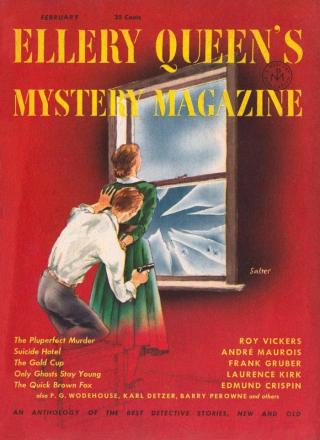
Ellery Queen’s Mystery Magazine. Vol. 19, No. 99, February 1952
- Автор: Грубер Фрэнк, Кемельман Гарри
- Год: 1952
- Язык: английский
- Год: American Mercury
- Жанр: Другие детективы

Электронная книга - «Ellery Queen’s Mystery Magazine. Vol. 19, No. 99, February 1952». Краткое содержание книги:
Said Garman to himself as he gripped the wheeclass="underline" “Now I wonder who the devil this fellow is? He is very anxious to get away from here, but I wouldn’t think anything of that if he was wearing a different-colored coat. Still, the situation is not without interest. If he tries any hanky-panky trick on me I shall break his jaw. Of course, he may not be that fellow. He wouldn’t be found so near the spot. But if he is—”
Garman suddenly checked the conjecture. A soft whistle crept to his lips. A startling idea had darted like an electric current through his mind. He muttered to himself: “In that case — in that case, what would they say to it at the Club? Why... why — good heavens, what a point to score!”
So strange and powerful was the idea that had presented itself to Garman that it imparted an almost literal flash to his eyes. In the grip of it he stared straight ahead, thinking rapidly, guiding the car subconsciously. He did not see the uneasy glances which his companion kept bestowing upon him.
After they had covered seven miles Garman decided to act. His first move was to bring the car to a standstill. They were then in a partly-sunken road, heavy and black with mud, and the twisted roots of trees came out on the bank like monstrous serpents.
“Now, then, answer short and sharp!” commanded Garman. “Who are you?”
The other winced at the demand, and put out a hand towards the door. “You take a strange tone with me,” he replied.
“I do. And I have a reason. You are the man looked for in the Tracer murder.”
“That’s an infernal lie,” was the stammered response.
“Is it?” snarled Garman, grimly. “It is up to you to prove your word. You will not object?”
“What do you mean?”
“That we stop at the next police station, where you can answer a few questions.”
“You can stop at all of them if you choose,” sneered the other.
“One will be enough.”
As he spoke, Garman restarted the car; but before it had traveled a yard his companion vaulted clean over the side of it. Garman lost a second or two, then was after him. The pursuit was of brief duration, for suddenly the stranger stopped as if a pistol ball had pierced his heart.
“Oh, my God! He’s there — again — there!” he cried in a voice hoarse and broken by terror.
A thrill quivered over even Garman’s well-strung nerves. He stared intently in the direction to which the other pointed. In the dark wall of the night all he could perceive — and that very faintly — was a gnarled oak tree with its writhing limbs, on which the unfallen brown and withered leaves made a husky sound in the wind.
“Who’s there? What the devil do you mean?” cried Garman, as he grasped the fugitive by the shoulder.
“He!” was the gasped response. “I saw the flash of his gold spectacles. There... there! He’s got on the same reefer coat! He has taken his hands from his pockets! Keep him off! He isn’t dead! Can’t be! I have seen him like that twice since. He’s alive! Keep him away!”
The voice rose almost to a scream, sending an icy shiver the length of Garman’s spine. With a single action he spun the man round and pushed him by main strength into the car, where he collapsed. Garman started again, and he flung a queer and apprehensive glance towards the oak tree as he passed it.
The car covered several miles before either man spoke. Presently Garman broke the silence between them.
“We are drawing near town,” said he. “I suppose you will no longer deny that you are the man wanted by the police for the murder of Mr. Tracer of Windy Oaks?”
“My story isn’t a matter for their ears,” answered the other. “That is what I shrink from. There is more in it than I dare tell the police. No one would understand — but a friend; and where am I to find one — now?”
His teeth chattered together, for the speed-created half-gale of wind had penetrated to his bones.
“Do you deny that you murdered Mr. Tracer?” demanded Garman.
“It is that word ‘murder’ that I take exception to.”
“That you killed him, then?”
“Suppose I say that I did?”
“Then I should offer you a chance.”
“You? How is that possible?”
“I cannot explain here and now. You shall know in an hour’s time.”
“You want me to do something?”
“Perhaps I do, and perhaps I don’t.”
“It must be something devilish, then.”
“You can refuse, if you choose. What is your name?”
“Milt.”
“All right, Milt. Now you know as well as I do that if you get into the clutches of the police you are done for. And if you try to leave me again, without my permission, I will hand you over as sure as I live. I am twice as strong as you are, and twice as determined. Will you trust yourself to my hands? I repeat — I mean to offer you a chance. Now will you be placable or not?”
The other was silent. He looked at Garman in a queer and furtive manner.
“Confound you! What are you thinking about?” asked Garman.
“I was thinking that you have something ugly at the back of your head,” was the slow and resentful answer.
“Very well; it’s the police for you,” snarled Garman, savagely.
“No! I’ll chance it,” replied Milt, with abrupt vehemence.
Garman nodded, muttered something unintelligible, and lengthened put the speed. In a few minutes a faint glow in the sky showed that the strange ride was coming to a finish.
Fifty-five minutes later two men turned out from Regent Street into Beak Street. The elder had tucked his arm into the other’s, and they walked along in that old-fashioned way, as if they were the best of pals, though a close observer could have detected the fact that one man was in reality preventing a possible desire to bolt on the part of his companion.
As the hour was nine o’clock the big arteries of the West End had absorbed most of the life of the streets, and the narrow thoroughfares this side of Regent Street were almost deserted. A thin veil of rain had turned the dust to a clayey paste; refuse from the small, mean shops had been swept into the gutters; iron shutters were up and dingy blinds drawn.
Suddenly the older man halted. “This is our destination,” he announced.
He had stopped before a low shop with an embayed Georgian front, which bore the name, Alexander Diarmid, Cigar Merchant.
There was a shabby side-door, and to the lock of it he applied a key. A narrow and common little passage was disclosed, covered with a cheap linoleum. At the end of this mean hallway ascended a long flight of stairs, lighted at the foot by the naked flame of a gas-jet in a wire guard.
“This way, Milt,” said the older man, and still holding the other lightly by the arm he climbed the ladder-like staircase. As they drew near to the door at the top, a voice was heard speaking in a monotonous accent, as though reading. As Garman rapped seven times on the door the voice stopped. He then knocked four times, paused, then gave two more raps.
A clear voice called, “Enter!”
As Garman opened the door he felt his companion shrink back, but he was prepared for that, and grasping him by the back of the neck, he hurled him forward with violence.
Recovering his balance, Milt looked round. In a long room about a dozen men were seated, and one standing at the head of a table, with a paper in his hand. Each man had a strip of black cloth across his eyes, which had been adjusted when Garman knocked, and each was in evening dress.
He who had been speaking, after a glance at the interrupters, continued: “I have to confirm the secession of Lord Mountcarres. In the matter of the Rochfort Cobras he thinks we stepped beyond the limits of our cult. He resigns, therefore.
“I have to report three new applications for membership. The greatest care must be exercised. One is supported by Dr. Yeatman, not present. Another by Mr. Clark Anstey, present. The third by Professor Hungars, abroad. These gentlemen know the rules of membership. As I say, great care is demanded. We all remember the affair of the Canaris Mummy, when the weak nerves of a candidate nearly burst the Club to pieces.