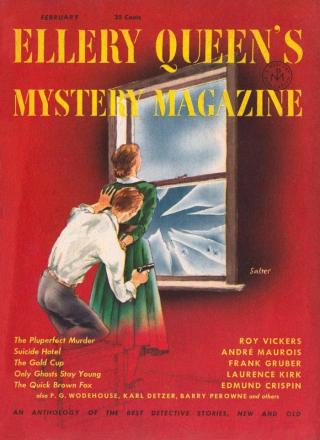
Ellery Queen’s Mystery Magazine. Vol. 19, No. 99, February 1952
- Автор: Грубер Фрэнк, Кемельман Гарри
- Год: 1952
- Язык: английский
- Год: American Mercury
- Жанр: Другие детективы

Электронная книга - «Ellery Queen’s Mystery Magazine. Vol. 19, No. 99, February 1952». Краткое содержание книги:
“Car coming,” Jim managed to say.
“Yeh,” Casey agreed. He was fussing with a handful of shotgun shells. “If it’s them... um... we’d best stop right here. See that culvert ahead? Straddle it.”
Jim stepped on the brake. His car wobbled, halted at last.
“That’s right,” Casey said. “Turn her a little. Block the road. You get in the ditch.”
Once more the oncoming light flashed against the rain, brighter this time. Casey snapped off their own headlamps. Then he climbed out.
“In the ditch, kid,” he repeated, “never mind the water.” Something made him chuckle. “No rats in this war, anyhow. Keep your head down.”
“It’s him!” Jim shouted.
The car flashed over the hill. It was roaring toward them.
“Yeh, it’s them,” Casey agreed.
That had been a single headlamp lighting the sky. It was coming fast. Too fast to mean anything except chase... or escape. Jim ran for the ditch. One headlight... trying to get to Empire... not home for chores... scar... tall... nice looking...
“Head down!” Casey repeated.
The car was only a quarter-mile away. An eighth of a mile. Jim could hear it roaring down the grade. It wasn’t a jalopy. Came too fast. Charley always did like to go fast...
“Aim steady, kid!” Casey sang out. “If you got to shoot, do it quick!”
The car was two hundred yards away and doing sixty when Jim heard the yell of its brakes. He looked quickly over his shoulder. Casey waved his flashlight once, snapped it off, grabbed his shotgun, and took aim.
The one-eyed car was screeching, twisting, trying hard to stop. They knew they were trapped. Jim raised his pistol. It was awfully heavy. His fingers felt numb, holding it. Numb, like his knees in this cold ditch water. Aiming at Charley, was he? Aiming to shoot him? He let the pistol waver. The oncoming light swept its beam crazily across the road, right and left, wiping a brief white streak in the night, touching old Casey, standing there, with the shotgun in his hands.
Then the light went out. The car had halted, thirty yards away. For an instant there was only wet darkness. Then a dozen quick flashes spurted from the black bulk of the bandit car and Jim heard the ping of the slugs. Someone was shooting at Casey. Someone with the tommy-gun. A tall young fellow, nice looking, with a scar. Voices shouted and a car door slammed. Casey didn’t fire. What was he waiting for? Jim yelled, “Sarge!” No answer. “Sarge!” he cried.
He found Casey on his knees beside his car. The shotgun lay on the wet pavement. Casey was holding the fender with both hands, trying to get to his feet. He was being sick.
“Let... ’em get me...” he said. He tried to laugh. “Let... them punks... get me...”
Old Casey wasn’t as heavy as Jim had imagined. Only the car door was too narrow. But he got him in. A slug was in his shoulder.
“Hurt a lot?”
Casey tried to laugh. “Not... a lot.”
Jim staggered up. It couldn’t matter now whose brother that was. “Give me the shells,” he heard himself yelling. He took them, snatched up the shotgun. “Be right back, Sarge,” he promised.
Running, he didn’t think to bend low. Didn’t Charley know he’d catch him? Hadn’t he always caught him, ever since they were kids? Even in the dark he could see where the gang had raced down the muddy bank. A snag of somebody’s raincoat hung on the barbed-wire fence. Jim ducked through it and halted, listening.
They were over that way, down the hill. He ran, following the sound.
Back on the road he heard a police siren coming. Some other car, that meant. It would find Casey. He ran on: He needn’t turn back now. For anything. Needn’t turn till the job was done.
A voice shouted: “Dropped it in the mud. Busted it.”
“Let it go,” someone answered. “Don’t need it.”
Jim didn’t recognize either voice. They were too far off. It didn’t matter, anyway. Didn’t matter, either, what they had dropped; even when he tripped over it, the tommy-gun, he didn’t pause. He didn’t want it, any more than they did. He still could hear them. But they didn’t hear him. Or else they didn’t care.
“Where the hell we goin’?” one of them yelled. “Me, I want the road. Get another car. Hell with the woods.”
Jim slowed, and moved forward more silently. Casey had said they would find the swamp too tough. Jim could hear them arguing. He tried to make out the voices. But still he couldn’t. He could see them, though. Suddenly, in the darkness of the woods, his wet eyes made out the three darker shadows. He knelt in the swamp water and carefully lifted the shotgun. What would his mother say, if they brought bad news about Charley?
The three plunged toward him, still crashing through the brush. Going hack to concrete, were they? He couldn’t tell which was tallest. Couldn’t see what they looked like. Whether any of them had a scar. But one did have a scar. Three witnesses had said...
“Halt, you!” he sang out.
The three halted.
“What’s this, a gag?” a voice demanded.
“I’ll shoot,” Jim said. He felt very calm. Nothing mattered. If he had to shoot, he had to shoot. If that was Charley nearest him, it was Charley.
“Shoot, then,” one of the figures said.
“If I could see him,” another muttered.
So they couldn’t see him, here on his knees. He had that advantage.
“Who the hell are you, anyhow?” the voice demanded.
“Drop your gun, you,” Jim bade. “Drop it.”
There was a flash, instead. So they wanted to shoot him, too, did they? Jim’s finger closed on the trigger. Slowly. Squeezing the way he’d been taught on the range. The fellow who’d tried to shoot at him sang out as he fell.
“Rest of you want the same?” Jim asked. They didn’t.
“How many guns?” Jim asked. “Throw ’em in the brush!” He heard one crash.
“Pick up your man,” he bade them. “Carry him. Face into the rain. It’ll take you to the road.”
They did not resist. But it took both of them to lift the man Jim had shot. He was tall, seemed heavy, and they kept tripping.
“I’m right behind you,” Jim warned. “Now, which of you is Charley?”
“Huh?” the voice asked. “Another gag? No Charley here.”
At the edge of the woods Jim met the corporal from the Traverse City post and a couple of troopers coming to help him. Two new police cars and the sheriff’s sedan stood at the road by the culvert. Casey still was there, propped up in his own seat. He was smoking his pipe, swearing, while two of the hoys, who had taken his tunic off, were binding the hole in his shoulder. He wasn’t being sick any more. When he saw Jim, he said, “Three dirty punks, kid, just like I said.” He shouted at the hoodlums, “Where you birds from?”
“Chicago,” one answered. He was a hungry-looking guy. All three looked hungry. And scared. And dumb. One did have a scar. But he didn’t look like Charley. Not a bit.
“What’d I tell you, kid?” Casey demanded. “City punks. Anybody’d know it, way they done the job. No farm kid would make all them mistakes.” He paused. “Ouch!” he said. “Just punks.”
“Sure,” Jim said. “That’s right.”
He was feeling easy. Over to the west a flock of cars were rushing down the hill. Posse men tumbled out. Troopers were patting him on the back, calling it nice work to bring in all three. One of them shouted, “Come on, boys. Get Casey and this lug to the hospital.”
“Me?” Casey said. “Oh, all right. Only first, on the way, leave Jim here get to a ’phone. He’s been havin’ an awful time. Something awful important to call about.” He chuckled.
“Thanks, Sarge,” Jim said. “Never mind. Nothing to call about now...”
International Investigators, Inc.