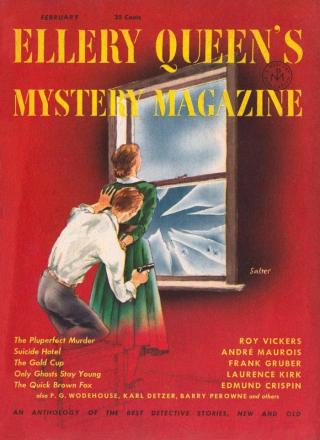
Ellery Queen’s Mystery Magazine. Vol. 19, No. 99, February 1952
- Автор: Грубер Фрэнк, Кемельман Гарри
- Год: 1952
- Язык: английский
- Год: American Mercury
- Жанр: Другие детективы

Электронная книга - «Ellery Queen’s Mystery Magazine. Vol. 19, No. 99, February 1952». Краткое содержание книги:
Jim shrugged. Sure, Charley was eighteen. Lots of boys were that age. What matter if the rest of the description fitted, too? Must be plenty of nice-looking, six-foot boys with brown hair and scars. Plenty of them. Sure there were. It couldn’t be Charley! Couldn’t! It had been a mistake ever to start worrying.
“Can’t be any mistake about it,” Casey suddenly said, as if he were reading Jim’s mind.
“What you mean, no mistake?” Jim roared. “Sure it’s a mistake!” Jim stopped short, realizing that Casey had turned again and was giving him one of those long looks.
“Well, for gosh sakes, try keepin’ your shirt on,” he advised. “No mistake, I’m thinkin’, none a-tall. Easy to get the one guy. No chance for mistake when three eye-witnesses... cashier before he died, little kid that got shot in the leg, and now this here lady... when all three of them give the identical same description. You can just close your eyes and see this one tall guy...”
“Mebbe,” Jim said, and cleared his throat. “Mebbe that’s right.” But he need not close his eyes. He could see plainly enough, just staring ahead at the rain. See Charley, tall and good-looking in spite of that scar. See him doing his chores down by the barn. See him driving the team at potato-digging time, hauling the crop to the root cellar. See him dressed up for town. See him the way he used to be, a nice little kid with big eyes. And see him the way he was last Sunday, mad clear through at everybody, slouching even when he walked, wanting some money of his own. Talking about nothing else.
“Hey,” Casey warned, “you got two wheels off the concrete.” He waited till Jim straightened out the car again. “Most times,” he said, “preserve me from a flock of eyewitnesses. Bankers and women is worst. Can’t see straight when they’re scared. Give you three or four descriptions of the hoodlums afterward. You can’t tell whether to look for the Governor or Shirley Temple...”
The radio interrupted. “Car 17,” it directed, “on U.S. 25 south of Muttonville, an accident. First repeat.”
Jim settled back... one message, at least, that had nothing to do with the bank job. Casey was talking again, which again was unusual.
“Yes, sir, ree-cruit, it’s goin’ to be easy. Good description to start on, and we know enough else about these hoodlums...”
“What else?” Jim asked quickly.
“Why, we know just what sort of birds they are. Small-time punks. Not been at it long. Shoot hard as anybody else, but don’t know how to get away as easy.”
“How you know they’re punks?”
“First place ’cause they took off this here little one-horse bank. ’Cause they pull a job up here in the sticks where there ain’t many roads or bridges and we can blockade ’em nice. ’Cause afterwards they lam north ’stead of south. If they had sense to pour sand out a boot, they’d know we’d corner ’em up north. They ain’t got a chance. Now this kid with the scar...”
“What about him?” Jim asked.
“Well, I was wonderin’. Seems like I’ve seen a kid answers that look-out, kid hangin’ around somewheres...”
Jim turned his head. The sergeant wasn’t even glancing at him, but certainly there was something suspicious in his voice. The rain drummed noisily on the top of the car and the tires made a continuous sucking sound against the pavement. Roaring across muddy fields between black patches of pine woods, where the soggy snow still hid in little pockets, the squally northeast wind found the car and pummeled it.
“If I could just get to a ’phone,” Jim said.
“You ’phoned twice already. What’s so almighty important?”
“Nothing important,” Jim said. He had telephoned home twice. And Charley was out both times, had been away since early morning and the folks didn’t know where he was. Hadn’t even come home to do his chores. That last call was at seven o’clock. It was past nine right now; he might be there...
The radio awakened. A bell struck three quick taps. Then the dispatcher’s tired voice said: “Signal seven-one-one. Signal seven-eleven. Signal seventy-one-one.”
“Huh!” Casey said. “Something comin’ up?” His tone was almost enthusiastic. “That signal’s for the skipper. Want him to ’phone his office. Think maybe them satchel-pants district detectives decided to go to work, after all? Turned something up? Hope so. I sure want some shut-eye.”
“Not me,” Jim said. “Not sleepy a-tall.”
He wasn’t. His nerves were too tight for sleep. He’d been driving since noon when the first radio dispatch came in. The bandits still were in Pineville Bank then. They’d gone in shooting like amateurs, one with a tommy-gun, and the cashier hadn’t a chance. But as he dropped with four slugs in him he tripped the new silent alarm. That gave the law a break. It registered not on the front of the bank, where it would warn the robbers to hurry, but in the sheriff’s office, so the blockade got started while the hoodlums still were scooping the money into sacks.
Within five minutes eighty cars had started to close in, blocking crossroads and bridges as the radio directed them. They had made a ring of men and guns fifty miles from the bank that no bandits, neither smart old hands nor dumb young punks, could hope to break. That ring still was holding. Twenty other cars, like this same number 88, had sped inside the circle and begun to cruise, shaking down everything they met, raiding shacks, putting the bee on farmers who might think it smart to shelter a bank mob. In the hunt by now were sheriffs of a dozen counties, police of a hundred small towns, checking every car at their city limits.
“Them posses of Legionnaires and farmers must be gettin’ plenty wet,” Casey suddenly remarked. He turned up the radio. It reported railroad detectives in Grand Rapids were searching all southbound freights; game wardens in Manistee and Benzie Counties with portable transmitters were out in the swamps; at seven o’clock the four coast guard stations along Lake Michigan had sent out surfmen in pairs to watch the dunes. “Gettin’ lots of free help.”
Jim nodded. Just before dark the dispatcher had reported that even country telephone operators were spreading the alarm, grinding out long and short rings on party lines, warning farmers to keep eyes and ears open and doors locked. The dispatcher signed off and immediately Casey said:
“Lots o’ talk but no news. Don’t tell nothing. Nary a word whether they found fingerprints.”
Jim felt a sudden relief. At least Charley never had been printed. Never any reason to be. He was a good kid, wasn’t he? No matter what, they’d not find him in those green steel cases in the record room down at East Lansing.
“One fingerprint’s worth a dozen scars,” Casey said.
Jim turned and looked at him this time. Why didn’t Casey come right out and mention Charley, instead of hinting around about scars? It was Jim who had introduced Charley to old Casey, that Sunday when the kid came down to visit recruit school and Casey had been in charge for the day. But the sergeant didn’t say anything more, just kept on growling about the weather. The weather would help, eventually. Twice already police cars had flushed out the bandits, and twice, thanks to luck, they’d got away.
But they weren’t riding now. They were afoot, in the rain. The Seventh District captain had shot it out with them over west of Manton, and they’d ducked into the woods, leaving their sedan with its rear end full of holes, like a pepper box, in the middle of a gravel road.
“They won’t stay out long,” Casey said. “Not them birds.”
“Why not?” Jim asked.
“Ain’t got the guts. Mud an’ dark in the woods, why, it’ll give ’em the creeps. They’ll run for the concrete. I know their kind. I seen it happen...”
The radio bell rang. Jim slowed the car to listen. Creeps? Mud and dark wouldn’t give Charley the creeps...