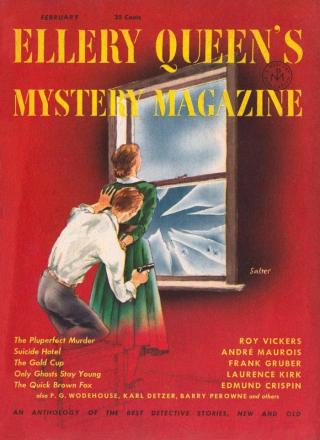
Ellery Queen’s Mystery Magazine. Vol. 19, No. 99, February 1952
- Автор: Грубер Фрэнк, Кемельман Гарри
- Год: 1952
- Язык: английский
- Год: American Mercury
- Жанр: Другие детективы

Электронная книга - «Ellery Queen’s Mystery Magazine. Vol. 19, No. 99, February 1952». Краткое содержание книги:
“ ‘But the most crushing proof that Moriarty was not the man Holmes asserted him to be comes from Holmes himself. In The Valley of Fear Holmes cheerfully confesses to a flagrant crime — his breaking into and entering of Moriarty’s house. Not only that, but he searched the house thoroughly — and found nothing incriminating or compromising! Nothing whatsoever. “That,” remarks Holmes blithely, “was what amazed me.”
“ ‘Familiar as we are with Holmes’s preference for the complex rather than the simple solution, the tortuous rather than the straight path, it is certain that here he is flogging his favorite hobby-horse just too unmercifully.
“ ‘His search of the house was thorough. He was desperately anxious to prove his case, therefore he would have seized with pleasure upon the least trifle which could be construed as bolstering, his theory. Had there been the tiniest jot of evidence against Moriarty in that house, most assuredly Holmes would have found it. Yet he! found nothing. Why? Manifestly because there was nothing to find. And, as it is impossible to conduct any enterprise of magnitude without some sort of written record — even if it is no more than the plan of a bank to be robbed or a map showing where the body is buried — it follows that the Professor Moriarty suspected by Holmes was not the ruler of the underworld.
“ ‘Nevertheless, there was such a ruler. There was an expert whose services were engaged by the Scowrers. Holmes was quite right as to his existence, but erred as to his identity. Who then was this master?’ ”
“Something,” grinned the young American, polishing his pince-nez, “tells me that I am not going to like his answer when I hear it.”
“ ‘Who then was this master who kept his identity so cunningly concealed? Here, let me refer you to my remarks earlier regarding Holmes’s favorite forms of phrase. The truth about the real Moriarty is, I believe, quite clearly indicated by two well-known Holmesisms, namely, “You know my methods, Watson,” and, “When a doctor goes wrong, he is the first of criminals. He has nerve and he has knowledge.” In other words, my dear Examiners, I submit that the underworld king who gave such desperate battle to Sherlock Holmes was none other than Dr. Watson himself!’ ”
His lordship could not proceed for the hubbub — half-outraged protest, half-delighted laughter — which rose from the Board. His lordship screwed the monocle back into his eye, peered again at the paper, and nodded firmly. “That’s what it says here. Listen to what the crafty devil says next.
“ ‘I would like at this point to remind members of the Examining Body of the dictum that when the impossible has been eliminated, whatever remains, however improbable, must be the truth’.”
“Ho ho ho,” wheezed the vast doctor, “the devil can cite Scripture to his own purpose.”
“But there’s a lot more,” went on his lordship. “ ‘When I first formulated this theory, my reaction was exactly what I suspect the Board’s has been — an immediate rejection as being utterly beyond credence. But then I began to wonder. After all, it is not unknown in times of war for secret agents to penetrate into the enemy’s territory, and even serve on the enemy’s General Staff. Consider, then, how strong a position Watson would hold as confidant of the very man who was trying to catch him, often being told in advance the full details of the very plan being hatched to bring about his own undoing.
“ ‘Still more valuable to Watson was the fact that of all the men in the world, he was the one who knew Holmes’s methods best. He knew them like the back of his hand, and Heaven knows he had them frequently re-explained just in case he ever forgot. It was child’s-play for him to make his own counter-plans, based on an accurate knowledge of how Holmes would set about solving the case.
“ ‘And here at last we have a plausible reason for Watson’s consistent self-depreciation in the stories. He presented himself as the stupid bungler because it kept suspicion away from him. No one, least of all Holmes, could ever have suspected dear old muffle-headed Watson of being a criminal, and a master criminal at that. It was a perfect disguise and was, in a way, a fresh twist to the device detected by the Chevalier in The Purloined Letter. By making himself so obviously a fool, Watson made himself invisible as a suspect.
“ ‘All this, you may contend, is merely supposition, but closer examination reveals evidence.
“ ‘Watson, by his own confession, was fond of a certain degree of high living. He frequented the Criterion Bar and was weak enough to overindulge in alcohol upon occasion. Combined with this weakness was an almost incurable indolence of nature — time after time we hear of him breakfasting after Holmes; and he had an extremely untidy streak, proof of which can be found in the famous anecdote of the two pictures, one framed, the other left unframed.
“ ‘Indeed, apart from these shortcomings of character which by themselves were sufficient to blast any hopes of a successful medical career, he does not even seem to have been a particularly knowledgeable doctor — his admissions of ignorance in The Dying Detective are a permanent blot upon the teachings of the University of London; and the fact that he was able to go gallivanting about the country with Holmes on his cases is a clear indication that his practice certainly did not flourish.
“ ‘Yet Watson had no private income. He was dependent upon his own exertions for money — yet, as we have seen, he neglected his medical practice shamefully. How then was he able to afford his way of life, the jaunts with Holmes? Obviously, he must have had a source of income which he did not mention in the chronicles, a source which he was careful to keep secret even from Holmes. But this secrecy was totally unnecessary — unless the money was procured by some dishonest means—
“ ‘But the real nub of my case against Watson is contained in what happened before, at, and after the incident at the Reichenbach Fall.
“ ‘There was first of all Holmes’s report to Watson of his interview with Moriarty, or rather I should say, with the master criminal. Even in Holmes’s drab and threadbare description, we can see that his visitor arrived heavily disguised. In Heaven’s name why? There was no reason for Moriarty to disguise himself when calling upon Holmes; but there was every reason in the world why Watson should!
“ ‘Parenthetically, I should also like to draw your attention to a detail, a small but still useful brick in the edifice: namelyб that Moriarty-the-criminal and Watson-the-chronicler were never seen together!
“ ‘Anyway, the man who called upon Holmes made a significant remark. He said, you recall, that he would be deeply sorry if he were forced to wipe out the detective. This statement is at least unexpected coming from a deadly enemy. On the other hand, it most exactly expresses what Watson’s sentiments would have been in the circumstances.
“ ‘After the report of the interview, the chronicle goes on to detail some absurdly melodramatic rushing about London, leaping in and out of hansoms to a split-second timetable, and some exceedingly snap identifications by Holmes of total strangers as pursuers.
“ ‘The upshot of all. this is that Holmes and Watson cross the Channel and begin a leisurely tour on the Continent. It is then — and this is the key point of my case — that Holmes receives a telegram informing him that the master criminal was not caught in the police net. Of course he was not! He had been carefully escorted out of the country by Holmes himself, and was standing by Holmes’s side when the telegram arrived.