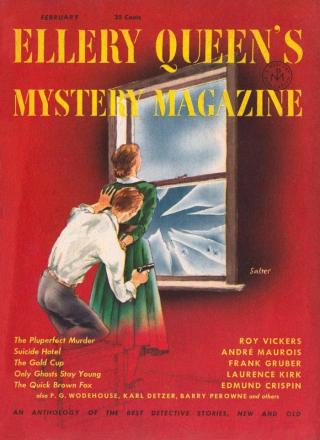
Ellery Queen’s Mystery Magazine. Vol. 19, No. 99, February 1952
- Автор: Грубер Фрэнк, Кемельман Гарри
- Год: 1952
- Язык: английский
- Год: American Mercury
- Жанр: Другие детективы

Электронная книга - «Ellery Queen’s Mystery Magazine. Vol. 19, No. 99, February 1952». Краткое содержание книги:
To which Wilmott replied: “Well, I expect that’s a matter of opinion!” This startling epigram seems to have infuriated Taylor, for we are assured that he then shouted:
“You won’t get anything out of me unless I know where those glasses came from!”
“From the basement area in Great James Street, if you really want to know.”
“Ah! That’s the game, is it? Well, you won’t get promotion out of this, because I’m going to spoil the game. I’ve had enough of your games. You can tell the bobby over there that it’s all right. I did the old girl in.”
That afternoon he signed his confession.
Bank Job
by Karl Detzer[2]
Are you one of those fortunate people who get an enormous kick out of browsing in second-hand bookstores? — and the mustier, the dustier, the better? If you are not, you are missing one of the really great pleasures of living. There are few thrills in life comparable to that of finding a long-sought bibliophilic treasure, nestling unwept, unhonored, and unsung in some cobwebbed, sleepy corner of an old bookshop, or in some dark, dank cubbyhole of ancient volumes that have not felt the caress of sunlight since the original owner, perhaps generations before, stacked the books helterskelter in that forgotten nook... We shall never forget the day, early in our collecting career, when we pounced on a copy of Conan Doyle’s MEMOIRS OF SHERLOCK HOLMES, the New York Harper edition of 1894, turned breathlessly to the contents page, and found listed there the story titled “The Card-Board Box” — and realized that we had in our hands a copy of the suppressed first edition, a rarity that has been quoted to us as recently as December 1948 for no less a sum than $87.50 — and here was this copy clearly marked by a dealer who obviously did not know the fine points of Sherlock Holmes first editions at the unbelievable price of 50 cents! Needless to say, we handed over four bits in coin of the realm, and dashed out of that store with the book clutched fervently and with the deeply satisfying knowledge that for once we were offsetting an occasion when we had paid through the nose for an overpriced book that we had been unable to resist...
The next time you go a-browsing, look on the shelf marked D (if the dealer is systematic enough to arrange his stock alphabetically), and try to pick up a book by Karl W. Detzer called TRUE TALES OF THE D.C.I. — a book that used to be fairly common but now has gone the way of most books over twenty-five years old. This volume of short stories will repay your searching and reading: it concerns that special branch of the A.E.F. which undertook to found up ten thousand international criminals swarming over Europe just after the armistice of World War I — “the greatest crime wave in history.”
Karl Detzer has always been particularly interested in “official” detectives — the result, unquestionably, of his unremitting efforts to depict realism. Here is the story of a Michigan state trooper, written by someone who obviously knows the real-life mechanics of manhunting on a grand scale — the story of a professional policeman whose professional problem is also a personal one...
The radio under the dash had been silent for five minutes except for the low, continuous bustle of static. The patrol car splashed ahead at a steady forty-five, its headlamps burning a shallow hole in the rain. It was rolling north again on U. S. 31, once more covering the same ten-mile sector it had been patroling since four o’clock. Somewhere over to the right, in one of those cold, wet swamps, the bank bandits probably were hiding.
Trooper Jim Smith shifted uneasily behind his wheel and stared through the spattered windshield at the darkness. He was only four months out of recruit school and this was his first bank job. If he’d ever guessed that it would turn out this way, that he’d be called so soon to choose between wanting to do his job right and... he swallowed hard, trying to dislodge the plug in this throat.
Sergeant Casey, who rode beside him, yawned. He warned, “Keep to your side of the yellow line, ree-cruit. Can’t drive all over the road, even if there ain’t traffic. What’s eatin’ you?”
Jim shrugged and didn’t answer. Usually Casey hadn’t much to say. He was an oldtimer as state troopers go, forty-six his next birthday, and fighting hard against his waistline. In this kind of weather he often got grouchy when the dampness began to sink into that big shrapnel scar on his shoulder. This wasn’t his first bank job by a good many dozen. For twenty years he’d been chasing hoodlums all over Michigan, ever since he got mustered out of the Rainbow Division and first pinned on a trooper badge. But this time he insisted on an answer, repeating, “What’s eatin’ you, anyhow?” and grunting, and turning in his seat to look hard at Jim Smith by the reflection of the dashboard light.
“Nothing’s eating me, Sarge,” Jim replied. “I’m okay. Nothing wrong at all.” But his voice didn’t sound right, even to his own ears. It sounded sort of choked. He knew that Sergeant Casey was nobody’s fool. He’d been a cop long enough to spot a phony voice when he heard one. But Casey didn’t say anything, just grunted again and looked ahead through the windshield, and after a minute began to swear quietly to himself about the rain.
Smith drove with his left hand, with his right dipped into his tunic pocket for cigarettes. He offered one to Casey.
“No, thank you kindly,” the sergeant refused, and rummaged in the dash compartment for his pipe. He found it and was stuffing the bowl from his pouch when the radio blared.
“Attention all cars on bank job. The woman customer who was shot in the chest by the bandits has regained consciousness. Her descriptions are as follows: Number One, six feet, one hundred sixty pounds, age about eighteen, dark brown hair, medium complexion, very nice looking, scar on left cheek...”
Jim gripped the wheel tighter. That was the third witness who’d noticed the scar. The radio still was talking, telling what the other two bandits looked like. Jim swallowed again. But he wasn’t listening. His own kid brother fitted that first description to a T... height, weight, age, hair, complexion, scar... young Charley, who didn’t like the farm any more than Jim had, who had to stick there when Jim got picked for drill school, who didn’t want to take his turn at planting potatoes and looking after stock. Charley knew all about this bank in Pineville that had been stuck up. It was only twenty miles from home. The Smith family never had banked there, never had banked much anywhere, but Charley knew all about it just the same.
Not that he was the kind of kid to stick up a bank. He wasn’t. He was a good kid. But his pockets always were empty. Whose weren’t, just working on a farm? And he’d taken to hanging around town half the time, days as well as evenings. Jim had talked to him about it just last Sunday when he was home for two hours. He had seen young Charley when Car 88 rolled through Pineville on Saturday night patrol. The kid was loafing on the corner right beside this same bank, waiting for the nine o’clock show to start. Anybody, passing, would see him. He was just too good-looking to miss.
The scar on his cheek where the horse kicked him once didn’t spoil his looks. It just made folks glance at him twice. Jim didn’t know the two fellows with him that night; round-shouldered little guys they were, and dressed sort of flashy. But Charley got mad when Jim mentioned them.
He argued that he was old enough to do as he pleased, wasn’t he? To pick his own friends, too. He was eighteen.
2
Copyright, 1940, by American Legion Magazine