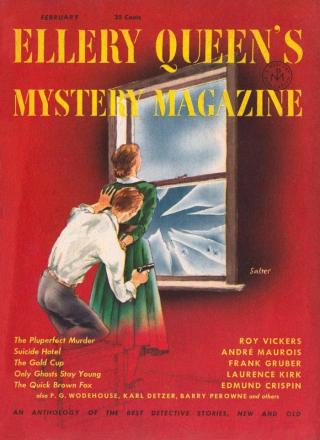
Ellery Queen’s Mystery Magazine. Vol. 19, No. 99, February 1952
- Автор: Грубер Фрэнк, Кемельман Гарри
- Год: 1952
- Язык: английский
- Год: American Mercury
- Жанр: Другие детективы

Электронная книга - «Ellery Queen’s Mystery Magazine. Vol. 19, No. 99, February 1952». Краткое содержание книги:
His lordship much preferred the tall blond American with the yellow-gray eyes who was rolling himself a cigarette. A little physical in his methods, perhaps, and rather more clipped in style than his lordship could wholeheartedly approve, but the American’s tough cynicism was decidedly an improvement on the Frenchman’s bravura.
Miss Jane stopped reading, and the minutes were adopted on the motion of the quiet young American whose pince-nez protected pale silver eyes. His lordship rather liked the youngster — practically no palate, of course, but he dressed rather more reasonably than most Americans, his manners were excellent, and his Duesenberg was almost as good as the Merlin. Of his professional abilities, there was no need to speak — his membership on the Examining Body was sufficient testimony.
His lordship smoothed down his glittering yellow hair, screwed his monocle firmly into his eye, and rose.
“Miss Jane and gentlemen. It is, I am well aware, quite unnecessary to remind any of you of the aims, purpose, and function of our organization. Just the same, I intend to do so tonight — oh, quite briefly, Sam, I assure you,” he added hastily as he saw the blond American raise a sardonic v-shaped eyebrow.
“I am going to do so for two reasons. One is that I disapprove of too much cerebral excitement so soon after a meal — in other words, we must give our jolly old turns time to deal with all the little vitamins and things — and the other is that I jolly well feel like doing it, so you’ll have to lump it.”
“Heh heh heh,” chuckled a huge red-faced man with a bandit mustache, “ ‘as my whimsey takes me,’ hey?”
“Exactly, doctor,” grinned his lordship. “Well, now. It is a good many years since our distinguished patron, the great Chevalier himself, founded the society which has come to be known as The Three Eyes — a rather weak pun on the initials of International Investigators, Inc., an organization which can truly be said to be unique, in the original and correct meaning of that much abused word.
“In The Three Eyes are gathered the greatest brains in the history of criminology. I admit that in the past there have been societies of a fairly similar pattern, but what raises us to our honored pinnacle is that we know no boundaries except those of intellect. We take our members from any and every country, practising by any and every code.
“The doctor here” — the man with the bandit mustache muttered “Harrumph” into a vast handkerchief, then beamed at his lordship — “the doctor has had his brilliant triumphs in England, but they are matched by the successes of the squire in Virginia.”
The squire’s gaze, oak-steady and unflinching as the courage of a mountain man, fixed upon his lordship, then after a pause during which a man might tell five slowly, the great frame bowed acknowledgement.
“Our estimable Sam” — the fair-haired Mephistopheles waved a sinewy hand in salute — “comes from a teeming, virile American city. Our adored Miss Jane” — the lady blushed and became flustered — “from a sleepy English village.
“Our French colleague has — er — operated on both sides of the fence” — the Frenchman sprang to his feet and, white teeth glistening in the black beard he was affecting tonight, bowed like a Gascon. “But,” his lordship continued drily, “has he any advantage over our padre who knows all crimes without having committed a single one?” The tubby little cleric at the end of the table looked startled and managed to drop first his pencil and then his scratch-pad on the floor.
“And if I may be immodest and speak of myself for a moment, you all know that I bear the courtesy title of Lord. But naturally, in any well-conducted regime, a Lord must always be outranked by a—” His lordship made an elegant salute to the silver-eyed American, who almost succeeded in looking modest.
His lordship lit a cigarette and went on. “So much for those of us who are here tonight. But in my opinion, our greatest advantage as an organization is that we are not static. Our membership is not restricted to some arbitrary number. We are always prepared to accept newcomers, provided of course that they attain to the standards we have set. That those standards are high — very, very high — I shall not attempt to deny. For instance, it has always been a source of deep personal regret to me that my spiritual father, one of the greatest if not actually the greatest investigator ever produced by my country, has hitherto failed to satisfy our requirements.”
“Perhaps,” the plump little priest said mildly, “our requirements failed to satisfy him.”
“Ann Chadwick’s cook used to talk in riddles like that,” murmured Miss Jane. “So irritating. Then one day she received a mysterious telephone call, went out, and never came back. Ann Chadwick was most upset.”
“Somebody goosed her cook, huh?” Sam’s fingers were busy with tobacco package and papers.
“Never mind that.” The doctor sighted along his cigar at the chairman. “I agree with you about — ahem! — the absentee. Couldn’t we do something about making him an honorary member, say?”
“No.” His lordship’s voice was regretful but firm. “Sorry, doctor, but it’s out of the question. Apart from being against the constitution of The Three Eyes, it wouldn’t be right to do it. Really, you know, after the mess he made of the Irene Adler affair, it wouldn’t do — it wouldn’t do at all.”
“Hmf. He’s not disbarred for life, then?”
“Oh, lor’, no. If he pulls off something really clever and then applies for membership, I’m positive the Board will welcome him. I really must suggest it to him, next time I see him. However, all this is by the way, so I’ll push on.
“Our custom has been that candidates wishing to join The Three Eyes submit a thesis upon some aspect of criminology. This work is then considered by the Examining Body in council, and if our verdict is favorable, the applicant is granted a Doctorate of Crime and admitted to the society. We have had some extremely interesting and informative papers in the past — I still remember with great pleasure the enlightening views offered by Mr. John J. Malone, of Chicago, in his excellent work, The Influence of Alcohol Upon the Processes of Deduction, and I shall always be grateful to Inspector John Appleby for his brilliant unmasking of the real murderer of Hamlet’s father. I am certain that other theses will come readily to your minds.
“Tonight, it is my privilege to read to you a paper submitted by a Mr. — or it may be a Monsieur — LaMont. There is this slight dubiety because, apart altogether from the French sound of his name, I am given to understand that one of his relatives was a distinguished painter of the French school.
“I may add that Mr. LaMont’s thesis will be the only one heard this evening. There was to have been another, from an American lady, but she appears to have confused her dates in some way. She has sent a note of apology. It reads,” his lordship picked up a sheet of paper from the table, “ ‘Had I but known—’ ”
“Rejected!” shouted the Examining Body in one firm voice.
His lordship inclined his sleek head. “I could not agree with you more. That then leaves us only with Mr. LaMont’s work to consider. With your permission, I shall sit down to read it.”
In their various ways, the Examining Body prepared to listen. The doctor closed his eyes, Sam pasted a cigarette to his lip and stared at the ceiling, the Virginia squire set his great clasped hands on the table before him and looked attentively at his lordship, the Frenchman fondled his beard, Miss Jane edged forward on her chair, the silver-eyed American polished his glasses, and the little priest began to build a castle of sugar-lumps he had found in his pocket while looking for his handkerchief.