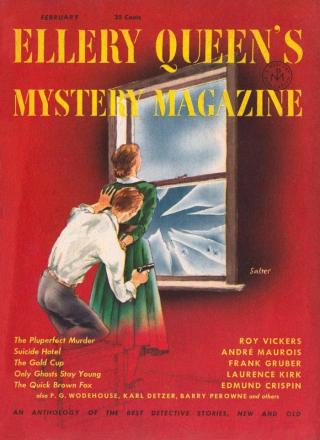
Ellery Queen’s Mystery Magazine. Vol. 19, No. 99, February 1952
- Автор: Грубер Фрэнк, Кемельман Гарри
- Год: 1952
- Язык: английский
- Год: American Mercury
- Жанр: Другие детективы

Электронная книга - «Ellery Queen’s Mystery Magazine. Vol. 19, No. 99, February 1952». Краткое содержание книги:
They had been pawned just before closing time on March 22nd, the day of the murder, by a man and a woman together, both probably under thirty years of age.
Sergeant Wilmott (who later gained a V. C. in the great war) then carefully contrived a meeting between the pawnbroker and his assistant on the one hand, and Taylor and Miss Sadler on the other. Both men were instantly positive that they had never seen either the man or the woman before.
In the eyes of the police this definitely removed suspicion from Taylor. Armed only with the pawnbroker’s rather hazy description, they began to look for the thieves, one of whom was almost certainly the murderer. They never found them — possibly because they were not looking for pickpockets.
In short, the crime, as a crime, was perfect. Nothing could now betray Taylor but blind chance. And the blind chance happened.
Taylor’s prolonged search for his missing pince-nez yielded nothing. He seems to have dismissed the matter, to have put every detail of his successful crime out of his mind. The picture of him during the next few weeks is of a young man in a hurry.
After a day or two of decorous mourning for his benefactress he resigned his position and borrowed £1oo from Mr. Hellier on account of the £43,000 which, minus death duties, would be his as soon as the tedious formality of probate was complete.
He had in the meantime persuaded Miss Sadler to leave her employment without notice, in order to devote her whole time to preparations for their wedding.
The preparations were no doubt as thorough as could be desired, but Taylor seems to have been unable to spare time for the ceremony itself. The young couple set up housekeeping together in a maisonette in Addison Road. Assisted by Mr. Hellier, Taylor borrowed again on his prospects — the amount of the loan this time being £7000.
The murder of Miss Absolom became one of London’s unsolved mysteries.
The first link in the chain of blind chance that dragged Taylor to the gallows was the failure of a well-known architect, who occupied rooms on the first floor of the house in Great James Street, which had once been the scene of Taylor’s labors. Mr. Hellier seized his opportunity of acquiring a much better suite and proceeded to transfer himself upstairs. Naturally he wished to leave his old office properly clean and for this purpose he employed for a week an extra charwoman. By a supreme flourish on the part of the goddess of chance this extra charwoman happened to be a Mrs. Taylor.
Mrs. Taylor’s first task was to clean the basement which Mr. Hellier had used for the storage of office lumber. In the basement well, partly concealed by a piece of guttering, Mrs. Taylor found a small case containing a pair of gold-rimmed pince-nez.
Mrs. Taylor took them to Mr. Hellier who looked at them and said he thought they must belong to his late clerk, Mr. Harold Taylor, who would doubtless reward her if she were to take them to his address, which Mr. Hellier would write down for her.
On the following morning Mrs. Taylor again stopped Mr. Hellier on his way out to lunch. She had seen Mr. Harold Taylor who had said that the glasses were not his. So, far from obtaining any reward, Mrs. Taylor had not even received her bus fare.
The woman, thought Mr. Hellier, was becoming a nuisance in her anxiety to be rewarded for her find.
“I can only suggest that you should take them to the lost property office at Scotland Yard. If the owner is found you will receive a part of their value as reward,” said Mr. Hellier and hurried on his way to lunch.
Mrs. Taylor took his advice during her own dinner hour. Doubtless in the belief that Scotland Yard might at least do something about the wasted bus fare, she gave the clerk the whole story of her pilgrimage to Addison Road.
For no other reason than that her name was Taylor she was sent first to Tarrant of the Department of Dead Ends. He was disappointed when he learned that she had come in order to talk about a pair of pince-nez that did not belong to Harold Taylor. But he hung on from force of habit.
He opened the case, read the name of the Holborn opticians who had made it, and sent the pince-nez by messenger to the firm with a request for information.
The answer he received was that the glasses had been made for a Mr. Harold Taylor, that they had been ordered in duplicate and the frame fitted on August 25th, paid for in cash by an elderly lady, and delivered to Mr. Taylor in Doughty Street on September 2nd, 1908.
Now it must not be imagined that Superintendent Tarrant thereupon slapped his thigh and “in a flash saw the whole dastardly crime down to its smallest detail.” He had probably done all that within a second or two of first going through the premises in Great James Street. Flashes have their uses, but they cannot be reproduced in court for the enlightenment of a jury. The difficulty is always proof. And no one knew better than Tarrant that the glasses by themselves would prove nothing.
He sent Sergeant Wilmott to Addison Road, convinced that he was wasting his time, to ask Harold Taylor if the glasses were his.
“No, they are not mine,” said Taylor. “They look to me very like the ones an old woman brought here yesterday. Nothing to do with me. I can buy myself a pair if I want them.”
“Are you sure? Why not try them on and see if they fit you?”
“Of course I’m sure!” replied Taylor with an emphasis that struck the sergeant as superfluous. “If they were mine, why on earth shouldn’t I say so and have done with all this hanky-panky?”
That question remains unanswerable to this day. Why did Taylor deny ownership of the glasses? Even if they had been found on Miss Absolom’s dead body they would not have endangered him, as he was known to be almost an inmate of the flat. In the circumstances it was impossible that the glasses could ever have proved anything against him.
Sergeant Wilmott apologized for the trouble he had given and departed — for the firm of opticians, to ask if they could give incontrovertible proof of the ownership of the glasses.
They replied that while it was very improbable that they should have made glasses of exactly the same prescription, in a frame of exactly the same measurements, for someone else, they could only be certain if they were to look through their files — which would take about a week.
That week was one of strange activity for Harold Taylor. First, again with the help of Mr. Hellier, he married Miss Sadler by special license, there being certain reasons of a domestic nature which removed most of the normal obstacles to this form of marriage. Then he applied for a passport for himself and his wife for Brazil.
Next, he went to the store where he had bought (and paid for) his furniture and now resold it at a fraction of its cost. The furniture was to be moved and the cash paid at once — a queer transaction in view of the fact that he had nearly £2500 in his current account.
He had still five days to wait before he could sail. As his furniture had been removed, he was forced to take his wife to a hotel. Of all the hotels in London he chose the Charing Cross Railway Hotel — where he used to dine with Miss Absolom.
On Tuesday, April 23rd, the day before he was to sail, he transferred £4000 to Messrs. Cook, the well-known tourist agents, and drew £320 in cash for immediate use. As he came out of Cook’s office in Ludgate Circus he was met by Sergeant Wilmott, who had been instructed to find out why Taylor had given Miss Sadler’s age as twenty-two when it was really nineteen, and why he had stated that her parents were dead when in fact they were both alive.
Sergeant Wilmott explained the nature of his errand as tactfully as possible and requested Taylor to accompany him to the Yard.
There followed one of those fragments of dialogue that always look so disconnected and unnatural when they are reported in the newspapers.
Taylor said: “You don’t expect me to swallow that. I only told them the tale to save a lot of fuss, and you know it isn’t that as well as I do.”