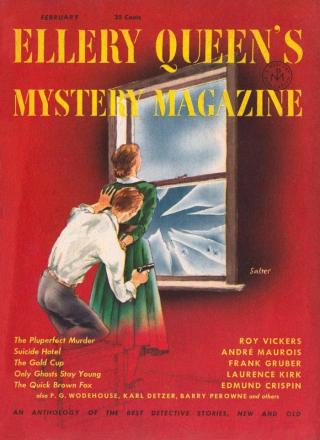
Ellery Queen’s Mystery Magazine. Vol. 19, No. 99, February 1952
- Автор: Грубер Фрэнк, Кемельман Гарри
- Год: 1952
- Язык: английский
- Год: American Mercury
- Жанр: Другие детективы

Электронная книга - «Ellery Queen’s Mystery Magazine. Vol. 19, No. 99, February 1952». Краткое содержание книги:
We do not know how the conversation started. Taylor’s signed statement begins, as it were, at the end, with the facts accepted by both sides.
(“Miss Absolom did not say anything at first, but she was angry. Then she said: ‘You’re much too young to think like that about women and when the time comes for you to marry you must marry a lady.’ And I said: ‘Rose is quite lady enough for me or anybody else.’ And then Miss Absolom said I must give up Rose and as she had been paying for me all this time I said I would. Then Miss Absolom was quiet and before I went back to the office she kissed me like she often did and said I was a good boy, which was only her way of speaking, and that she wanted to see Mr. Hellier but not about me and Rose, but about something quite different which she did not mention to me.”)
The latter part of that last rambling sentence does not ring true. Why this labored explanation that though she wished to consult her solicitor it was “not about me and Rose.” It is fairly safe to assume that Miss Absolom wished to discuss precisely that matter and that she told Taylor as much.
On his way back to the office we may guess that Taylor was contemplating the fact that the material benefits he had so far received were an inadequate return for all that he had endured at the hands of Miss Absolom. There was the question of the future to be considered — with special reference to the coming interview between Miss Absolom and her solicitor.
Mr. Hellier’s offices were on the ground floor of a house that had once been a dwelling house. On your left, as you entered the open front door, was a small room, the window of which opened over a basement. Behind this was Mr. Hellier’s room. On your right was the waiting room and behind that was the clerks’ room.
Taylor had the little room all to himself. His early struggles as an author had at least made him a fairly good typist, so that a good deal of copying work fell to him.
At twenty minutes past two Mr. Hellier came back from lunch with a client named Dacosta. Mr. Hellier looked into the waiting room and asked Taylor whether he had finished the Dacosta agreement.
Taylor had completed the work before leaving for lunch. It was lying on the table beside his typewriter. Here he took his first risk — albeit a very small one: that Mr. Hellier would not notice the agreement.
“No, sir,” he answered. “I am sorry but I haven’t started on it.”
Mr. Hellier expressed his annoyance and then inquired how long the work would take.
“I will bring it into your room at a quarter to three, sir, if I am not interrupted in the meantime,” answered Taylor.
“Who is going to interrupt you?” grunted Mr. Hellier.
One imagines a “deprecatory smile” on the face of the young clerk as he answered: “As it’s so important, sir, I’ll make sure, if you don’t mind, by locking the door.”
Taylor locked the door and waited until his employer was in his own room with Mr. Dacosta. Then he put on his bowler hat, his overcoat, and his gloves. Next, he opened the window and dropped six feet into the basement.
Within a minute he was at the corner of Red Lion Street, and some one hundred yards from the Square. He went into a public house which displayed a telephone sign. Here he gave the number of the block of flats and in due course this call was answered by the porter. Altering his voice just enough to make it unrecognizable, he told the porter that he wanted to speak to Mrs. Eagle on an urgent matter. He gave a mumbled name and urged the porter to hurry.
Now Mrs. Eagle was tenant of a flat on the fifth floor. Miss Absolom’s flat was on the second floor. Further, there were only two telephones in the building at that time — Miss Absolom’s and the one in the porter’s office.
As soon as the porter laid down the receiver, Taylor cut off. He hurried to the block of flats, reaching Miss Absolom’s door, of which he had a latchkey, just as the porter, an elderly, corpulent fellow, arrived on the fifth floor.
He knew that she was resting in her bedroom. Without disturbing her he went to the kitchen whence, after some consideration, he emerged with a flatiron and a blind-cord.
The details become gruesome. It will be sufficient to record that at a quarter past eleven that night Miss Absolom’s maid, entering the bedroom with hot cocoa, found her mistress battered to death.
To leave a gap of five minutes or so we again find Taylor at the telephone — this time in the hall of Miss Absolom’s flat. He is handling the instrument somewhat awkwardly because he has his gloves on. In a pocket case are five gemmed rings, subsequently valued at £70, just torn from the dead fingers of Miss Absolom.
He again rang the porter and apologized for the stupidity of the exchange in cutting him off before he could speak to Mrs. Eagle. There was no need, he protested in his slightly altered voice, to trouble her a second time if the porter would be good enough to tell her that her cousin was in London and would like to meet her at her club at four o’clock.
Taylor listened for the porter’s footsteps and then, leaving Miss Absolom’s flat by the front door, took his big risk. He had disposed of the porter who was at that moment on the floor above, making his second journey to Mrs. Eagle’s flat. But he could not similarly dispose of the other tenants, most of whom knew him by sight. If one of them were to see him leaving the block, detection would be certain.
The risk came off. No one who knew him saw him leave the block — no passerby in the Square noticed him. Before Mrs. Eagle had finished explaining to the porter that she possessed neither a cousin nor a club Taylor was back in his little room in Mr. Hellier’s office with the better part of ten minutes to spare.
He unlocked the door and Waited. Then he took the typed agreement to Mr. Hellier, at the same time asking and obtaining permission to leave the office an hour early.
Shortly after five o’clock he was in the Burlington Arcade, the tip of a leather pocket case protruding from his coat pocket. He took a couple of turns, shop-gazing in the manner of a country cousin. Then he made the inevitable discovery that the protruding leather case had caught the attention of a pickpocket and had duly disappeared.
There was now nothing more to be done. He spent a pleasant evening in the company of Miss Sadler. We may assume that he slept well and that he even looked forward to the morning’s papers with a certain confidence.
But when the time came for him to read them, he discovered that he had lost one of his two pairs of gold-rimmed pince-nez. In the light of after events we may safely say that this discovery shattered his complacency and filled him with something approaching panic.
A pair of gold-rimmed pince-nez, however, was not among the clues to the crime. There was, indeed, a singular lack of clues. That the porter had been decoyed from his point of observation was less a clue than a mere fact. The theft of the rings obviously was either the motive for the crime or a “blind.”
As to the “blind” theory, there was only one person known to have a motive for killing Miss Absolom and that was her heir and protege, Harold Taylor. But medical evidence supported the common-sense view that the crime was committed in the time between the two telephone messages received by the porter — that is between 2:25 and 2:35. During that period, as Mr. Hellier testified, Taylor was in his little room copying an agreement on his typewriter.
When they interviewed him, the police found Taylor calm and even helpful. He was able to give a minute description of the missing rings and to help his words with rough but serviceable drawings. This information was sent out and on March 26th, four days after the murder, a pawnbroker of Marylebone Road, accompanied by an assistant, called at Scotland Yard and produced the five rings.