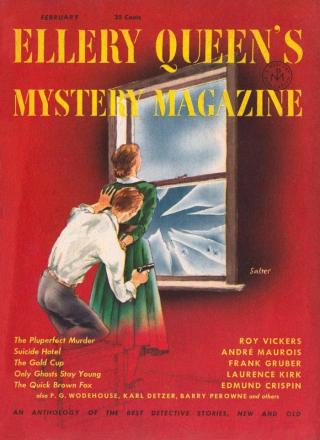
Ellery Queen’s Mystery Magazine. Vol. 19, No. 99, February 1952
- Автор: Грубер Фрэнк, Кемельман Гарри
- Год: 1952
- Язык: английский
- Год: American Mercury
- Жанр: Другие детективы

Электронная книга - «Ellery Queen’s Mystery Magazine. Vol. 19, No. 99, February 1952». Краткое содержание книги:
“A cane!” I exclaimed.
“Precisely,” said Nicky. “And when you think of a cane, Professor Hawthorne is the first person who comes to mind.”
“Are you serious, Nicky?”
“Why not? It’s an important part of the rather theatrical costume he designed to go with the new personality he acquired since becoming a great man. You can readily see that in his mind, at least, the mark of his cane would identify him as surely as if he had branded the young man with his initials.”
“But why would he want to kill his protégé?”
“Because he wasn’t — wasn’t his protégé, I mean. You remember the young man was scheduled to come up for examination at the beginning of the semester and did not. Hawthorne told us that it was because our library had acquired the original Byington Papers and that Bennett wanted a chance to study them. But The Byington Papers had been published in full, and it is only a short summary of this dissertation that the candidate expounds at the exam. So that even if the original manuscript were to furnish additional proof of his thesis, it would not justify postponing the exam. Hence, we must conclude that Bennett had got an idea for an entirely new dissertation. Naturally, he told Hawthorne about it. But Hawthorne had to go down to Texas, so he probably got Bennett to say nothing of his discovery until his return. Then when announcement was made of the new edition of Hawthorne’s book, Bennett decided to stand for examination again. Hawthorne came back as soon as he found out. He arrived last night and this morning was his first chance to see Bennett. I am quite sure he did not come intending to kill him. He would have brought another weapon if he had. He came to beg him to hold off again until they could work out something together — a paper on which they would collaborate, perhaps. I don’t think it occurred to Hawthorne that Bennett might refuse. But he did, probably because he felt that after the announcement of a new edition of The Byington Papers he could no longer trust Hawthorne.
“To Hawthorne, this refusal meant the loss of everything he held dear — his academic standing, his reputation as a scholar, his position in the university. So he raised his cane and struck.”
“But what discovery could Bennett have made that would justify Hawthorne’s killing him?” I asked.
Nicky’s eyebrows rose. “I should think you could guess that. We know that Bennett’s dissertation subject had something to do with the original manuscript. My guess would be that the book that you noticed on his desk, Lieutenant, was a History of Calligraphy — two ‘l’s,’ Lieutenant — a history of handwriting.” (The look of sudden recognition that lit up Delhanty’s face confirmed the guess.) “I fancy the other books were probably concerned with paper and the chemistry of ink — that sort of thing. In any case, I am quite certain that Bennett had discovered some proof — scientific proof, not internal criticism like Korngold’s which is always subject to different interpretations — but proof of handwriting styles and ink and paper that The Byington Papers were a forgery.”
The telephone exploded into sound and when I lifted the instrument to my ear, I heard the excited, panicky voice of Sergeant Carter.
“He just shot himself,” he cried. “Professor Hawthorne just shot himself here at the hotel!”
I glanced at the two men in the room and saw that they had heard. Delhanty had risen and was reaching for his hat.
“Stay there,” I said into the phone. “Lieutenant Delhanty will be there in a minute. What happened?”
“I don’t know,” Carter answered. “I went to the library but he had just gone. I caught him at the hotel here and I gave him Professor Welt’s message. He just nodded and went into the next room, and a couple of seconds later there was a shot.”
“All right, stand by.” I cradled the phone.
Delhanty was already at the door. “That’s it,” I said to him.
“Guess so,” he muttered, and closed the door behind him.
I turned to Nicky. “What message did you ask Carter to give him?”
He smiled. “Oh, that? I merely suggested to the Sergeant that he ask Hawthorne to bring Bennett’s notes with him.”
I nodded moodily. For a minute or two I was silent, staring at the desk in front of me. Then I looked up.
“Look here, Nicky, did you expect that your request would have the effect it did?”
He pursed his lips as if to take thought. Then he shrugged his shoulders. “I did not consider it beyond the bounds of possibility. However, my primary concern was my responsibility to poor Bennett. I thought that if there was any merit in his idea, I ought to expand his notes into a paper which I would publish in his name.” His little blue eyes glittered and his lips relaxed in a frosty smile. “Naturally, I wanted to begin as soon as possible.”
The Pluperfect Murder
by Roy Vickers
The “Holborn murder,” as it was called at the time, deserves its place in the list of perfect crimes. True that Harold Taylor took an insane risk. But he took it with his eyes open, knowing it was a risk — and the risk came off. He made no mistake, tripped himself on no tremendous trifle. It would have been utterly impossible for the most brilliant detective, the most thorough police organization, to catch him.
He was hanged, in the end, through the agency of a charwoman, who, being unable to read the newspapers, had never even heard of him — never knew the grim consequences of her action. She wanted a reward, of approximately eight shillings and sixpence, for finding a pair of gold-rimmed pince-nez that had nothing whatever to do with the crime.
Harold Taylor was the son of a schoolteacher in the village of Maenwy in Carnarvonshire. In January 1908, when he was twenty-two, his father died. After all expenses had been paid and the furniture sold Harold found himself possessed of a sum of £85. On the strength of this he threw up his clerkship in a local estate-office and went to London to seek fame and fortune as an author. By May of that year his capital had shrunk to £10 while his prospects remained less than nothing.
It was the year of the opening of the White City, at Shepherds Bush, with the Franco-British Exhibition. The area of the exhibition was so extensive that many persons who were in no sense invalids were glad to hire wheeled chairs in order to see it all without undue fatigue. Taylor, a well set-up young man, quite passably good-looking, was glad to sink his pride and become a chair-man at a wage of £1 per week, plus tips.
One Saturday afternoon a patron in the form of an elderly, richly dressed, and rather obvious maiden lady stepped into Taylor’s chair.
She was Florence Absolom, aged fifty-four, the blamelessly respectable daughter of a deceased Wesleyan minister through whom indirectly she had inherited some £43,000 in gilt-edged securities. Miss Absolom lived by herself in a small flat in Red Lion Square, off Holborn.
It seems that Miss Absolom alone of all with whom he came in contact saw in Taylor a man who was too good for his surroundings. “A gentleman,” as she no doubt would have expressed it. For this reason, perhaps, she gave him no tip but invited him to tea at her flat for the following afternoon.
The conversation turned largely on the subject of speed. Miss Absolom expressed her nervousness of taxicabs, then a comparative novelty. Gradually she worked round to the suggestion that Taylor should hire a car and take her for a ride — at her expense, of course. He agreed. The fact that he had never driven a car was nothing. He had a friend, a lorry man employed at the White City, who would teach him in the earlier part of the mornings of the coming week and he would take Miss Absolom out next Sunday.
As he took his leave she pressed a £5 note into his hand for “expenses.” He repeated his assurance that there would be no expenses and, somewhat stiffly, placed the £5 note on her mantlepiece and departed.