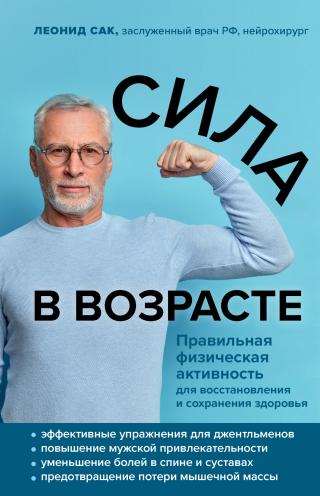
Сила в возрасте. Правильная физическая активность для восстановления и сохранения здоровья
- Автор: Сак Леонид Давыдович
- Год: 2021
- Язык: русский
- Год: Эксмо
- ISBN: 978-5-04-157074-3
- Жанр: Здоровье

Электронная книга - «Сила в возрасте. Правильная физическая активность для восстановления и сохранения здоровья». Краткое содержание книги:
В формате PDF A4 сохранён издательский дизайн.
27. Ibanez J., Izquierdo M., Arguelles I. et al. Twice-weeklyprogressive resistance training decreases abdominal fat and improves insulin sensitivity in older men with type 2 diabetes // Diabetes Care. – 2005. – Vol. 28. – P. 662–667.
28. Haskell W. L., Lee I. M., Pate R. R. et al. Physical activity and public health. Updated recommendation for adults from the American College of Sports Medicine and the American Heart Association // Circulation. – 2007. – Vol. 116. – P. 10811093.
29. Hills A., Shultz S., Soares M. et al. Resistance training for obese, type 2 diabetic adults: a review of the evidence // Obesity Reviews. – 2010. – Vol. 11 (№ 10). – P. 740–749.
30. Hovanec N., Sawant A., Overend T. J. et al. Resistance Training and Older Adults with Type 2 Diabetes Mellitus: Strength of the Evidence // Journal of Aging Research. – 2012. – Vol. 2012. – 12 pages.
31. Kalapotharakos V., Michalopoulos M., Tokmakidis S. et al. Effects of a heavy and a moderate resistance training on functional performance in older adults // J. Strength Cond. Res. – 2005. – Vol. 19. – P. 652–657.
32. Kraemer W. J., Ratamess N. A., French D. N. Resistance training for health and performance // Curr Sports Med Rep. – 2002. – Vol. 1. – P. 165–171.
33. Kumar S., Adhikari P., Jeganathan P. Physical Activity in the Prevention and Treatment of Type-2 Diabetes Mellitus and its Complications – A Critical Review of Reviews // Indian Journal of Ancient Medicine And Yoga. – 2011. – Vol. 4 № 3–4.
34. Laukkanen J. A., Rauramaa R., Makikallio T. H. et al. Intensity of leisure-time physical activity and Cancer mortality in men // Br J Sports Med. – 2011. – Vol. 45. – P. 125–129.
35. Lee I. M., Paffenbarger R. S. How much physical activity is optimal for health? Methodological considerations // Res Q Exerc Sport. – 1996. – Vol. 67. – P. 206–208.
36. Liu C. J., Latham N. K. Progressive resistance strength training for improving physical function in older adults // Cochrane Database of Systematic Reviews. – 2009. (Issue 3) Art. No.: CD002759.
37. Maddalozzo G., Snow C. High intensity resistance training: Effects on bone in older men and women // Calcified Tissue International. – 2000. – Vol. 66. – P. 399–404.
38. Martin B. W., Mäder U., Stamm H. P., Braun-Fahrländer C. Physical activity and health – what are the recommendations and where do we find the Swiss population? // Schweiz Z Sportmed Sporttraumatol. – 2009. – Vol. 57 (2). – P. 37–43.
39. Mayer F., Scharhag-Rosenberger F., Carlsohn A. et al. The intensity and effects of strength training in the elderly // Dtsch Arztebl Int. – 2011. – Vol. 108 (21). – P. 359–364.
40. McGuigan M., Newton R., Kraemer W. J. Resistance Training for Better Health in Older Adults // International Journal of Sport and Health Science. – 2006. – Vol. 4. – P. 19–28.
41. Morris J. N., Heady J. A., Raffle P. A. B. et al. Coronary heart disease and physical activity of work // Lancet. – 1953. – Vol. 265(6795). – P. 1053–1057.
42. Murlasits Z., Reed J., Wells K. Effect of resistance training frequency on physiological adaptations in older adults // Journal of Exercise Science & Fitness. – 2012. – Vol. 10. – P. 28–32.
43. Naci H., Ioannidis J. Comparative effectiveness of exercise and drug interventions on mortality outcomes: metaepidemiological study // BMJ – 2013. – Vol. 347. – P. 55–77.
44. Nelson M. E., Rejeski W. J., Blair S. N. et al. Physical activity and public health in older adults. Recommendation from the American College of Sports Medicine and the American Heart Association // Circulation. – 2007. – Vol. 116. – P. 1094–1105.
45. O’Donovan G., Blazevich A. J., Boreham C. et al. The ABC of Physical Activity for Health: a consensus statement from the British Association of Sport and Exercise Sciences // J Sports Sci. – 2010. – Vol. 28 (6). – P. 573–591.
46. Oja P., Bull F., Fogelholm M. Physical activity recommendations for health: what should Europe do? // http://www.biomedcentral.com/1471-2458/10/10.
47. Pate R. R., Morris J., Paffenbarger R. S. et al. Physical Activity and Public health. A recommendation from the Centers for Disease Control and Prevention and the American College of Sports Medicine // JAMA. – 1995. – Vol. 273. – P. 402–407.
48. Paffenbarger R. S. Jr., Blair S., Lee I-Min. A history of physical activity, cardiovascular health and longevity: the scientific contributions of Jeremy N Morris, DSc, DPH, FRCP // Int. J. Epidemiol. – 2001. – Vol. 30 (5). – P. 1184–1192.
49. Paffenbarger R. S., Laughlin M. E., Gima A. S. et al. Work activity of longshoremen as related to death from coronary heart disease and stroke // N Engl J Med. – 1970. – Vol. 282. – P. 1109–1114.
50. Peterson M. D., Rhea M. R., Sen A. et al. Resistance exercise for muscular strength in older adults: a meta-analysis // Ageing Res Rev. – 2010. – Vol. 9. – P. 226–237.
51. Peterson M. D., Sen A., Gordon P. M. Influence of resistance exercise on lean body mass in aging adults: a meta-analysis // Med Sci Sports Exerc. – 2011. – Vol. 43. – P. 249–258.
52. Powell K. E., Paluch A. E., Blair S. N. Physical activity for health: What kind? How much? How intense? On top of what? // Annu Rev Public Health. – 2011. – Vol. 32. – P. 349–365.
53. Physical Activity and Public Health: Updated Recommendation for Adults From the American College of Sports Medicine and the American Heart Association // Circulation. – 2007. – Vol. 116. – P. 1081–1093.
54. Romo-Perez V., Schwingel A., Chodzko-Zajko W. International resistance training recommendations for older adults: Implications for the promotion of healthy aging in Spain // J. Hum. Sport Exerc. – 2011. – Vol. 6. – № 4. – P. 639–648.
55. Ruiz J., Sui X., Lobelo F. et al. Association between muscular strength and mortality in men: prospective cohort study // BMJ. – 2008. – Vol. 337, a439.
56. Sharman M., Newton R., Triplett-McBride T. et al. Changes in myosin heavy chain composition with heavy resistance training in 60to 75-year-old men and women // Eur J Appl Physiol. – 2001. – Vol. 84. – P. 127–132.
57. Sesso H., Paffenbarger R. S., Lee I. M. Physical activity and coronary heart disease in men: The Harvard Alumni Health Study // Circulation. – 2000. – Vol. 102. – P. 975–980.
58. Sigal R., Kenny G., Wasserman D. et al. Physical activity/exercise and type 2 diabetes: a consensus statement from the American Diabetes Association // Diabetes Care. – 2006. – Vol. 29 (№ 6). – P. 1433–1438.
59. Singh A., Jones L., Antonelli J. et al. Association between exercise and primary incidence of prostate cancer. Does race matter? // Cancer. – 2013. – Vol. 1–19. – P. 1338–1343.
60. Siscovick D. S., Weiss N. S., Fletcher R. et al. The incidence of primary cardiac arrest during vigorous exercise // N. Engl. J. Med. – 1984. – Vol. 311. – P. 874–877.
61. Steib S., Schoene D., Pfeifer K. Dose-response relationship of resistance training in older adults: a meta-analysis // Med Sci Sports Exerc. – 2010. – Vol. 42 (5). – P. 902–914.
62. Strasser B., Siebert U., Schobersberger W. Resistance training in the treatment of the metabolic syndrome: a systematic review and meta-analysis of the effect of resistance training on metabolic clustering in patients with abnormal glucose metabolism // Sports Medicine. – 2010. – Vol. 40. – № 5. – P. 397–415.