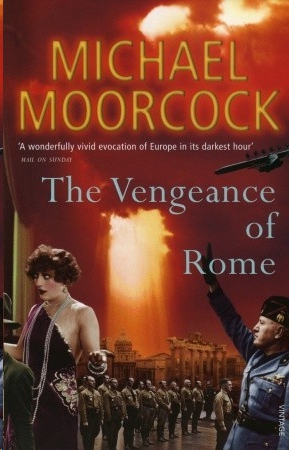
The Vengeance of Rome
- Автор: Муркок Майкл
- Серия: Between The Wars #4
- Язык: английский
- Жанр: Научная фантастика

Электронная книга - «The Vengeance of Rome». Краткое содержание книги:
‘I never saw that side of ‘im,’ Mrs Cornelius admits. Hitler of course had tried to court her. He was always attracted to actresses, especially English ones. He couldn’t get enough of Jessie Matthews.
Putzi Hanfstaengl, himself a keen fan of the cinema and also something of an amateur comedian, agreed that Hitler was a first-class mimic. Putzi’s main job in the 1920s was to console Hitler at the piano with selections of favourite musical numbers.
‘He could imitate anyone — voices, mannerisms, attitudes, everything. Peasants, politicians, Junkers. But nowadays he relies on me to cheer him up. Me and those endless romantic comedies and cartoons he watches.’
He needs to relax, I said. It is the same for me. Mindless, silly entertainment is what you need when you have such heavy responsibilities.
But Putzi was unconvinced. Left to himself, Putzi insisted, Hitler would do nothing but watch his screens and eat cream cakes. ’Some men are by nature voyeurs. It’s bad for them to have their dreams come true.’
Putzi was a little anxious about the coming revolution. Röhm condescended to Hanfstaengl in a way he did not to me. ‘I think you, too, Putzi, are not ecstatic at the prospect of your prayers being answered.’ There was in Röhm a bit of the jovial sadist.
Privately Putzi told me he wanted to be in movies. If not as an actor, then as a director or producer. A musical arranger even. He had always lived in his dreams. He preferred them to reality. He sought me out whenever he had the chance and pumped me on my Hollywood life.
One day Röhm came back with a French-language version of Buckaroo’s Code, and we watched it together. He was impressed.
‘You have a vocation I think, Max, just as do I,’ Röhm decided. ‘What a pity you gave it up. You remind me a little of Alf.’
His opinion, of course, was coloured by his affection for me.
We mount the steps to the street. Slowly, arm in arm, we turn for home. Friday afternoon in Golborne Road and the lifeless rain falls a little heavier on this decaying tail of the Portobello Market. They sell fake antiques up at the south section now. Tourists shriek with delight at their discoveries of reconstituted scrimshaw and reproduction Brummagen jugs. Here at the north end they find only irreparable fan heaters and profoundly stained kettles. The secondhand tools and yellowing paperbacks are all that’s left of dead old men’s work and dreams. I used to sort through bombed houses which contained better junk. The perpetual rain rusts everything not protected by that mixture of grease blended with nicotine which forms the local varnish. Nothing gets it off. In fire you watch it melt with the metal.
The assembly of stallholders and their listless consumers has the unhappy permanence of a displaced persons camp. Refugees from bleaker interiors, they huddle under sacks, plastic bags, old coats. Rain soaks the grey burlap and tarpaulins over the stalls. It seeps into the shops, streaking the floors with a kind of mucus. Toothless women gape in the cheerless doorways of chip shops. You cannot tell that they were ever anything but hags.
The people are colourless. Even in the grey light they are like simplified drawings, silhouettes. No matter how close you go to them the details of their faces and costume grow no sharper. They puff a thin roll-up into an ember and cough on yellow smoke. From the corners of bloodless mouths they mumble at one another. Their faces are defined by lines of grime, sketch maps of a thousand small disappointments.
Mrs Cornelius pauses to pick through some miscellaneous domestic objects. She gives an enamel saucepan her disdainful onceover.
‘After the War,’ I tell her, ‘I was still in politics. There were no blacks here then. Just Irish and Poles. Perek Rachman brought the blacks in.’ But, of course, I did not blame him. He was good to me. They picked on him during the Keeler business because they thought he was a Jew. It killed him.
‘Wos that when you wos wiv Colin Jordan?’ Spurning the saucepan she picks up a set of rusting knives tied together with fatty string. ‘When you lived in Portland Road?’ She squints down their length.
‘Of course not.’ She listens to nothing. I never lived in Portland Road. She has no interest in politics. Jordan was much later. He took over the League of British Fascists. Leese’s old HQ. They called it the Black House, but it was just a terraced shop. There was a mortician’s next door. Leese’s widow used to live over it. I had tea with her every Tuesday. She hated the BUF. Mosley and her husband had fallen out years ago. Leese thought Mosley was a liberal. I met the Empire Movement people there. G. K. Chesterton was their most famous member, and of course he died. They were pleasant, mostly middle-aged, but they could not muster more than a few hundred supporters even when we went into the Common Market. Hitler’s dream of United Europe became reality. He knew he could not coerce the British. ‘They always have to volunteer,’ he said. ‘They like to think they’re in control.’ But Leese’s Information Service for the Jew Wise, as he called his organisation, was not behind Europe.
Later Leese turned his attentions to the blacks. That was an entirely different struggle and one which he also lost, though his ideas are not forgotten. I have not been down to Portland Road lately. It has an unnatural character with its window boxes, brass knockers and dark green paint. The street is no longer a comfort to me. London was once full of sanctuaries. Today there are fewer and fewer of them.
She flourishes a sawtoothed German carving knife. The colour has worn off the wooden handle. ‘Ten pee! Look at that, Ivan!’ Her outrage swells her. ‘It’s just like mine. You know my bread knife. And there’s a lot more effin’ rust on this one.’ She has found her moral high ground. She replaces the knife and raises her disgusted eyes level with the stallholder’s. He murmurs some stock response and glares shiftily at the dark grey tarmac beneath his sodden boots.
Golborne Road is our most wretched street. Its gutters abound with filth swept in from the surrounding boroughs. The locals don’t notice or care. Light has no hope of escape from the smeared shopfronts. Mephitic lumps occasionally shift behind the glass. Nothing can lift the fog of desperate nihilism infecting the unwholesome air. I raise my comforter against it. I protect my mouth. Mrs Cornelius says that it will do no good. The stuff gets in through your skin, she says. Through your eyes. It’s like a gas.
Röhm told me he had only a passing acquaintance with Hitler in the trenches. ‘He won his Iron Cross fair and square. We used to say he’d “saddled the nightmare”. You’d give him an order and he’d go into this kind of trance. Next minute he’d just set off through the shell-storm like he was running up the street to get a loaf of bread for his mother. Flak and bullets everywhere. Screaming, our Alf would run on, faithful to the end. They said he captured a bunch of Froggies single-handed once, but that sounds too much like the Mussolini story to me. Initiative was never really Alf’s strong point. Nobody ever promoted him. He was like a lot of soldiers. He preferred taking orders to giving them.’
Röhm runs those hard fingers over his mosaics. We sit on a marble bench beside the wall. The mosaics are still in progress. They are blatantly erotic, reminiscent of Pompeii. He has had experts design them. He knows all the best interior decorators. This is the work, he says, of Sohner, who does the Berliner Film Company’s sets and designed Dietrich’s costumes for Der blaue Engel. ‘That’s what we should keep Jews on for. I don’t mind them as entertainers either. It’s the writers you have to watch. But you won’t convince Hitler of that. Like me, he’s a simple creature. He has an On/Off switch and a Fast/Slow lever.