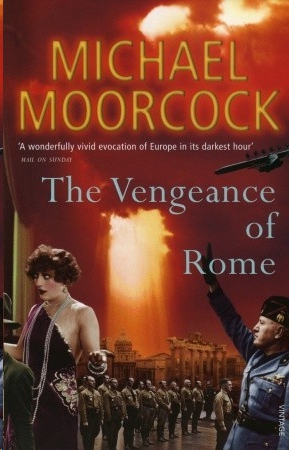
The Vengeance of Rome
- Автор: Муркок Майкл
- Серия: Between The Wars #4
- Язык: английский
- Жанр: Научная фантастика

Электронная книга - «The Vengeance of Rome». Краткое содержание книги:
We ate a large and leisurely dinner. Then Röhm’s handsome young chauffeur arrived to tell us our car was ready. The Stabschef was already a little tipsy. He sang some sentimental Spanish song he had learned in Bolivia. He opened his window so he could breathe in the rich, scented air of the Bavarian capital. ’Ah! One has to acknowledge the pleasures of peace. But they are only won through the hardships of war.’
We stopped at my hotel where I packed a small bag containing a change of clothes, a box of cocaine and some papers I preferred to keep with me. Then we were off, driving through the haze of twilight into what seemed to me at that moment an infinitely rosy future.
I was glad of the chance to see a little of the surrounding countryside. The neat, well-ordered Bavarian fields were a symbol of the best of Germany. The German’s natural sense of harmony is only occasionally perverted by experiments in social democracy. It is expressed most finely in his music and his mathematics. They are masterly bookkeepers. They exemplify so many of our Christian virtues. They are the Yankees of Europe. Sometimes, of course, they can exercise those virtues a little too fully, as with their generosity towards the Turks.
Röhm, as usual, was stimulating company. He continued to drink a little more than he should, but the stress of his responsibilities was tremendous. The only expression of his insobriety was a somewhat looser and coarser tongue. He loved to relax in manly company, to forget for a few hours the ‘Prussian manners’ he was forced to cultivate as an officer, a member of the Reichstag and a senior senator in the Bavarian parliament. He spoke of his frustrations with the bloodless, feeble self-abusers he was forced to keep company with, of the protocol he had to observe so as not to let Hitler down. He would do nothing, he said, to damage Hitler’s chances of becoming Chancellor.
Feeling a little abandoned by Il Duce and wondering about my future, I was quietly pleased to have Röhm’s friendship. While never wielding power for himself, only for the common people for whom he held it in trust, he was the most powerful man in Germany. Without him, Hitler and Strasser could not move. Without his troops, Hindenburg and the old guard could outlast and, if necessary, outfight Hitler. It crossed my mind more than once that I was becoming close friends with the future Duce of Germany, but at that time I had no intimation of Röhm’s real secret.
I relaxed beside him in the staff car’s huge back seat while he discussed the work of German painters he admired and asked if they had their American equivalents. I said that the ‘folkish’ movement had taken odd forms in America. The favoured art form these days was the cinema. Even great artists worked for Hollywood, designing sets and drawing storyboards. He had visited Los Angeles on his way back from Bolivia and had been impressed by the palm trees and the lovely houses. How surprising things were there! How German! With a touch of North Africa. A friend of his was over there. Did I know Ludecke? He was a good Nazi. I had to tell him that my own political links in America were with the Ku Klux Klan. Sadly, I added, the Klan had been taken over by opportunists, its original ideals forgotten.
Röhm was sympathetic. The National Socialist movement was threatened with the same kind of takeover. He was uneasy with this searching out of businessmen for bedfellows. If the party needed funds, Hitler should send a bunch of Hitler Youth boys out whoring. ‘There must be plenty of takers for those beautiful, rounded little arses.’ It would be a quicker, more honest and no doubt more lucrative way of raising the money they needed. ’But Hitler hardly cracked a smile at my suggestion. Alf’s getting very serious these days. Very straight.’
The Stabschef had a hamper for the journey. As it grew dark and the car rushed on through quaint little villages and rolling fields, he took out a bottle of champagne and popped the cork. His strange, battered face had an almost melancholy quality to it, and I saw a hint of sadness in his eyes which he tried to disguise. I did not know what had happened to put him in this mood. He was doing his best to rid himself of it. I wanted to tell him he did not need to pretend anything, that he was with an equal, one who would respect all his secrets.
When he laid a large line of cocaine upon his beefy wrist and took it like snuff I knew for certain that I had found a kindred soul. I accepted his line, holding his wrist with my fingertips as I bent my nose to some of the purest South American snow I had enjoyed in years. In Bolivia the Stabschef had developed a refined taste.
At my prompting Röhm spoke of his youth, of his exile to Bolivia after the Munich putsch. He laughed. ‘Before I arrived in Bolivia, buggery was unknown there!’ He had met only one ‘schitzy’ to his taste, just towards the end of his stay. He had admired those ‘dark-eyed Latin beauties’ from afar, had groaned for them, far preferring them to blonds. Yet no one understood. He would rather have been in prison. He had exercised great discipline, he confessed. As a lieutenant colonel with considerable responsibilities, he could probably have ordered one of those luscious creatures into his bed. And now, he added almost under his breath, here he was, tête-à-tête with just such a beauty!
He was a little slurred in his speech. I was not entirely following his thickly accented Bavarian. He switched off the interior lamps. We travelled in complete darkness, with no light save the reflection of our own glaring headlamps. I, too, had known the pain of exile and the terrors of captivity. In sympathy I reached towards his arm.
A little to my surprise, he turned on the light to look at me briefly. His eyes filled with tears. I murmured a question. There came a pause, a silence as the car’s great engine continued to pound and the wheels carried us deep into the German heartland. Then, suddenly, that noblest of all Nazis doused the light once more and seized my hand in his. His deep, thrilling whisper declared his most profound passion for me.
That love, he said, was the purest he had ever known. It was driving him mad.
TWENTY-FOUR
I take Mrs Cornelius to the canal. The council have now paved parts of the towpath, and it is a little easier to avoid the dog muck. Nothing wholesome grows in that sparse manure. They never clean it up. Once every six months some swarthy municipal playboy minces down and dabs a fastidious broom at the stuff. What a privilege to see you, I say. Sarcasm is wasted on him. He would probably understand Turkish if I was willing to compromise with him.
He whines that they are understaffed. Certainly you are, I sympathise. I often see you hiding in the cemetery pretending to work. Occasionally you lack a fourth for poker. But you carry on. You play with cards so faded and damp you depend on complicity and instinct to identify the suits. Sometimes I hear you disputing a flush.
The rain is a filthy drizzle. The grey grass exudes a kind of phlegm. The canal gives off vapours that hang like poisoned ectoplasm in endless valleys of vandalised warehouses. As the pedestrian underclass we have no alternative but to pass through these desolate canyons. The miasma is particularly bad under the bridges and is no good for my chest. Mrs Cornelius complains that it gets in her muscles and arteries ‘like freezin’ slush’. The troglodytes living in the nearby storm drains and sewers have painted warning challenges on the walls. I am reminded of Germany in the early thirties. Advertisements for concerts and lectures are sprayed with gibberish. Some letters have been misremembered or are upside down. Their only coherence is in what they symbolise. Which these days could be anything. William Blake, the famous British lunatic, is their most popular hero. Like all their predecessors they proclaim the triumph of blind faith over reason. The written word becomes a formal image and loses all meaning, no more than a growl or a reassuring croon, a badge. Nowadays more and more of these subterraneans write in Arabic or Persian. Carthage never sleeps.