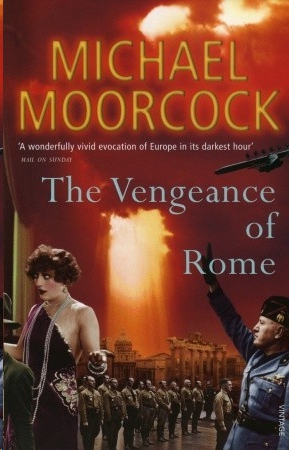
The Vengeance of Rome
- Автор: Муркок Майкл
- Серия: Between The Wars #4
- Язык: английский
- Жанр: Научная фантастика

Электронная книга - «The Vengeance of Rome». Краткое содержание книги:
When Geli Raubal came into the restaurant, Röhm noticed her over my shoulder and pointed her out. She seemed a typical, silly Bavarian girl with a broad, pretty face and light brown hair. Surprisingly for the summer, she wore a blouse buttoned at the neck and wrists and carried a shawl. She was escorted by a young SS officer, a man so blond as to be, like my friend Kolya, almost an albino. I forget his name. She was very friendly with everyone, almost flirtatious, but there was a heated, unwholesome quality about her eyes I could not define, though I recognised it well enough. Suffice to say that Hitler was not the only man, or perhaps even woman, she would present with her favours.
Röhm confirmed my impression. ‘She’s a slut.’ Röhm did not drop his voice. She knew him and was aware of his dislike. She pretended she had not seen us. ‘She’s going to get young Alf into trouble one day. And if you think I’m indiscreet — well, he beats everything. Did Hanfstaengl tell you about the sketches and the photos Schwartz had to fork out for? Or that damned letter? The stuff they found of mine and published was in comparison the work of a little old lady writing to the pastor. The drawings alone would have brought him down if anyone had seen them. That’s what I mean about him. He needs someone to keep a hand on his tiller.’
Chuckling affectionately in that warm way of his, Röhm leaned back in his chair. ‘You wouldn’t think it, would you? He’s always been the same. I rescued him from a Red firing squad, you know. Just after the War when I was still with the Reichswehr, before we got disbanded by those Berlin wankers.’ All the time he spoke he was popping little white sausages into his mouth. ‘He thought he was a goner, poor bugger. Scared silly. Literally wet his pants. Great courier during the War. Blind brave, we used to say. He’d go into this trance and trust to his luck. I’ve seen men do that. They become fearless. He knows what it is to be scared for your life — what you’ll do to stay alive. People recognise that in him. They have experience in common. He knows their real grievances, how they think. He’s a brave little bastard sometimes. Under orders, anyway. He was like my pet dog after I saved his life, and he started working for me. A great Number Two. Would follow any orders. Faithful as they come. He kept getting caught, too. The communists caught him. Then we caught him, thinking he was a commie. Almost shot him, too! He’s always been a lucky bastard.’
I was rather astonished at Röhm’s confidences, especially offered in his ordinary voice in a large restaurant, but he was not a close-mouthed man at the best of times. When he took some schnapps or ‘coked’ he was even less tactful. We had hit it off famously. When he was in Munich, he often sought me out. We had a rapport I had only known previously with my beloved Kolya, similar to that which still existed between myself and Mussolini.
In spite of Mrs Cornelius being my best friend, she has always called me ‘a bloke’s bloke’, by which she means I have a certain affinity with other men of action and intellect. While I have enjoyed wonderful relations with women of all ages and classes, I will admit a particular understanding between manly equals translating to the most extraordinary levels of human feeling. Life is lived on the highest possible plane at an unprecedented level of intensity. Not understanding that herself, Mrs Cornelius is inclined to belittle it. She believes all our idealism, all our visionary yearnings, are to do with sex. She has been infected by one of the very people she claims to despise. I speak of that member of the Unholy Triumverate, the arch-Jew Freud, who set out to undermine the cornerstones of Christian idealism and very nearly succeeded. Yet let them make a few disparaging remarks about the Lutheran Church, and the Nazis are characterised as atheists and devil-worshippers! Most Nazis were in fundamental agreement with Martin Luther. Whatever their other failings, both knew the danger to society of the tribe which calls the world its nation.
Mrs Cornelius sighs for me. She says I was a fool not to marry.
A fool not to marry you again, I say.
The days in Munich dragged on. I became bored, anxious for some action. I considered telegraphing Mrs Cornelius at St Crim and risking a visit there. When my boredom grew uncomfortable, I decided to take myself up to Berlin, but then I received a telephone message from the Stabschef’s adjutant, which was to alter everything I understood about myself and the world! Röhm would be in town late that afternoon and would be delighted if I would dine with him at the Bratwurstglockl. He named an hour. I said I would be there.
Although this was not the first time I had dined with the Stabschef, it was the first time he had made this kind of formal appointment. It gave me an extremely pleasant sense of anticipation. Evidently I was about to be accepted into the Nazi inner circle.
Believe me vain, but I am a firm believer in destiny. Some events are meant to take place, just as some people are meant to meet. Fate or coincidence does not bring us together, but a special kind of destiny. How often has the average person met someone famous and influential? Very rarely. Yet how often do influential people meet? All the time. One has only to pick up a political biography to understand this. In those dark days after the World War, with civil strife erupting on all sides, a few men had the vision, the character and the ruthless will to justice to take control of events. There exists an instant mutual recognition between great men and women. Röhm was one such man. I was another.
‘It is as simple as that,’ I tell Mrs Cornelius.
She shrugs. ‘Brown shirts or brown ‘atters — it all comes down to exercising Mister Willie,’ she insists. ‘Or rather ‘im exercisin’ you.’ Sadly, she has seen too much of the coarser side of men. She was never greatly attracted to romance, only to power.
Röhm was already at the restaurant when I arrived. He was standing beside a table, his feet planted wide, his hands folded behind his back, enjoying a joke with his lieutenants. They sprawled in a comradely heap across the big padded benches and, though a little drunk, continued to treat him with respect. He was one of them and understood them. The essence of all the Nazi leadership’s authority was based on protocols which were the antithesis of Bismarck’s. These were men of the people. Men of action. Men of practical common sense. Men who looked after their own. Young men with blood in their veins. Men who had known all the terrors of war, who had been baptised in fire.
When Röhm saw me he grinned with pleasure. His men knew me by now. We were all regulars. Some whistled greetings. Some had friendly nicknames for me, which I took in good part. They called me ‘the Spanish onion’ or ‘Cowboy Joe’. I waved and gave the Fascist salute. Röhm strode over to me and caught me by the arm, steering me towards his usual table, a dark, secluded archway set on the far side of the cellar and offering a view of its length.
I ordered us both large steins of the dark, rich bock beer he enjoyed here, and before we decided on our food he suggested that after we had dined we drive out to see his new house. I could stay overnight and be back in Munich by the next day. I might find it enjoyable. There were a few people he wanted me to meet.
I had earlier suspected that I was again being invited to join an inner circle. I had said little of my intimacy with Mussolini or some of the other leaders of world affairs, but his instinct recognised me. Of course I accepted.