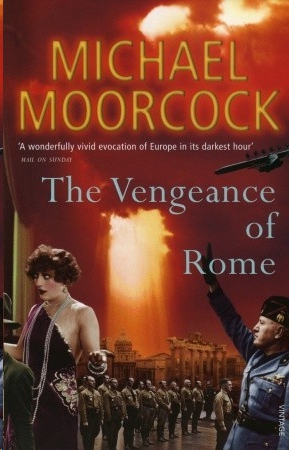
The Vengeance of Rome
- Автор: Муркок Майкл
- Серия: Between The Wars #4
- Язык: английский
- Жанр: Научная фантастика

Электронная книга - «The Vengeance of Rome». Краткое содержание книги:
After 1934 only two of us still knew the entire sequence of events. I am the last one at liberty. The other is in prison with amnesia, a vegetable. They say he can’t last. I met him during the War, during my internment. British intelligence arranged the meeting. I think they were testing me. He had very little memory left. He knew me and kept trying to warn me, as he had earlier. ‘Those Messerschmitts,’ he whispered, ’are treacherous.’ That, of course, was why he had fled. Unconsciously he had known that he would be his hero’s next victim. The journalists and pseudo-historians make some conventional logic of it, but he was as anxious to escape as I was. His action undoubtedly saved his life. His loyalty to Hitler, however, ensured his silence.
In the end he did what he had advised me to do. He escaped by plane. He knew, though his faith was as powerful as ever, that he was a marked man. His beloved, infallible master intended to murder him. In his rejection of conventional religion and his taking up of occultism, his faith in Hitler was his only stability and he could not afford to let it go. But he naturally did not want to die. Hess reconciled the conflict in his typical way. If he was of no further use to his master, then he would leave. And find a way to be of use again. Hess escaped into a kind of limbo. I did not really envy him. I believe I kept my perspective. I have never denied the real issues that lay at the heart of the Nazi cause. My quarrel was with the application of the principles. Many had the same misgivings as time went on. My own experience, of course, might have prejudiced me, but I always prided myself on my openness both to ideas and to fresh experience.
My experience at the Villa Röhm was, I will admit, dreamlike. As if I was in a perpetually running Hollywood epic. Some of Röhm’s rivals thought it vulgar, but I was reminded of Hearst’s famous Castle of San Simeon and of the Hollywood homes, such as Chaplin’s.
Putzi called Röhmannsvilla ‘De Mille Bon Marche’. Silks and fine cottons hung everywhere. Marble statuary of boys and young men, fountains, tiled baths and erotic mosaics were all drawn from classical models. A perfect setting for the elaborate parties Röhm liked to throw for his top lieutenants who never failed to bring fresh guests, many of them recruited from the Hitler Youth’s finest. The newcomers were always wonderfully impressed. A great morale booster.
I saw something so noble, clean and healthy about those young bodies that only a person with a twisted mind would observe anything perverse in what went on there. True, we tested ourselves and others to certain extremes, but this served to harden us more. Röhm himself explained how we emulated the greatest Greeks and Romans. Whenever heterosexuality was made a faith, he said, civilisations collapsed. Hitler understood that as well as he did. Only homophobes like Himmler and Goebbels feigned disgust. They were addicted to sentimentality and women the way Hitler was addicted to his cream cakes and his dog whips. Their own weakness was why they always railed against him. Göring, with his weight, and Goebbels, with his club foot, had not exactly put the purest sperm into circulation, and as for Hitler, he possessed serious drawbacks, as we said in Kiev, to his stuffing any chicken with his particular pudding.
Röhm had no time for women except as mothers. The rest were sluts and parasites. He found it hard to be polite to most of them. He said they were a distraction, incapable of higher brain functions. They were natural prey to Jews and other vermin. He had loathed Rosa Luxemburg, whom he described as a hermaphrodite and an abomination. He tolerated the army politician von Schleicher precisely because he understood him to have been involved in the execution of Luxemburg and Leibnitz.
Ultimately, Röhm told me, he saw a time when women would hardly be needed at all, and those we had left could be hardened up like Amazons, as auxiliaries and breeders. Hitler’s weakness for Geli Raubal was a sure sign things were going wrong. Röhm had nothing against his Chief having a sentimental interlude, but Raubal had become an unhealthy obsession and was getting them both into trouble. She was likely to destroy Hitler’s political career. The party couldn’t afford much more scandal around him.
Röhm insisted that the light of his old friend’s life was nothing but a whore. ‘She fucks anything that moves. She’d fuck a turd if it was stiff enough. She’s had two of his chauffeurs behind his back and half the damned SS. Everyone knows about her and that SS fellow Zeiss. Yet Alf won’t hear a word against the bitch. He’s broke because of her. She’s getting him to buy her singing lessons and send her to fucking Vienna to become an opera star! No, Mashi, we really don’t need young Geli around at the moment. I’m all for her going to Vienna to follow her vocation. I know a nice house on Rosenstrasse. They’ll employ her. She can take her pictures with her.’
Röhm, Putzi and Schultz, the Nazi Party treasurer, had been responsible for buying back Hitler’s drawings and letters. The go-between was the ubiquitous Hieronymite priest Father Bernhard Stempfle, a sometime contributor to Völkischer Beobachter and Der Stunner. The letters, Röhm said, were graphic. The photos were steamy. But the drawings were amazing. Better than his usual doodles. Putzi had wondered what kind of man would make a woman pose like that. And he had come to understand about the dog whips they all carried. He was not grateful for the knowledge, he said. It gave him a rather different idea of the Chief.
‘He’s completely addicted to the bitch,’ Röhm complained. ‘And she’s blackmailing him, believe me. She could well have corrupted that seedy priest, though I know for a fact he’s not interested in grown women. The commies will use her, if they can.’
By coincidence that same evening he presented me with a marvellous costume, a fantasy of lace and silk, and said he would be touched if I would wear it for him. Röhmannsvilla was a kind of Hollywood in itself, and I felt secure there. I was never afraid of make-believe in its place. In this case, of course, I had hardly any choice. I indulged him. I love the sensation of silk. I gave myself up to it and did not really mind the pain at the end. ‘Slut,’ he said. ‘You gorgeous little slut.’
I always believed it pure folly to assume that what a consenting adult does in the privacy of his own apartments has any bearing on his public life. No true historian bothers himself with such questions. A man should be judged by his public actions, not on his taste in suits, sex or soup.
Mrs Cornelius, of course, was involved in the Christine Keeler business, though she never went to Cliveden. Mandy Rice-Davies was her good friend, and they often spent afternoons together. ‘The only problem with all o’ that,’ she says, ‘was Chrissy and that loony Schwarze, whatever his name was . . .’
‘Lucky,’ I say.
‘They was both barmy and that messed it up for everyone else. Jack Profumo should ‘ave known better, but there wasn’t much to the rest of ‘em.’