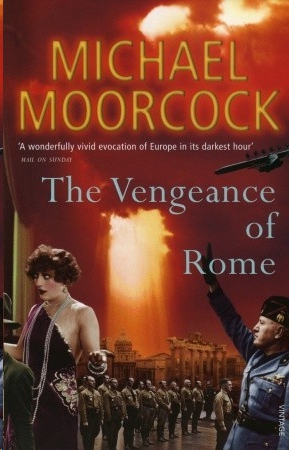
The Vengeance of Rome
- Автор: Муркок Майкл
- Серия: Between The Wars #4
- Язык: английский
- Жанр: Научная фантастика

Электронная книга - «The Vengeance of Rome». Краткое содержание книги:
But some of us remember. Stiffly Roland and Arthur and El Cid stir in their hidden caverns. Their flexing fingers reach for their swords. Soon the world will enjoy again the glory and nobility of her golden past. My cities will spring from the depths, splitting open the earth as they thrust towards the calm and comforting skies. They will take us to the heights where the air is pure and we can flourish.
The earth has betrayed us. They have soured it for us. Our legends are made into music-hall jokes and bad films. Our heroes become hobgoblins and devils. We are told that our memories are lies, our history is fiction. Our ideals are mocked. Our values are satirised. The old are ourselves. By failing to protect them, we in turn inevitably fall prey to the predators. The logic is obvious. I tell them this. But you only find it out when your body starts to fail you, when you think twice before crossing the street to your usual newsagent because a gang of youths with shaven heads and football colours are standing outside chortling over copies of the Beano and the Dandy, whose characters they so closely resemble. You have heard their insults for seventy years. You have suffered their threats, and your body can recall every blow they have struck on it. You want no more, so you do without your newspaper. Not that the papers are anything but communist rags.
I am surprised they can read. They wear football caps and scarves like the uniforms I used to see on the Sozis and Nazis. Home-made colours. They enjoy the comforts of collective violence. They slobber after power and fear all responsibility. They lie and they boast and they swagger and they imagine themselves mass murderers and gang bosses. They buy large, vicious dogs. They beat their women. They terrorise their children. And people say the Nazis were bastards.
Franz Stangl led an impeccable private life. Whatever happened at Treblinka and so on was nothing I knew about. His family loved him and were never frightened of him. He was a faithful husband and a responsible father like many of the best Nazis. They were Austrians and South Germans, of course, and disliked the Prussian glorification of war, which was to infect Hitler so badly in his later years. They were solid family men. Whatever they had to do outside, they never inflicted it on their nearest and dearest.
So who suffers most? Or worst? These scalp-heads, these Mohawkiscliers, who bring only noise, filth and violence to society? They are genuinely worthless. They contribute almost nothing in labour or money. They know only to take.
Who suffers worst are the decent men, women and children. Those of us who contribute order and cleanliness to the world. Make those hooligans into pet food, I say to her. Let the kangaroos roam free. Let some faithful family cat feast on their fatty flanks, their beer-fed guts, their coarse meat. Our cities would be quieter. Our dogs content.
We turn into the northern end of the Portobello Road, where the walls of convents and monasteries become an inescapable channel. This is the only stretch where there are no doorways, no depths, nowhere to disappear. The walls of the religious institutions are too tall and too well protected to scale. Yet already the road takes on a different character. Already it is a cut above what we leave behind. The difference is subtle. The stalls still contain the same miscellaneous mixture of false brands, redundant canned goods and hardware looking like loot from some forgotten bombsite. The same hopeless electrics, disintegrating plastic and stained paper, yet here you feel you might just possibly find something you could use. The stallholders are a little more optimistic about their wares. ‘Have a look,’ they say, ‘we can always talk about the price.’
Mrs Cornelius gives this section of the market her considered inspection. You can tell that she feels it worthier of her. She picks up a toy panzer tank bearing a flaking swastika. ‘Your big mistake, Ivan, after you got mixed up with them Nazis, was to get mixed up with them ‘omos. You never ‘ad no common sense, but you ‘ad somethin’ like good luck! All that changed when you started flirting about with ‘Itler.’
‘I didn’t exactly volunteer,’ I point out. Her intolerance is unworthy of her. ‘You never used to mind such things.’
‘I’m not talkin’ about buggery.’ She turns suddenly to look at me. ‘I’m talking about ther rest of it. You never knew when to scarper. An’ it wasn’t for want of my warnin’ you every five bloody minutes!’
‘A Greek chorus,’ I say affectionately.
She is amused. ‘A bit less of the Greek,’ she insists. ‘A Greek got me out of England in the first place. I started in the chorus, though.’ And she begins her soothing reminiscence of Kilburn Empire triumphs and glory days in Hollywood.
I find it impossible to watch those films any more. There is no equipment for them. For almost twelve years I have been working on a projector I found in the market. But where are the spares? I have tried to make them or take them from other machines. So far I have had no real luck. The old bulbs and valves are impossible to find. What happened to all those projectors? Hitler had one. Mussolini had one. Stalin had one. Franco had one. Hearst had one. Roosevelt had one. Churchill had one.
In the years between the Wars we were all cinema-crazy. Any man with money wanted his own little theatre where he could watch Mickey Mouse, Douglas Fairbanks, Cuddles McTitty and the milkman to his heart’s content. Industrialists and potentates bought themselves the convenience and privacy which after the War the BBC would try to imitate with TV for the masses. A chicken in every pot, a car in every garage, a cinema in every home. They bribed the electorate. We got Sunday Night at the London Palladium instead of justice. And the masses were content. They are always content until the fantasies on which they feed begin to poison them and then they gaze mindlessly around for some other teat to suck.
‘Look,’ says Mrs Cornelius, taking my arm. She suddenly leans on me and catches her breath. ‘It’s brightening up a bit.’
TWENTY-FIVE
The rain has lifted and the sky has grown paler, but that is all. Not exactly cause for unbridled optimism. But I do not say anything. It would be cruel to dash her hopes.
We are almost at the train bridge and the flyover. We have two bridges now. The stalls underneath represent a halfway point. They make a miscellaneous collection. White Hindoos in hideous orange nylon offer me garish comic books depicting the mysterious battles of their vast pantheon of gods. They hawk untuned bells and stinking joss sticks. They offer handbills.
‘No thank you,’ I say, ’I have not yet joined the Alternator Society.’ The entire area under the bridges stinks of wet fur, some of it from living dogs and some of it from their ancestors, adorning the lice-ridden bodies of the Love Generation. Through this drift the odours of damp rice, of tea and coffee, of fried fat. We pass perfumed candles and bags of spices, all their ‘gravey booby’ drug materials. Her fingernails a flight of red bees, Mrs Cornelius runs an appreciative hand over the chrome flanks of a massive toaster which looks as if it had once served a significant mechanical function on a Cunarder. ‘They built things to last in them days,’ she says.
‘They were not affordable to most of us.’
‘They’re all right second-hand,’ she assures me. ‘They run for ever.’ But I could see that the elements were destroyed. I picked up a birdcage with some of its bars bent, as if in a sudden fit of strength the occupant had forced its way to freedom.
‘She had a dead canary with her all day,’ said Röhm to me. ‘That was the weird thing. Hess remarked on it. So did Father Stempfle. They were called in by the mother.’
He was talking about Geli Raubal. We were in the middle of the most significant event of 1931, though you would never discover that from any of the history books. The facts were there for all to discover, at least for a while. Of course, they could not interview Father Stempfle. He had confessed her. And passed the information on. They did not make the connection. Röhm, of course, knew exactly what had happened. It is hard for a woman to shoot herself through the heart with a Walther PPK 38 of that model. The weakness, said Röhm, of the case. Nobody thought it worth investigating so they didn’t put many police on it. That gave everyone time to brush over the tracks. Then Hitler became the property of academic authority obsessed with his ‘strategies’, ‘plans’ and war management and his true story faded away. He, however, was never at rest after ‘31. The beginning of his personal decline came just as his public star was rising. Thereafter his public confidence was almost entirely play-acting and pharmaceutical drugs.