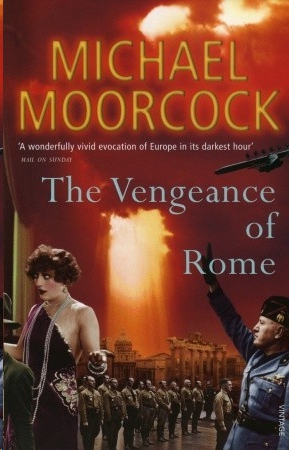
The Vengeance of Rome
- Автор: Муркок Майкл
- Серия: Between The Wars #4
- Язык: английский
- Жанр: Научная фантастика

Электронная книга - «The Vengeance of Rome». Краткое содержание книги:
‘We witness the end of language,’ I say. ’The destruction of memory. The death of culture. This is what your Harold Wilson has done for the country. So much for Labour’s golden promises!’
‘Nobody misses culture much, Ive, love.’ Mrs Cornelius believes she comforts me. ‘Or language.’ With a slender scarlet nail she dabs delicately at the corner of her crimson mouth. ’Just the people ‘oo’ve got time for it. Which isn’t many. If the op’ra went tomorrer most people wouldn’t notice. When was you last at Covent Garden anyway?’
‘That’s scarcely the point.’ I am remembering those great pre-war performances. Those wonderful, gay Viennese.
Yesterday as we came out of the tunnel we found a dead dog lying on the towpath almost in the water, twisted so that its hindquarters were open revealing its genitals, a red erection. Its short black fur had dried into symmetrical muddy spikes. Its eyes and muzzle were half open, releasing the tongue. It stared over the canal with a resigned and melancholy grin.
‘Someone’s fallen out with the Mafia.’
I uttered my first thought. In my circumstances, I am reasonably nervous, never sure if that particular vendetta against me still continues.
She tells me I am loony. ‘Barkin’,’ she says.
But I was once threatened in that way, I insist. In Rome. Nineteen thirty-two, I think. You were there when it happened to me. I told you about it on the train to Vienna.
I now know of course who was actually stalking me. She refuses to believe me. Some people live their whole lives in a permanent state of denial. Half of what I say she dismisses or derides, revealing an unconscious defence mechanism against unpalatable truth. I at least shall not be surprised when Brodmann walks through the door with a gun in one hand and a KGB badge in the other.
I have noticed how a threatened man or woman will unconsciously try to turn into the creature they most fear rather than be destroyed by it. We are so eager to conspire with our masters. We have few alternatives and almost no choices any longer. So it was in Dachau. I have been stripped of my rank, humiliated and abused. Never once have I complained.
Of course, in most circumstances complaint meant an immediate and painful death. Even when you have had the science of the method explained to you (in my case by Himmler and Schnauben themselves) it does not make your response any more rational. You know that any escape plans you make are fantasies. Any hope you entertain is a nonsense. I learned that already in Egypt. Those of you who have never experienced this kind of fear have no business judging us. By denying your own vulnerability, you make yourself further vulnerable to whatever threatens you.
Mrs Cornelius says Brodmann would be eighty at least. She says I live too much in the past. And where else should I live? I ask. How good does the future look to you? And has the future provided you with experience? Why should the present suit you better than the past? Is there something wrong with the past? You can forget. You can. What you must lose is the memory of desire, the sensation of innocence, the inability to tolerate what is disgusting. All these will become virtues enabling you to forget desire, innocence, intolerance, love. You will forget and yet memory will persist as a cold sense of loss, a yearning for something better and sweeter which you have forbidden yourself. For with memory comes loss, with desire comes pain, with hope comes despair. Hell offers an absence of virtue. It offers an eternity when all you yearn for is time.
I am an old man. My only consolations are my memories. I cultivate my past like a favourite garden; I order it like a beloved library. I go back to the years of my youth and my power when my good looks were favourably compared to Rudolph Valentino’s and Cesar Romero’s and my future was golden. I was a la mode.
Until you think back you do not understand how much your physical appearance determined your destiny. I hardly realised at the time what I had in common with the early Nazis. More than any other people, Germans celebrated youth as healthy, untainted by the poisons of the past, unburdened with the compromises and struggles of the ‘Men of War’. The Nazis were young. Most of the men who came to run the Third Reich were in their thirties. Their youth, inexperience and idealism were part of their great appeal. Ordinary Germans accepted the Nazis as the vital force to channel that youthful energy back into constructive action. Their idealism united the nation, forming ranks against the common enemy. If their youthful rhetoric was a little fiery, people tolerated it. Watch Things to Come if you want to know how we felt about putting the old ways behind us and building a rational world where technology assured our enduring security. H. G. Wells was not above borrowing the odd idea or two from the despised little corporal!
Most Germans had known only war, disintegration and violent struggle. Perpetual uncertainty is anathema to that honest, amiable German soul yearning to translate its experience of comradeship into a greater community to include all Germans, rich or poor, noble and commoner. They had been told so many lies for so long, they refused to listen. They equated education with the manipulations of the ruling class. They had lost faith in conventional politics. They wanted not a state in the old sense, but a national community of equals: a mighty German family practising the old German family virtues. These sentiments were repeated over and over again. Jews wanted it, too. Those idealists were not brutes.
The Reds and liberals were mostly men of the older generation. They had amply demonstrated their ineptitude in government, their inability to keep their promises. Yet people still yearned for that promised breaking down of class tensions which shackled Germany. They wanted stability first and foremost. Hitler promised a just and ordered future. Nationalism and socialism had failed, but perhaps national-socialism would balance the best of both philosophies. Ordinary Germans had seen Russia collapse into a civil war almost touching their borders, engulfing Poland and Finland, Romania and Ukraine. Germany could well be next. Their hatred of extremists led the German people to vote NSDAP.
Only the Brown Tide could resist the Red. Röhm was convinced of that. He was dedicated to the elimination of Communism and Big Business Capitalism. But he was no fanatic. He was just as dedicated to his pleasures. It had been a long time, he said, since he felt so truly in love. There was something, he said, about my skin. And those dark Mediterranean eyes. He used to joke about my looking too Jewish for my own good. He was by his own admission completely besotted with me. ‘I am a childish and romantic man of a wicked disposition.’ He believed he had his own measure. I, however, found him generous and sensitive, loyal to his friends, faithful to his duty. His modesty would be his undoing. I suppose I loved him, too, a little. I was definitely flattered by his attention. Röhm was even more famous than Hitler in many circles. A light would burn in that oddly vulnerable, horribly scarred face when he tried to explain his feeling for me. ‘There is a quality in you, Max, that I recognise and need.’
I was at once charmed and compromised. I had important business to complete in Rome. For me this interlude was no more than a holiday. I said nothing of Mussolini to Röhm but reminded him how I was not entirely a free agent, that I worked for the Italian aircraft industry.
Röhm had no problem with this. He was, however, deeply interested in my South Russian battle experiences, assuming that, as an American flyer, I had longed for action. He himself had considered joining the Air Corps if only to get out of the trenches, but he was already too old. I had to describe for him in detail the period I spent fighting beside the Cossacks during that ruthless war between Red and White. He was trying to guess what might happen to his Germany in the event of a civil war. He listened with deep sympathy to my stories of capture and torture.