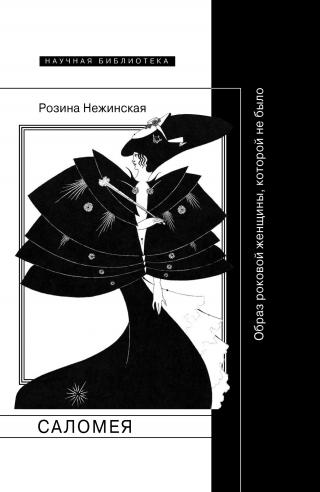
Саломея. Образ роковой женщины, которой не было
- Автор: Нежинская Розина
- Год: 2018
- Язык: русский
- Год: НЛО
- ISBN: 978-5-4448-1034-7
- Жанр: Исторические приключения

Электронная книга - «Саломея. Образ роковой женщины, которой не было». Краткое содержание книги:
Egyptomania. Egypt in Western Art 1730–1930 / Eds. J.-M. Humbert, M. Pantazzi, C. Ziegler, C. Ziegler. Ottawa: National Gallery of Canada, 1994.
Eimerl S. The World of Giotto, c. 1267–1337. N. Y.: Little Brown & Company, 1967.
Ellmann R. Oscar Wilde. N. Y.: Alfred A. Knopf, 1988.
Essays on Women in Earliest Christianity / Ed. C. D. Osburn. Joplin, MO: College Press Pub. Co., 1993–1995.
Fairlie A. Imagination and Language. Collected essays on Constant, Baudelaire, Nerval and Flaubert. Cambridge: Cambridge University Press, 1981.
Filippo et Filippino Lippi. La Renaissance à Prato. P.: Silvana Editoriale, Musée du Luxembourg, 2009.
Fisher B. D. Salome, adapted from the Opera Journeys lecture series by Burton D. Fisher. Coral Gables, FL: Opera Journeys, 2002.
Flaubert G. Oeuvres, II. P.: Bibliothèque de la Plèade, Editions Gallimard, 1952.
Flaubert G. Trois Contes / With an afterword and notes by P. M. de Biasi. P.: Seuil, 1993.
Flaubert G. Trois Contes. P.: Booking International, 1994.
Flaubert G. Voyage en Orient / Foreward by C. Gothot-Mersch. P.: Gallimard, 2006.
Flavius J. The Works of Josephus Flavius / Trans. W. Whiston – www.ccel.org/j/josephus/works/ant-18.htm.
Fossi G. Filippo Lippi. Florence: Scala, 1989.
Fowlie W. Mallarmé. Chicago: The University of Chicago Press, 1953.
Freedman L. Titian’s Independent Self-Portraits. Florence: Leo S. Olschki, 1990.
Gautier T. Jettatura. Boston: D. C. Heath and Co., Publishers, 1904.
Gautier T. Le Roi Candaule. P.: Librairie des amateurs, A. Perroud, Libraire-editeur, 1893.
Gibsen M. Symbolism. Koln, London, Los Angeles, Madrid, P., Tokyo: Taschen, 2003.
Gilman L. Strauss’ «Salome». A Guide to the Opera with Musical «Illustrations». L.: John Lane, the Bodley Head; N. Y.: John Lane Company, 1907.
Girard R. Le Bouc émissaire. P.: Grasset, 1982.
Girard R. Scandal and the Dance: Salome in the Gospel of Mark // Ballet Review. Winter 1983. P. 67–76.
Giusti A. M. The Baptistery of San Giovanni in Florence / Trans. S. Grieco. Florence: Mandragora, 2000.
Gormley B. Salome. N. Y.: Alfred A. Knopf, 2007.
Grojnowski D. L’ordre moral et le désordre: Les Salomé de Gustave Moreau. Toulouse, 1981.
Grojnowski D. Salomé, l’art et l’argent // Cahier de l’Herne J-K Huysmans. 1985. № 47. P. 165–173.
Guido Reni 1575–1642. Los Angeles: County Museum of Art, Nuova Alfa Editoriale, 1988.
Haase M. Reconciling Contradiction. The Myth of Salome. Thesis. Indianapolis: Christian Theological Seminary, 1994.
Hägg T. The Art of Biography in Antiquity. N.Y: Cambridge University Press, 2012.
Hägg T. The Novel in Antiquity. Berkeley: University of California Press, 1983.
Hartt F. History of Italian Renaissance Art. Painting, Sculpture, Architecture. N. Y.: H. N. Abrams, 1969.
Hausamann T. Die tanzende Salome in der Kunst von der christlichen Fruhzeit bis um 1500. Zurich: Juris Druck, 1980.
Heffernam J. The Museum of Words: The Poetics of Ekphrasis from Homer to Ashbery. Chicago: University of Chicago Press, 1993.
Heine H. Atta Troll / Trans. H. Scheffauer. N. Y.: B. W. Huebsche, 1914.
Henry N. Mallarmé et le symbolism. P.: Librairie Larousse, 1986.
Hermann L. Hérodiade // Revue des Etudes juives. 1973. № 12. P. 49–63.
Heywood J. C. Salome. A dramatic poem. N. Y.: Hurd and Houghton, 1867.
Hoare P. Oscar Wilde’s Last Stand: Decadence, Conspiracy, and the Most Outrageous Trial of the Century. N. Y.: Arcade Pub., 1998.
Hoehner H. W. Herod Antipas. Cambridge: Cambridge University Press, 1972.
Holmes M. Fra Filippo Lippi. The Carmelite Painter. New Haven; L.: Yale University Press, 1999.
Hourticq L. La jeunesse de Titien. P.: Librairie Hachette, 1919.
Huot S. Le mythe d’Hérodiade chez Mallarmé: genèse et evolution. P.: A. G. Nizet, 1977.
Husslein-Arco A., Koja S. Lovis Corinth: A Feast of Painting. N. Y.; L.: Prestel Pub, 2010.
Huysmans J.-K. Against Nature / Trans. M. Mauldon. Oxford: Oxford University Press, 1998.
Ilan T. Jewish Woman in Greco-Roman Palestine. Peabody, MA: Hendrickson Publishers, Inc., 1995.
Jackson H. Introduction // Wilde O. Salome. N. Y.: Heritage Press, 1945.
Jensen M. H. Herod Antipas in Galilee: The Literary and Archaeological Sources on the Reign of Herod Antipas and Its Socioeconomic Impact on Galilee. Tübingen: Mohr Siebeck, 2006.
Jolowicz H. F. Historical Introduction to the Study of Roman Law. 2nd edn. Cambridge: Cambridge University Press, 1952.
Kaplan J. Gustave Moreau. Los Angeles: Los Angeles County Museum of Art, 1974.
Karayanni S. S. Dancing Fear and Desire: Race, Sexuality and Imperial Politics in Middle Eastern Dance. Ontario: Wilfrid Laurier University Press, 2004.
Kemperdick S. Rogier van der Weyden, 1399/1400–1464. Cologne: Könemann, 1999.
Knapp B. L. Flaubert: Dance and the Archetypal Harlot, Wife, and Castrator // Arabesqué, № 8–9. N. Y.: Ibrahim Farrah, 1985.
Kokkinos N. Which Salome did Aristobulus Marry? // Palestine Exploration Quarterly. 1986. № 118. P. 33–50.
Kornitz B. H. de. Salome: Virgin or Prostitute? New York: Pagean Press, 1953.
Kuryluk E. Salome and Judas in the Cave of Sex: The Grotesque: Origins, Iconography, Techniques. Evanston, IL: Northwestern University Press, 1987.
La femme en Méditerranée, Actes du Colloque de Bari, 8 June 2007 / Eds. P. Brunel, G. Dotoli. Biblioteca della Ricerca, Alain Baudry et les éditeurs, 2007.
La narration: quand le récit devient communication / Éd P. Bühler, J.-F. Habermacher; postface de Paul Ricoeur. Geneva: Labor et Fides, 1988.
Lacambre G. Gustave Moreau, 1826–1898. P.: Réunion des musées nationaux, 1998.
Lacambre G. Gustave Moreau: Magic and Symbols. N. Y.: Harry N. Abrams, 1999.
Lacambre G. Gustave Moreau: Maître Sorcier. P.: Gallimard & Réunion des musées nationaux, 1997.
Lacambre G., Feinberg L. J., de Contenson M.-L., Druic D. Gustave Moreau: Between Epic and Dream. Princeton: Princeton University Press, 1999.
Lacan J. Seminar on «The Purloined Letter» // Lacan J. Écrits / Trans. B. Fink. N. Y.: Norton, 2006. P. 6–51.
Laforgue J. Moralités legendaries. P.: Flammarion, 2000.
Large V. The Reader in the Strategy of Fiction // Expression, Communication and Experience in Literature and Language. Proceedings of the XIIth Congress of the International Federation of Modern Languages and Literatures / Ed. R. G. Popperwell. L.: The Modern Humanities Research Association, 1973. P. 86–102.
Le Monde de l’Art. Association artistique russe du début du XXe siècle / Introd. V. Petrov, A. Kamenski. Leningrad: Editions d’art Aurora, 1991.
Lietzmann H. A History of the Early Church. 4 vols. in 2. N. Y.: Meridian Books, 1961.