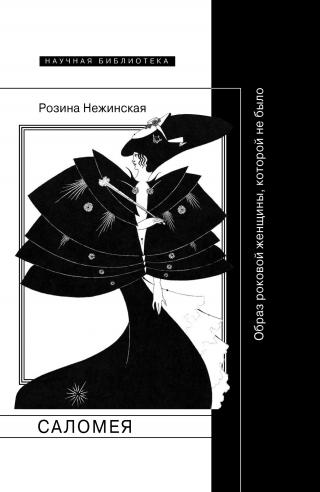
Саломея. Образ роковой женщины, которой не было
- Автор: Нежинская Розина
- Год: 2018
- Язык: русский
- Год: НЛО
- ISBN: 978-5-4448-1034-7
- Жанр: Исторические приключения

Электронная книга - «Саломея. Образ роковой женщины, которой не было». Краткое содержание книги:
Atkinson K. Queen Salome: Jerusalem’s Warrior Monarch of the First Century B. C. E. Jefferson, NC: McFarland & Co., 2012.
Austin L. J. Essais sur Mallarmé. Manchester; N. Y.: Manchester University Press, 1995.
Bach A. Women, Seduction, and Betrayal in Biblical Narrative. Cambridge: Cambridge University Press, 1997.
Bach A., Exum J. C., Dillon L., Dillon D. Miriam’s Welclass="underline" Stories about Women in the Bible. N. Y.: Delacorte Press, 1991.
Bal M. Lethal Love: Feminist Literary Readings of Biblical Love Stories. Bloomington: Indiana University Press, 1987.
Bal M. Narratology: Introduction to the Theory of Narrative. 2nd edn. Toronto: University of Toronto Press, 1997.
Ballarin A., Savy B. M., Romanino G. La Salomè del Romanino ed altri studî sulla pittura bresciana del Cinquecento. Cittadella: Bertoncello artigrafiche, 2006.
Ballerini I. L. On the Scaffolding with Filippo Lippi: Prato Cathedral of Santo Stefano, Visits on the Scaffolding of the Restoration Worksite for Filippo Lippi’s Frescoes. Prato: Provincia Di Prato Agenzia Per Il Turismo, 2001.
Barasch M. Giotto and the Language of Gesture. Cambridge: Cambridge University Press, 1990.
Barthes R. Mythologies. N. Y.: Hill and Wang, 1995.
Baudelaire C. The Flowers of Evil / Trans. J. McGowan. Oxford: Oxford University Press, 1998.
Bénichou P. Selon Mallarmé. P.: Gallimard, 1995.
Bentley T. Sisters of Salome. New Haven: Yale University Press, 2002.
Bernard E. Aventure de ma vie (My Life Adventure). Unpublished manuscript, Musée du Louvre.
Bochet M. Salome. Du voilé au dévoilé. P.: Les Editions du CERF, 2007.
Bonafoux P. Portraits of the Artists. The Self-Portrait in Painting. N. Y.: Skira, Rizolli, 1985.
Brenner A. A Feminist Companion to the Song of Songs. Sheffield: Sheffield Academic Press, 2001.
Campbell J.-C. The Legend of Salome in the History of the Arts. Thesis. Northampton: Smith College, 1931.
Cansinos-Asséns R. Salomé en la literatura: Flaubert, Wilde, Mallarmé, Eugenio de Castro, Apollinaire. Madrid: Editorial– América, 1919.
Capodieci L. Gli ornamenti simbolici: l’uso degli elementi decorativi nella «Salome tatuata» di Gustave Moreau // Ricerche di Storia dell’Arte. 1995. № 57. P. 5–22.
Capodieci L. Salomé // Gustave Moreau: Les aquarelles. P.: Somogy Editions d’Art, 1998.
Chambers E. K. The Medieval Stage. Oxford: Oxford University Press, 1978.
Cheney L. De G., Faxon A. C., Russo K. L. Self-Portraits by Women Painters. Aldershot: Ashgate, 2000.
Clark K. An Introduction to Rembrandt. N. Y.; Hagerstown; San Francisco; L.: Harper & Row, Publishers, 1978.
Cohn H. The Trial and Death of Jesus. N. Y.: Ktav Publishing House, Inc., 1977.
Cole B. Giotto and Florentine Painting 1280–1375. N. Y.: Icon Editions; Harper & Row, 1976.
Cole B. Nature and the Ideal in Khnopff’s «Avec Verhaeren: Un Ange and Art, or the Caresses» // The Art Bulletin. 2009. № 91. P. 325–342.
Cooke P. Gustave Moreau et les arts jumeaux: peinture et littérature au dix-neuvième siècle. Berne: Peter Lang, 2003.
Cooke P. Gustave Moreau’s «Salome»: The Poetics and Politics of History Painting // The Burlington Magazine. 2007. № 149. P. 528–536.
Cooke P. History Painting as Apocalypse and Poetry: Gustave Moreau’s «Les Prétendants», 1852–1897, with Unpublished Documents // Gazette des beaux-arts. Jan 1996. P. 27–48.
Cooke P. La pensée esthétique de Gustave Moreau à travers ses écrits // Dossiers de l’art. 1998. № 51. P. 16–26.
Corley K. E. Were the Women around Jesus Really Prostitutes?: Women in the Context of Greco-Roman Meals // Society of Biblical Literature Seminar Papers / Ed. D. J. Lull. Atlanta: Scholars Press, 1989. P. 487–521.
Curl J. S. Egyptomania. The Egyptian Revivaclass="underline" A Recurring Theme in the History of Taste. Manchester; N. Y.: Manchester University Press, Manchester, 1993.
D’Arcais F. F. Giotto. N. Y.: Abbeville Publishers, 1995.
Daffner H. Salome: ihre Gestalt in Geschichte und Kunst, Dictung, bildende Kunst, Musik. Munich: Hugo Schmidt, 1912.
De Palacio J. La Féminité dévorante: sur quelques images de la manducation dans la littérature décadende // Revue des Sciences Humaines. 1977. № 168. P. 601–618.
De Palacio J. Motif privilégié au jardin des supplices: le mythe de la décollation et le décadende // Revue des Sciences Humaines. 1974. № 153. P. 39–62.
De Vos D. Rogier van der Weyden. P.: Hazan, 1999.
De Vos D. Rogier Van Der Weyden: The Complete Works. N. Y.: Harry N. Abrams, 2000.
Décaudin M. Salomé dans la littérature et l’art de l’époque symboliste // Bulletin de l’Université de Toulouse. 1965. № 152. P. 1–7.
Décaudin M. Un Mythe «fin de siècle»: Salomé // Comparative Literature Studies. 1967. Vol. IV. № 1/2. P. 109–117.
Del Mastro M. L. All the Women of the Bible. Edison, NJ: Castle Books, 2004.
Dictionnaire des mythes du fantastique / Eds. P. Brunel, J. Vion-Dury. Limoges: Presse Universitaire, 2003.
Dierkes-Thrun P. Salome’s Modernity: Oscar Wilde and the Aesthetics of Transgression. Ann Arbor: University of Michigan Press, 2011.
Dijkstra B. Idols of Perversity. Fantasies of Feminine Evil in Fin-de-Siècle Culture. N. Y.; Oxford: Oxford University Press, 1986.
Doody M. A. The True Story of the Novel. New Jersey: Rutgers University Press, 1996.
Dottin-Orsini M. Cette femme qu’ils dissent fatale. P.: Bernard Grasset, 1993.
Dottin-Orsini M. Lectures fin-de-siècle de l’iconographie de Salomé // Bible et Imaginaire. 1991. № 11. P. 121–137.
Dottin-Orsini M. Portrait de femme fatale en vampire // Littératures. 1992. № 26. P. 41–57.
Dottin-Orsini M. S comme Salomé. Salomé dans le texte et m’image de 1870 à 1914, une exposition documentaire du Centre de promotion de la recherche scientifique. Université de Toulouse-Le Mirail, 1986.
Dottin-Orsini M. Salomé de Henri Regnault (1870): genèse et réception d’un tableau légendaire // Textes, Images, Musique, Cahiers de «Littératures». 1992. P. 30–45.
Dottin-Orsini M. Salomé. P.: Éditions Autrement, 1996.
Dottin-Orsini M. Salomé-Hérodiade // Dictionnaire des mythes littéraires / Ed. P. Brunel. P.: Editions du Rocher, 1994. P. 1176–1187.
Downey K. B. Perverse Midrash: Oscar Wilde, André Gide, and Censorship of Biblical Drama. N. Y.: Continuum, 2004.
Drewska H. Quelques interprétations de la Légende de Salomé dans les Littératures contemporaines. Thesis: Montpellier, 1912.
Dumesnil R. Introduction // Flaubert G. Oeuvres, II. P.: Editions Gallimard, 1952. P. 575–583.
Eco U. Art and Beauty in the Middle Ages. New Haven: Yale University Press, 2002.