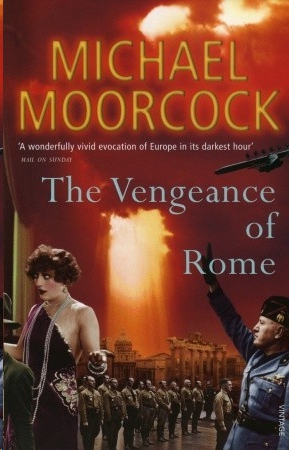
The Vengeance of Rome
- Автор: Муркок Майкл
- Серия: Between The Wars #4
- Язык: английский
- Жанр: Научная фантастика

Электронная книга - «The Vengeance of Rome». Краткое содержание книги:
While I visited Munich’s many fine galleries and churches, such things cannot hold a restless mind like mine for long. The up-to-date kinema houses allowed me to see what the German movie world was doing. The films were mostly affairs of sickening violence or cloying comedy.
Surprisingly, I had not yet heard from Mussolini or any representative of his. The Italian secret service seemed unduly cautious. Was I wasting my time? I am the kind of man who feels uneasy if not tackling some important problem. I would have liked to speak to some of the other Nazi leaders. They were never available. The Italians had made a mistake to send me to Munich first. It was a ‘heart’ town of the Nazi Party, where much of their history had taken place, but political business was still done in Berlin.
Whenever Hitler or Strasser were in town they were always closeted with their closest colleagues. They had no time for a stranger, albeit a sympathetic one. At first there had been some talk of my being Jewish, although mostly in fun, and I had been very quick to correct that error! Soon everyone took me for Italian. In these days the public was first becoming truly aware of the depths of the ‘supranational’ conspiracy and were understandably angry with the Jews. Everyone now knew me as Max Peters, even if the Völkischer Beobachter described me as ‘Hollywood’s new Latin American adventure star’ and seemed to think I was from the Argentine. I was, they said, of Spanish, Italian and German origin. An Aryan through and through. A strange thing for a pure-blooded Slav to be living such a lie!
Because of some modish jazz dance, South America was all the rage in films that year. Even as I wrote my first reports back to my Duce, I enjoyed a small renaissance. I became a popular figure locally. I made no secret that I was a keen supporter of Mussolini and a friend of Young Germany. I spoke of a common European destiny, of a Union of States which would one day be as great as the USA. I gave a number of interviews in the press, warning of the perils facing modern society. My films began to be shown again, chiefly in the cinemas not wholly given over to sound, and even the Brownshirts treated me with cheerful familiarity now they recognised me. Of course there continued to be incidents. Clashes between Reds and Browns were fairly common. It was wise to avoid the backstreets.
After a month or so I began to feel like an old Municher and was soon able to talk expertly and heatedly on matters of sausages and beer! I did not follow the extraordinary ups and downs of the Reichstag as reported in the German press but instead heard the opinions of Putzi and his circle. Everyone was extremely excited. Their mood infected me. I began to take an interest in some of the personalities. I was surprised that so much healthy controversy existed between party members. This could only be to the good. Hitler’s mistake was to favour only one aspect of National Socialism over so many others. Variety, as Mrs Cornelius insists, is the spice of life.
The party was divided into two basic wings: the left, which still clung to its anti-capitalist socialist programmes, and the right, which favoured a system similar to the corporate state founded by Mussolini where private capital continued to flourish but under the firm control of government. Because of its sudden need for election money, the party had been forced to negotiate with powerful interests. The Army, the Church and Big Business were given certain reassurances. Since the onset of the Great Slump, which they blamed on America, the firm of I. G. Farben had been funding Röhm and Strasser, while Thyssen was openly backing Hitler and Göring. Others in the movement refused to take ‘capitalist gold’. They clamoured for an immediate uprising against the bosses and moribund social institutions. Hitler had already split with Gregor Strasser’s brother, Otto, over questions of race and aesthetics. Fiorello’s friend, Otto had left to form the so-called ‘Black Front’ and was now in Austria. Yet the party was growing. It had now almost a million members with thousands more ‘fellow-travellers’. The economic disasters which the masses and the middle classes had suffered had radicalised many Germans. They were considering voting for the Nazis, but barriers of class and tradition remained. Professional politicians looked down on the rowdy National Socialists as anarchist street fighters and little else. Hindenburg loathed the notion of a civilian commoner taking over his office. With a great deal of work to do and much at stake, most of the Nazis were agreed that everything hinged on the powers of Adolf Hitler to convince Hindenburg.
‘The trouble is,’ said Ernst Röhm one day at a lunch Putzi had been unable to attend, ‘Alf’s so fucking unreliable. You never know from one day to the next how he’ll go. Sometimes he can hold the whole of Germany in his palm; sometimes he’s too nervous to ask a waiter for a glass of milk. That slut has turned his bowels to water. He’s too involved with her.’ Röhm was one of the few people I had ever heard call the Führer by his family nickname. He had come into the beer cellar looking for one of his ‘boys’, as he called his adjutants, and seeing me, decided he had time for a cup of coffee. I was sitting with the Sternholders, a pleasant couple of Hitler sympathisers I had met at Putzi’s a few days before. They lived not far from the Brown House in the same exclusive district and were a little overwhelmed by the presence of the Stabschef.
Röhm put his hand on my shoulder, fixing me again with that honest, direct stare. ‘Why haven’t we seen you at Röhmannsvilla?’ The Sternholders were embarrassed to hear such direct talk. Röhm, who lived his entire life in rough male company, occasionally forgot himself. He apologised. ‘I’m a wicked, uncouth man, and sometimes I lose control of my nature. Forgive me.’ Bowing, he made his farewells. I promised to visit him at his new villa in what he called ‘the Bavarian heartland’. I could see how he had gained his reputation for brusqueness. He had no time for play-acting, he said, but he still valued good manners. The Sternholders thought he was ‘too proud for his own buttons’ and found him coarse. They were unconvinced by my defence. The judgement of people like them would prove Röhm’s undoing. By characterising him as a brute, something less than human, his enemies would later murder him with impunity and have the- German people sigh with relief at their salvation. How many years will it take until they realise Röhm was the Caesar they deserved, not the Triumvirate they were finally awarded? And yet, of course, I must take some blame for it all. It is extraordinary how we all appear to have connived in our own destruction! And from the noblest of motives.
A minor drama was taking place concerning my baggage. Everything the young men had packed had turned up at my hotel, the Königshof, near the cathedral. The only thing missing was a case of spare drawings. These were not the duplicate plans and photographs I had put in the large envelope before I left Italy. They were some miscellaneous pieces I had had lying around. I could not remember the case being loaded on to the train. I was fairly certain it had been stolen or confiscated. Most of the work would be useless to a foreign power, but it was irritating to know that I was receiving unwanted attention. My personal sets of documents were thoroughly hidden in linings and spines. I continued to pursue the lost luggage, however, but with little success. The Germans were inclined to blame the Austrians. The Austrians blamed the Italians. And so on.
The world news was increasingly disturbing. Everyone became rapidly abstracted as the financial situation worsened, and Germany once again seemed about to slide into anarchy. For a few days the whole country was unnaturally still, waiting and listening, as a frightened animal waits and listens.