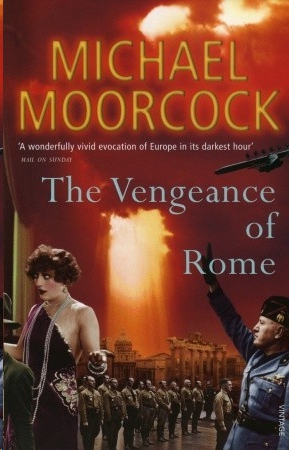
The Vengeance of Rome
- Автор: Муркок Майкл
- Серия: Between The Wars #4
- Язык: английский
- Жанр: Научная фантастика

Электронная книга - «The Vengeance of Rome». Краткое содержание книги:
During those first Munich days, as I continued to explore the city, admiring her wonderfully Baroque architecture and nostalgic for more civilised times, I saw by coincidence quite a lot of Ernst Röhm. He recommended restaurants to me, as well as concerts and parks. I had fallen in with a group of young people, many of them members of the movement, whose idealism was as powerful as mine. Eager to hear my impressions of modern Italy, they had been proud to show me their city.
My new friends had many questions. How was financial stability maintained, for instance. I became a proselytiser for Il Duce. I contrasted the sense of well-being and optimism in my adopted country. At a period when even the United States was descending into communism, the Italian example was the only light burning in Europe. This, of course, inspired them. They knew they must one day come to power in a bloodless revolution as Mussolini had done.
The size and strength of the SA inspired other young hotheads, however, to speak of ’bloody revolution’, of taking over the state by force: this was another subject of noisy debate between Nazis in those days. Today’s youth sees only comic-strip images, stereotypes of swaggering SS officers and a demented Führer lusting to rule the world. They do not realise that most Nazis were people like themselves, just old enough to vote and anxious to throw out the old professional politicians who had led them into disaster through compromise and vacillation. They did not want war. Most of them were not even particularly anti-Jewish. They just wanted a change. They wanted something done. The Nazis promised to do something.
Millions voted for Hitler because he was the young head of a young party which disdained the old-fashioned Junkers style, which spoke and acted in modern terms. During elections cinema films of Hitler were made by Goebbels to show in every village and town in Germany. The Nazis used radio effectively for the first time, as well as the press. The politician who controlled the airwaves also ultimately controlled the masses. Other politicians wrote articles or addressed town hall meetings. Hitler flew in a modern aircraft to speak personally to all seventeen states of the federation. This, of course, took money, and it was the source of that money which gave certain Nazi idealists pause. In private they were assured that the industrialists would be used to bring themselves down. But in public Hitler, if not Strasser, reassured the traditional German powers of landed aristocracy, industry, Church and Army, that he worked only to ensure their endurance.
I heard Hitler speak for the first time over the radio in the Pohlnerkeller in Wilhelmstrasse. We were all gathered in silence, yet slowly, as the man spoke, his voice rising and falling, coaxing us to tears as well as to rage, a low roaring noise filled the cellar until, as the speech ended, every man and woman was on their feet, raising their arm in salute and shouting ‘Heil Hitler!’
A moment that stirred my soul.
Then I realised fully the oratorical power of the ‘German Mussolini’ and understood why, with all their reservations, the Nazis had made him their spokesman and their leader.
Meanwhile, I still had met no OVRA officer. Had the German secret police recognised and arrested him? There still existed a strong antipathy to fascisti in old leftist Weimar circles. Naturally I could not contact my Chief directly. I had been warned to do nothing that would connect me directly with my adopted nation.
Time dragged on. Every second week I picked up a registered envelope at the central post office. It contained only money, in new German notes. Because I was not ‘earning my keep’, I felt I was here under false pretences. So far no one, apart from Hanfstaengl and Röhm, had shown the slightest interest in me. Perhaps they knew I was a spy.
A couple of weeks after I arrived Göring sent me an apology via an intermediary. He still wanted to talk aircraft with me, he said, and hoped to see me soon. I had not understood that he wanted to talk about aircraft at all! He had until recently represented a Swedish aircraft company. I made allowances for him. Everyone said how the poor man was utterly distracted and had gone into retreat with his ailing wife, scarcely taking any interest in the outside world.
Aimlessly I wrote some further reports. I still had nowhere to send them. I could not risk telephoning. I decided that if I did not hear anything by the end of the month I would find an excuse for visiting either the Italian Consulate or the papal nuncio. I would leave my reports with them. And if they refused me, I would tear them up and return to Rome. I had the impression that the great machine of state had lost track of me! But I still had money and all other necessities of modern life, so I continued to behave as usual. I must admit I did not have an arduous time. I had become something of a minor celebrity in Munich. I occasionally ate at the Brown House, when Putzi or some other major official could sign me in, but it became increasingly crowded and the food got worse. Only party members were allowed entrance unaccompanied. And I grew tired of being addressed as ‘Herr Signor’. So I found a pleasant restaurant in central Munich where I would take my lunch almost every day. It was called simply enough the Bratwurstglockl.
The place was frequented by higher ranking SA and SS officers. There I met several men who would become famous later, including Himmler, who seemed a colourless creature, and Christian Weber, a bluff, hearty fellow of the old school. Generally I found the SA fellows more agreeable. Almost all good-natured Bavarians, they were men with regular army experience. With an honest, down-to-earth quality, they would do anything for you.
I was constantly amused that these Nazis were forever assuring me that I did not look Jewish, that I was evidently Spanish. It could be so hard to identify some Americans as Jews or Aryans, because of our Indian blood. I think they associated my style of dress with Jewish vulgarity rather than Italian chic. I did not blame them. They were unsophisticated lads, forever apologising. Their famous unruliness was entirely to do with bad local leadership. Röhm would often say, ‘There are no bad Brownshirts - just bad officers.’ We were to discover that in 1933, when any scum jumped on the Nazi bandwagon.
I spent more and more time with Stabschef Ernst Röhm. He enjoyed speaking Spanish with me. He was at heart, he admitted, a monarchist, but he was also a realist. He had picked up many ideas about guerrilla warfare and revolutionary tactics in South America and was delighted to learn I had fought against the Bolsheviks in Russia.
‘I envy you that,’ he said. ‘What wouldn’t I give to have a crack at an entire division of the bastards.’ He loved war as much as he loved life. He was a man of his time and yet oddly out of his time. A man of ruthless hardness, if necessary, but of extraordinary tenderness, too.
That tenderness of Röhm’s is what you find in his writings, especially those scandalous letters which he wrote from Bolivia and whose publication was intended to destroy him. He made no secret that he was the author. Only Hitler, he said, insisted they were lies. ‘All that hypocrisy will be swept away when we’re in power,’ said Röhm. ‘We’ll proclaim our sexual orientation the way the Greeks did — proudly and aggressively.’ He believed in the old Platonic ideal. As far as he was concerned, women had only one function, which was to give birth to healthy soldiers. ‘I don’t believe in treating them badly. But it’s as pointless to place a woman in a position of power as it is to put a soldier in the kitchen.’ I did not hold his absolutist views, but my blood was stirred by his vision.
I think we were in the Bratwurstglockl, tucking in to sausages, vast Wiener schnitzels and spaghetti, when we first saw Hitler’s mistress. I had heard only the vaguest of rumours about Miss Raubal and was a little embarrassed. I had no interest in the private lives of our great men. Their public world is all that should concern us. Lloyd George, sometimes called the English Mussolini, was a terrible womaniser, yet he brought his country into the twentieth century and prepared it for the twenty-first.