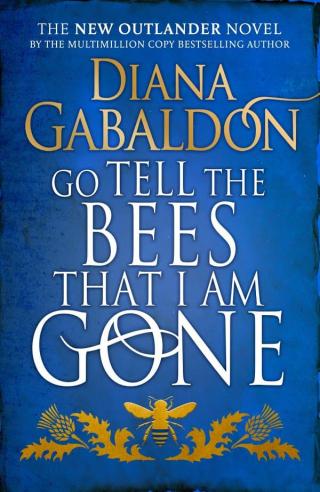
Go Tell the Bees That I Am Gone
- Автор: Гэблдон Диана
- Серия: Outlander #9
- Год: 2021
- Язык: английский
- Год: Delacorte Press
- ISBN: 978-1-473-51900-8
- Жанр: Исторические приключения

Электронная книга - «Go Tell the Bees That I Am Gone». Краткое содержание книги:
The past may seem the safest place to be . . . but it is the most dangerous time to be alive. . . .
Jamie Fraser and Claire Randall were torn apart by the Jacobite Rising in 1746, and it took them twenty years to find each other again. Now the American Revolution threatens to do the same. It is 1779 and Claire and Jamie are at last reunited with their daughter, Brianna, her husband, Roger, and their children on Fraser’s Ridge. Having the family together is a dream the Frasers had thought impossible. Yet even in the North Carolina backcountry, the effects of war are being felt. Tensions in the Colonies are great and local feelings run hot enough to boil Hell’s teakettle. Jamie knows loyalties among his tenants are split and it won’t be long until the war is on his doorstep. Brianna and Roger have their own worry: that the dangers that provoked their escape from the twentieth century might catch up to them. Sometimes they question whether risking the perils of the 1700s—among them disease, starvation, and an impending war—was indeed the safer choice for their family. Not so far away, young William Ransom is still coming to terms with the discovery of his true father’s identity—and thus his own—and Lord John Grey has reconciliations to make, and dangers to meet . . . on his son’s behalf, and his own. Meanwhile, the Revolutionary War creeps ever closer to Fraser’s Ridge. And with the family finally together, Jamie and Claire have more at stake than ever before.
Jamie took his spectacles off and leaned over my arm, peering at the spot I’d marked.
“The symptomology of this condition is both varied and obscure, requiring extensive observation and repeated testing before a diagnosis can be made,” he read. He glanced up at me. “Aye, well, that’s about the size of it, no?”
“Yes,” I said, and closed the book, feeling obscurely comforted. Jamie gave a mild snort, but took the book from me and put it back on the table.
“Ye can take the extensive observations as given,” he said dryly. “Repeated testing, though …” His expression changed, turning inward. “Aye, maybe. Just maybe. I’ll need to think on that.”
“Do,” I said, made slightly nervous by his look of interested contemplation. I had no idea how one might go about testing a hypothesis like his—or perhaps I did. I swallowed.
“Do you … want me to read it?” I asked. “Frank’s book?” The notion of reading The Soul of a Rebel—Frank’s final book—gave me a feeling that I would have formally diagnosed with no tests whatsoever as the heebie-jeebies. And that, without considering Jamie’s notion that Frank had somehow intended the book as a personal message to him.
He looked at me, startled.
“You? No.”
An outburst of giggling and minor shrieking rose suddenly from below. Jamie made a Scottish noise, got up, and pulled his boots on. Raising an eyebrow at me, he stepped out into the hall and walked slowly toward the head of the stairs, clumping loudly. As he reached the fourth stair, the noise below ceased abruptly. I heard a faint snort of amusement, and he went down quickly. I could hear his voice in the kitchen, and a meek chorus of assent from the children, but made out only the odd word here and there. Another minute, and he came briskly up the stairs again.
“Is the MacLennans’ little boy actually named ‘Oogh’?” I asked curiously, as he sat down to take off his boots.
“Aodh, aye,” he said, pronouncing it with a slightly more guttural sound at the end, but still identifiably “Oogh.” “Were we speakin’ English, I expect his name would be Hugh. Here, Sassenach.” He handed me a linen towel from the kitchen, wrapped around what proved to be a delectably fragrant peanut butter sandwich on fresh-baked bread with blackberry jelly.
“Ye didna get your fair share at supper,” he said, smiling at me. “Ye were too busy filling all the wee mouths. So I put one aside for ye, on top of your herb cabinet. Recalled it just now.”
“Oh …” I closed my eyes and inhaled beatifically. “Oh, Jamie. This is wonderful!”
He made a pleased sound in his throat, poured me a cup of water, and sat back, hands clasped about his knees, watching me eat. I reveled in every sweet bite, chunky bits of peanut, blackberry seeds, and chewy, grainy bread included, and swallowed the last of it with a sigh of satisfaction and regret.
“Did I ever tell you that I brought a peanut butter and jelly sandwich with me, when I came back through the stones?”
“No, ye didn’t. Why that?”
Why, indeed?
“Well … I think it was because it reminded me of Brianna. I made her peanut butter sandwiches so often, for her school lunches. She had a Zorro lunch box, with a little thermos in it.”
Jamie’s eyebrows went up. “Zorro? A Spanish fox?”
I waved a hand dismissively. “I’ll tell you about him later. You would have liked him. I didn’t take a lunch box, though; I just wrapped my sandwich in a sheet of—of plastic.”
Jamie’s brows were still raised. “Like the stuff Mr. Randall’s spectacles were made of?”
“No, no.” I flapped my hand, trying to think how to describe Saran Wrap. “More like … like the transparent cover on his book—that’s plastic, too—but lighter. Sort of like a very light, transparent handkerchief.” I felt a pang of nostalgia, remembering that day.
“It was when I came to Edinburgh, looking for A. Malcolm, Printer. I was feeling light-headed—with fright, mostly—so I sat down, unwrapped my sandwich, and ate it. I thought then that it was the last peanut butter sandwich I’d ever eat. It was the best thing I ever ate. And when I finished it, I let the bit of plastic go; there was no point in keeping it.” In my mind’s eye, I could see it now, the fragile clear plastic crumpling, unfolding, rising, and scudding along the cobblestones, lost out of time.
“I rather felt the same way,” I said, and cleared my throat. “Lost, I mean. I wondered, then, whether someone might find it, and what they might think of it. Probably nothing beyond a moment’s curiosity.”
“I daresay,” he murmured, reaching with a corner of the towel to wipe a smear of jelly off my mouth, then kissing me. “But then ye found me, and ye weren’t lost anymore, I hope?”
“I wasn’t. I’m not.” I rested my head on his shoulder, and he kissed my forehead.
“The bairns are settled, Sassenach. Come to bed wi’ me, aye?”
I did, and we made love slowly, by the light of the embers, with the sound of the wind and the rain rushing past in the night outside.
Sometime later, on the edge of sleep, my hand on the warm round of Jamie’s buttock, I thought of Frank’s face; his photograph, drifting through my mind—those familiar hazel eyes behind the black-rimmed glasses. Earnest, intelligent, scholarly … honest.
21
Lighting a Fuse
THEY SMELLED IT FIRST. Brianna felt her nose twitch at the mingled stench of urine and sulfur. Beside her on the wagon bench, reins in hand, her father coughed. With a fine coating of charcoal dust …
“Mama says it’s got medicinal purposes—or at least some people used to think it had.”
“What, gunpowder?” He spared her a sideways glance, but most of his attention was focused on the small cluster of buildings that had just come into view, charmingly situated at a bend in the river.
“Mm-hmm. A little Gun-powder tyed up in a rag, and held so in the mouth, that it may touch the aking tooth, instantly easeth the pains of the teeth. Nicholas Culpeper, 1647.”
Her father grunted.
“That likely works. Ye’d be too busy trying to decide whether to vomit or cough to be worrit about your teeth.”
Someone heard the rattle of the wagon wheels. Two men who had been smoking pipes near the river—a safe distance from the buildings, she noted—turned to stare at them. One tilted his head, estimating, but evidently decided they were worth talking to; he tapped the dottle from his pipe into the water and, putting the long-stemmed clay pipe into his belt, strolled toward the road, followed by his companion.
“Ho, there!” the first man called, waving. Jamie pulled the horses to a stop and waved back.
“Good afternoon to ye, sir. I’m Jamie Fraser, and this is my daughter, Mrs. MacKenzie. We’re seeking to buy powder.”
“I’d expect ye are,” the man said, rather dryly. “Nobody’d come here for any other reason.” Irish, she thought, smiling at him.
“Oh, that ain’t true, John.” His friend, a stocky man of thirty or so, nudged him amiably in the ribs, grinning at Brianna. “Some of us come to drink your wine and smoke your tobacco.”
“John Patton, sir,” the Irishman said, ignoring his friend. He offered Jamie his hand, and having shaken it invited them to drive in beside the stone building nearest the water.
“It’s the least likely to blow up,” the other man—who had introduced himself as Isaac Shelby—said, laughing. Brianna noticed that John Patton didn’t laugh.
The stone building was a mill. A constant dull rumble came through the walls, beneath the plash of the waterwheel, and the smell was quite different here: damp stone, waterweed, and a faint smell that reminded her of doused campfires and rain on the ashes of a burnt place in the forest. It gave her an odd quiver, low in her belly.