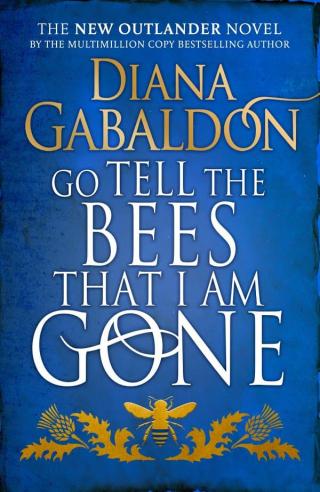
Go Tell the Bees That I Am Gone
- Автор: Гэблдон Диана
- Серия: Outlander #9
- Год: 2021
- Язык: английский
- Год: Delacorte Press
- ISBN: 978-1-473-51900-8
- Жанр: Исторические приключения

Электронная книга - «Go Tell the Bees That I Am Gone». Краткое содержание книги:
The past may seem the safest place to be . . . but it is the most dangerous time to be alive. . . .
Jamie Fraser and Claire Randall were torn apart by the Jacobite Rising in 1746, and it took them twenty years to find each other again. Now the American Revolution threatens to do the same. It is 1779 and Claire and Jamie are at last reunited with their daughter, Brianna, her husband, Roger, and their children on Fraser’s Ridge. Having the family together is a dream the Frasers had thought impossible. Yet even in the North Carolina backcountry, the effects of war are being felt. Tensions in the Colonies are great and local feelings run hot enough to boil Hell’s teakettle. Jamie knows loyalties among his tenants are split and it won’t be long until the war is on his doorstep. Brianna and Roger have their own worry: that the dangers that provoked their escape from the twentieth century might catch up to them. Sometimes they question whether risking the perils of the 1700s—among them disease, starvation, and an impending war—was indeed the safer choice for their family. Not so far away, young William Ransom is still coming to terms with the discovery of his true father’s identity—and thus his own—and Lord John Grey has reconciliations to make, and dangers to meet . . . on his son’s behalf, and his own. Meanwhile, the Revolutionary War creeps ever closer to Fraser’s Ridge. And with the family finally together, Jamie and Claire have more at stake than ever before.
“Well, my price is a dollar a pound. I sell for hard cash, and I don’t bargain.”
“Don’t you,” Bree said dryly. She reached into the pouch at her waist and came out with one of the thin gold slips that she’d sewn into her hems when she and the kids had come to find Roger. And she said a silent, absentminded prayer of thanks that they had found him, as she’d done a thousand times since.
“It’s not exactly cash, but it’s maybe hard enough?” she said, handing it over.
Mrs. Patton’s sandy eyebrows rose to the edge of her cap. She took the slip gingerly, felt its weight, and glanced sharply at Bree. To Brianna’s delight, she actually bit it, then looked critically at the tiny dent in the metal. It was stamped, but beyond the 14K and 1 oz., she didn’t think the markings would mean anything to Mrs. Patton, and apparently they didn’t.
“Done,” said the gunpowder mistress. “How many?”
AFTER SCRUPULOUS WEIGHING of both powder and gold, they agreed that one slip of gold was the fair equivalent of twenty dollars, and Brianna shook hands with Mrs. Patton—who appeared bemused but not shocked at the gesture—and made her way back to the wagon, carrying two ten-pound kegs of powder, followed by the two cousins, each similarly burdened.
Her father was still talking with Mr. Shelby but, hearing footsteps, turned round. His eyebrows rose higher than Mrs. Patton’s.
“How much—” He broke off and, pressing his lips together, took the kegs from her and loaded them into the wagon, along with the bags of rice, beans, oats, and salt that they’d traded for in Woolam’s Mill.
Finished, he reached for the sporran at his waist, but one of the cousins shook his head.
“She’s paid already,” he said, and with a brief tilt of the head toward Bree, turned and went back to the milling shed, followed by the other young man, who spared a look over his shoulder, then hurried to catch up with his cousin, saying something to him in a low voice that made the first man glance back again, then shake his head.
Her father said nothing until they were well out on the road toward home.
“What did ye use for money, lass?” he asked mildly. “Did ye happen to bring a bit when ye … came?”
“I had some coins—what I could get without too much fuss and expense—”
He nodded approvingly at that, but stopped abruptly when she withdrew another gold slip—it barely qualified to be called an ingot—from her pouch.
“And I got thirty of these, and sewed them into our clothes and the heels of my shoes.”
Her father said something that she didn’t understand in Gaelic, but the look on his face was enough.
“What’s wrong with that?” she asked sharply. “Gold works anywhere.”
He inhaled sharply through his nose, but the added oxygen seemed to be enough to enable him to get a grip on himself, for his jaw relaxed and the color in his face receded a little.
“Aye, it does.” The fingers of his right hand twitched briefly, then stopped as he shifted the reins a little.
“The trouble, lass,” he said, eyes fixed on the road ahead, “is just that. Gold does work everywhere. That’s why everyone wants it. And in turn, that’s why ye dinna want it to be widely known that ye have it—let alone in any quantity.” He turned his head toward her for a fraction of a moment, one eyebrow raised. “I would ha’ thought … I mean, from what ye told me about yon Rob Cameron … I thought ye’d know that.”
The quiet admonition made a hot flush burn up from chest to scalp, and she closed her fist around the slip of gold. She felt like an idiot, but also unfairly accused.
“Well, just how would you go about spending gold, then?” she demanded.
“I don’t,” her father said bluntly. “I try never to touch what’s hidden. For the one thing, I dinna feel it’s truly mine, and I’ll use it only in case of urgent need, to defend my family or tenants. But even then, I dinna use it directly.”
He glanced over his shoulder, and perforce, so did she. They’d left Patton’s well behind by now, and the road—a well-traveled one—lay empty.
“If I have to use it—and I will have to, if I’m to equip a militia—I shave bits away and pound them into small nuggets, rubbed in dirt and wiped down. Then I send Bobby Higgins, Tom MacLeod, and maybe one or two of the other men I’d trust with my family’s lives, each with a bittie pouchful. Not at the same time, not to the same place, and seldom to the same place twice. And they’ll change it, bit by bit, into cash—buying something and getting back the change in coin, maybe selling a nugget or two outright to a jeweler, changing a bit more with a goldsmith … and the money they bring back, that’s what I spend. Cautiously.”
That “trust with my family’s lives” made a hard nugget in her stomach. It was all too easy to see, now, the risk to which she’d just exposed Jem and Mandy and Roger and all the other inhabitants of the New House.
“Ach, dinna fash,” her father said, seeing her distress. “It’ll likely be fine.” He gave her a half smile and a brief squeeze of the knee. The horses were moving along at a much brisker pace now, and she realized that he was trying to get as far as he could away from the Powder Branch before nightfall.
“Do you …” The words died in her throat, drowned by the wagon’s rattle, and she tried again. “Do you think the men there”—she gestured behind them—“would come after us?”
He shook his head and leaned forward, intent on his driving.
“Not likely. The Pattons ken our business is worth more to them than what we carry. But I’d bet money one or another of the young ones will say something about the braw lassie in men’s clothes wi’ a purse of gold at her belt. It’s just luck whether they say it to anyone who might be moved to come and visit us—and we’ll pray they don’t.”
“Yes.” The first rush of shock and anger was passing, and she felt light-headed. Then she remembered something else that felt like a punch in the stomach.
“What?” Her father sounded alarmed; she’d made a noise as though she really had been punched. He was slowing the horses, and she waved her hands and shook her head.
“I’m—it’s just … they know who you are. Mrs. Patton recognized you.”
“Who I am? I told them who I am.” He’d slowed the horses further in order to hear what she had to say, though.
“She knows you’re Red Jamie,” she blurted.
“That?” He looked surprised but not worried. Slightly amused, in fact. “How the devil did she come to ken that? The lass is younger than you; she wasna born the last time someone called me that.”
She told him about Mrs. Patton’s uncles, and the broadsheet.
“Evidently you still look like you might have done the sorts of things that would get your picture on a Wanted poster,” she said, with a feeble attempt at humor.
“Mmphm.”
He’d slowed the horses to a walk, and the respite from the shaking and noise calmed her. She stole a glance at him; he didn’t look angry anymore—not even upset. Just thoughtful, with an expression she thought might be described as rueful.
“Mind,” he said at last, “it’s nay a good thing to have done the sorts of things that earn ye a reputation as a madman that kills without thought or mercy. But looked at from the other side—it’s nay altogether a bad thing to have such a reputation.”
He clicked his tongue to the horses and they slowly moved into a trot and then faster. The sense of urgency seemed to have left him, though. She watched him, sidelong, relieved that he wasn’t worried about being known as Red Jamie—and more relieved that the fact that he was known seemed to have made him less anxious about the gold.