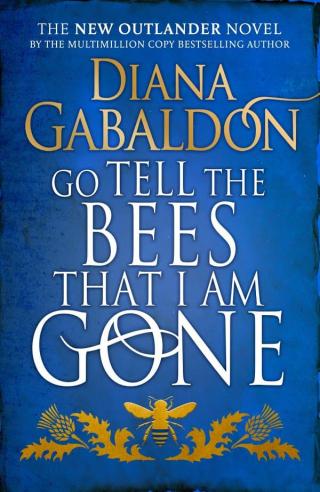
Go Tell the Bees That I Am Gone
- Автор: Гэблдон Диана
- Серия: Outlander #9
- Год: 2021
- Язык: английский
- Год: Delacorte Press
- ISBN: 978-1-473-51900-8
- Жанр: Исторические приключения

Электронная книга - «Go Tell the Bees That I Am Gone». Краткое содержание книги:
The past may seem the safest place to be . . . but it is the most dangerous time to be alive. . . .
Jamie Fraser and Claire Randall were torn apart by the Jacobite Rising in 1746, and it took them twenty years to find each other again. Now the American Revolution threatens to do the same. It is 1779 and Claire and Jamie are at last reunited with their daughter, Brianna, her husband, Roger, and their children on Fraser’s Ridge. Having the family together is a dream the Frasers had thought impossible. Yet even in the North Carolina backcountry, the effects of war are being felt. Tensions in the Colonies are great and local feelings run hot enough to boil Hell’s teakettle. Jamie knows loyalties among his tenants are split and it won’t be long until the war is on his doorstep. Brianna and Roger have their own worry: that the dangers that provoked their escape from the twentieth century might catch up to them. Sometimes they question whether risking the perils of the 1700s—among them disease, starvation, and an impending war—was indeed the safer choice for their family. Not so far away, young William Ransom is still coming to terms with the discovery of his true father’s identity—and thus his own—and Lord John Grey has reconciliations to make, and dangers to meet . . . on his son’s behalf, and his own. Meanwhile, the Revolutionary War creeps ever closer to Fraser’s Ridge. And with the family finally together, Jamie and Claire have more at stake than ever before.
“He was an historian,” I said firmly, refusing to turn my head and look behind me. “He wouldn’t—he couldn’t—falsify anything, any more than Roger could change what’s in the Bible. Or you tell me a deliberate lie.”
“And you of all people ken what history is,” he said bluntly, and stood up, knees cracking. “As for lying … everyone does that, Sassenach, if not often. I’ve certainly done it.”
“Not to me,” I said. It wasn’t a question and he didn’t answer it.
“Fetch a bowl, aye?”
He picked up the basin and moved out into the yard, where the wind caught at his shirt and belled the cloth out behind him. The clouds were boiling up behind the mountains, and the smell of rain was sharp on the wind. It wouldn’t be long.
I stood, feeling very strange, and turned. The front door was standing open, empty, its canvas covering pushed aside. I felt the wind whoosh past me, moving in my skirts, and heard it go down the hall and into the rooms before me, rattling the small glass jars in my surgery, flapping papers in Jamie’s study.
On my way to the kitchen, I glimpsed Frank’s book, lying on the table in Jamie’s study, and on impulse—glancing involuntarily over my shoulder, though I was quite alone—I stepped in.
The Soul of a Rebeclass="underline" The Scottish Roots of the American Revolution. By Franklin W. Randall, PhD.
Jamie had left the book open, facedown. He never treated books like that. He would use anything for a bookmark—leaves, bird’s feathers, a hair ribbon … once I had opened a book he was reading to find the small dried body of a skink that someone had stepped on. But he always closed a book, careful of the binding.
Frank stared up at me from the back cover, calm and inscrutable. I touched his face, very gently, through the clear plastic cover, with a feeling of distant grief, regret mingled with—why not be honest now? There was no need to keep secrets from myself—relief. It was finished.
Oddly, the feeling of someone standing behind me had vanished when I came into the house.
I picked the book up to close it, and glanced inside as I did so. Chapter 16, said the title at the top of the page. Partisan Bands.
I fetched the big creamware bowl Jamie had brought me from Salem and took it outside, not glancing at the book—now properly closed on the desk—but well aware of it.
Jamie began the winnowing, taking a handful from the basin, pouring the mix of peanuts and debris from one hand to the next and back again, letting the bits of shell and skin fly away as the heavier peanuts dropped with a small ting-ting-ting! into the bowl. The wind was strong enough—it would be too strong in a bit, and start blowing away the nuts as well. I sat down on the ground by the bowl and began to pick out any last fragments of shell that had fallen with the cleaned nuts.
“You’ve read the book, then?” I asked after a moment, and he nodded, not looking at me. “What do you think of it?”
He made another Scottish noise, shook the last of the peanuts clinking into the bowl, and sat down on the grass beside me.
“I think the bastard wrote it for me, is what I think,” he said bluntly.
I was startled. “For you?”
“Aye. He’s talking to me.” He raised one shoulder, self-conscious. “Or at least I think he is. Between the lines. I mean … it might only be as I’m losin’ my mind. That’s maybe more likely. But …”
“Talking to you … as in, the, um, text seems personally relevant?” I asked carefully. “It couldn’t help but be, could it? Given where and when we are just now, I mean.”
He sighed and twitched his shoulders, as though his shirt was too tight—which it wasn’t; it was billowing over his shoulders like a sail in the wind. I hadn’t seen him do that in a long time, and a crawling anxiety tightened my chest.
“He’s—it’s—” He shook his head, looking for words. “He’s talking to me,” he repeated doggedly. “He kens who I am—who I am,” he said with emphasis and looked at me, his eyes dark blue. “He kens it’s the Scotsman that took his wife from him and he’s talkin’ directly to me. I can feel him, as if he stood behind me, whispering in my ear.” I flinched, violently, and he blinked, startled.
“That sounds … unpleasant,” I said. The tiny hairs prickled along my jaw.
The corner of his mouth turned up. He stopped what he was doing and took my hand, and I felt better.
“Well, it’s a mite unsettling, Sassenach. I dinna mind it, exactly—I mean, surely to God he has the right to say things to me if he likes. It’s only … why?”
“Well …” I said slowly. “Maybe … perhaps … for us?” I nodded toward the distant creek, where Jem and Germain and Mandy and Fanny were evidently catching leeches, with a good deal of shrieking. My lips felt dry, and I licked them briefly.
“I mean—we think, don’t we, that he found out? About you not dying, I mean. And maybe that he knew or guessed that Bree would come back looking for you. Maybe he … found me, too. In history, I mean.” Speaking the words made me feel quite hollow. The thought of Frank discovering something—God knew what—about me in the maelstrom of scattered documents. And making up his mind—while I was still right there with him, dammit!—not to tell me—and to find out more.
“He hasn’t—mentioned me, has he? In the book?” I forced the words out, just above the sound of the wind. A cold drop struck my cheek, and four large dark spots appeared instantly on my apron.
“No,” Jamie said, and rose to his feet, reaching down a hand to me. “Come inside, a nighean, it’s starting to rain.”
We barely made it into the house with the basin, the bowl, and our peanut crop—followed in short order by Germain, Jemmy, Fanny, Mandy, Aidan McCallum, and Aodh MacLennan, splattered with rain and with arms full of wet vegetables from the garden.
What with one thing and another—grinding the peanuts, putting the risen bread to bake, washing dirt from the young turnips, saving the greens in a bowl of cold water to keep them from wilting, handing fresh small knobby carrots out to the children, who ate them like candy, then slicing the fresh bread and assembling sandwiches, while roasting sweet potatoes in the ashes and making a warm bacon dressing for the cooked greens—there was no further conversation between me and Jamie about Frank’s book. And if anyone stood behind me, he was considerate enough to give me elbow room.
IT WENT ON raining through supper, and after ascertaining that the McCallums and the MacLennans wouldn’t be worrying where their boys were, Jamie brought down the mattresses and all of the children bedded down together in a damp, warm heap before the hearth.
Jamie had made a fire in our bedroom, and the scent of dried fir kindling and hickory wood overlaid the lingering turpentine scent of the fresh timbers. He was lying on the bed, clad in his nightshirt and smelling pleasantly of warm animals, cold hay, and peanut butter, and thumbing idly through my Merck Manual, which I’d left on the bedside table.
“Trying the Sortes Virgilianae, are you?” I asked, sitting down beside him and shaking my hair loose from its knot. “Most people use the Bible for that, but I suppose Merck might do just as well.”
“Hadna thought of that,” he said, smiling, and closing the book, handed it to me. “Why not? You choose, then.”
“All right.” I weighed the book in my hands for a moment, enjoying the tidy heft of it and the feel of the pebbled cover under my fingertips. I closed my eyes, opened the book at random, and ran my finger down the page. “What have we got?”