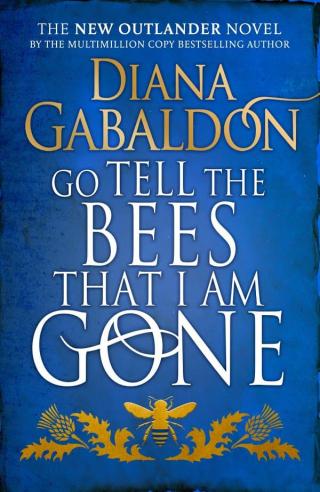
Go Tell the Bees That I Am Gone
- Автор: Гэблдон Диана
- Серия: Outlander #9
- Год: 2021
- Язык: английский
- Год: Delacorte Press
- ISBN: 978-1-473-51900-8
- Жанр: Исторические приключения

Электронная книга - «Go Tell the Bees That I Am Gone». Краткое содержание книги:
The past may seem the safest place to be . . . but it is the most dangerous time to be alive. . . .
Jamie Fraser and Claire Randall were torn apart by the Jacobite Rising in 1746, and it took them twenty years to find each other again. Now the American Revolution threatens to do the same. It is 1779 and Claire and Jamie are at last reunited with their daughter, Brianna, her husband, Roger, and their children on Fraser’s Ridge. Having the family together is a dream the Frasers had thought impossible. Yet even in the North Carolina backcountry, the effects of war are being felt. Tensions in the Colonies are great and local feelings run hot enough to boil Hell’s teakettle. Jamie knows loyalties among his tenants are split and it won’t be long until the war is on his doorstep. Brianna and Roger have their own worry: that the dangers that provoked their escape from the twentieth century might catch up to them. Sometimes they question whether risking the perils of the 1700s—among them disease, starvation, and an impending war—was indeed the safer choice for their family. Not so far away, young William Ransom is still coming to terms with the discovery of his true father’s identity—and thus his own—and Lord John Grey has reconciliations to make, and dangers to meet . . . on his son’s behalf, and his own. Meanwhile, the Revolutionary War creeps ever closer to Fraser’s Ridge. And with the family finally together, Jamie and Claire have more at stake than ever before.
Footsteps behind me interrupted my literary thoughts and I turned to see Jamie, barefoot and rumpled, tucking his spectacles back into his sporran.
“Enjoying your reading?” I asked, smiling.
“Aye.” He sat down beside me and picked a peanut out of the basin, cracked it, and tossed the nuts into his mouth. “Brianna says Dr. Seuss made a good many books. Have ye read them all, Sassenach?” He pronounced it “Soyce,” in correct German, and I laughed.
“Oh, yes. Many times. Bree had the whole set—or at least as many as were published then. I suppose she and Roger might have bought more for Jem and Mandy, if Dr. Seuss—the Americans say his name ‘Soos,’ by the way—if he went on writing. I don’t know how long he lived—will live,” I corrected. “He was still at it in 1968.”
He nodded, a little wistful.
“I wish I could see them,” he said. “But maybe Brianna will remember some o’ the rhymes, at least.”
“Ask Jem,” I suggested. “Bree says he’s read to Mandy since she was a baby, and he has an excellent memory.” I laughed, thinking of some of the Seuss illustrations. “Ask Bree if she can draw Horton the Elephant or Yertle the Turtle for you, from memory.”
“Yertle?” His face lighted with humor. “That’s no a real name, is it?”
“No, but it rhymes with ‘turtle.’” I cracked another nut and tossed the bits of shell into the grass.
“So does Myrtle,” he pointed out.
“Yes, but Yertle is a boy. No female turtle would have done what he did.”
Jamie was diverted; he paused with his hand in the basin.
“What did he do?”
“Made all of the turtles in Sala-ma-Sond build themselves into a tower so he could be King of all that he saw by sitting on top of them. It’s an allegory about arrogance and pride. Not that females aren’t capable of those emotions—just that they wouldn’t do anything so easily illustrated.”
Jamie picked up a handful of peanuts and crushed them absentmindedly, nodding.
“Aye? And what sort of allegory is yon Green Eggs and Ham?” he demanded.
“I think it’s intended to urge children not to be fussy about what they eat,” I said dubiously. “Or not to be afraid of trying new th— What are you doing?” For he’d dropped his handful of crushed peanuts into the basin, shells and all.
“Helping you,” he said, taking another handful. “You’ll be about that all day, Sassenach, doing it one at a time.” He crushed the second handful and dropped it, debris and all, into the basin.
“But picking all the shells out of there will—”
“We’ll winnow them,” he interrupted, turning and pointing with his chin toward the distant flank of Roan Mountain. “See the wind walkin’ down through the trees? There’s a storm a-boil.”
He was right: clouds were gathering behind the peak; the patches of pale aspen on the slope flickered as the rising wind touched their leaves, and the pines rippled in deep-green waves. I nodded and picked up several nuts to crush between my palms.
“Frank,” Jamie said abruptly, and I stopped dead. “Speakin’ of books …”
“What?” I said, not at all sure I’d just heard him say “Frank.” He had, though, and a small sense of unease coiled up at the base of my spine.
“I need ye to tell me something about him.” His attention was fixed on the basin of peanuts, but he wasn’t being casual about it.
“What?” I said again, but in an entirely different tone. I brushed peanut skins slowly off my skirts, my eyes on his face. He still wasn’t looking at me, but his mouth compressed briefly as he crushed a fresh handful.
“The picture of him on his book—the photograph. I was only wondering, how old was he when that likeness was made?”
I was surprised, but considered.
“Let me see … he was sixty when he died …” Younger than I am now … My lower lip tucked in for a moment, quite involuntarily, and Jamie looked at me sharply. I looked down and brushed away more peanut fragments.
“Fifty-nine. He had that photograph taken for that particular book cover; I remember, because he’d used the same photograph—a different, older one, I mean—for at least six books before that, and he joked that he didn’t want people meeting him for the first time to be looking over his shoulder for a man half his age.” I smiled a little, remembering, but met Jamie’s eyes, feeling slightly wary. “Why do you ask?”
“I used to wonder—sometimes—what he looked like.” He looked down and reached into the basin, but with the air of a man looking for something distracting to do. “When I’d pray for him.”
“You prayed for him?” I didn’t try to hide the amazement in my voice, and he glanced at me, then away.
“Aye. I—well, what else could I do for anybody then, but pray?” There was a tinge of bitterness to this; he heard it himself and cleared his throat. “‘God bless you, ye bloody Englishman!’ is what I’d say. At night, ken, when I thought of you and the bairn.” His mouth tightened for an instant, then relaxed. “I’d wonder what the bairn looked like, too.”
I reached out and closed my hand on his wrist, big and bony, his skin cold from the wind. He stopped crushing nuts and I squeezed his wrist, gently. He let out his breath and his shoulders relaxed a little.
“Does Frank look like you thought he did?” I asked curiously. I took my hand off his wrist and he picked up another handful of peanuts.
“No. Ye never told me what he looked like …” For bloody good reason. And you never asked, I thought. Why now?
He shrugged, and the twitch returned to his mouth, but now with a hint of humor.
“I liked thinkin’ of him as a short-arsed wee man, maybe losing his hair and soft round the middle.” He glanced at me and shrugged. The twitch had returned again. “I thought he was intelligent, though—ye wouldna have loved a stupid man. And I got the spectacles right. Though I thought they’d have gold rims, not black. Horn, are they? Or dark tortoiseshell?”
I gave a small, amused snort. Still, the sense of unease was back.
“Plastic. And no, he wasn’t stupid.” Not at all. And gooseflesh rippled briefly across my shoulders.
“Was he an honest man?” A soft crunch, the patter of peanuts and broken shells into the tin basin. The air was beginning to smell of oncoming rain and the rich, oily sweetness of peanuts.
“In most ways,” I said slowly, watching Jamie. His head was bent over the basin, intent on his work. “He kept secrets. But so did I.” Love has room for secrets—you said that to me once. I didn’t think there was room between us now for anything but the truth.
He made a small Scottish sound in the back of his throat; I couldn’t tell what he meant by it. He dropped the last handful of mangled shell into the basin and looked up to meet my eyes.
“Can I trust him, do ye think?” The clouded sky was still bright, and he was dark against it, wisps of hair flying free around his head. I shivered briefly, and my stomach shrank with the absurd but absolute conviction that someone was standing behind me.
“What do you mean?” I was on edge, and it showed in my voice. “You did trust him, didn’t you? With—us. Me and Brianna.”
“I hadn’t a choice about that, aye? Now I do.” He straightened, rubbing his palms together, and the last fragments of peanut skin whirled away in the strengthening wind.
I drew a deep breath to keep my voice from shaking, and brushed bits of shell off my bodice. “Now you do? You mean you’re wondering whether you can believe what he wrote in that book?”
“I am.”