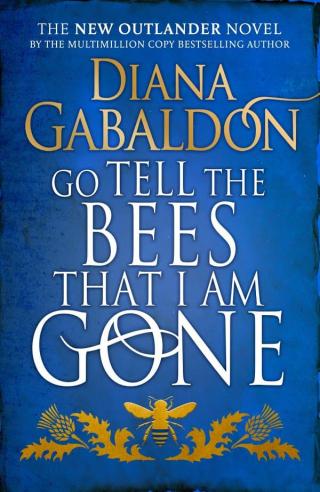
Go Tell the Bees That I Am Gone
- Автор: Гэблдон Диана
- Серия: Outlander #9
- Год: 2021
- Язык: английский
- Год: Delacorte Press
- ISBN: 978-1-473-51900-8
- Жанр: Исторические приключения

Электронная книга - «Go Tell the Bees That I Am Gone». Краткое содержание книги:
The past may seem the safest place to be . . . but it is the most dangerous time to be alive. . . .
Jamie Fraser and Claire Randall were torn apart by the Jacobite Rising in 1746, and it took them twenty years to find each other again. Now the American Revolution threatens to do the same. It is 1779 and Claire and Jamie are at last reunited with their daughter, Brianna, her husband, Roger, and their children on Fraser’s Ridge. Having the family together is a dream the Frasers had thought impossible. Yet even in the North Carolina backcountry, the effects of war are being felt. Tensions in the Colonies are great and local feelings run hot enough to boil Hell’s teakettle. Jamie knows loyalties among his tenants are split and it won’t be long until the war is on his doorstep. Brianna and Roger have their own worry: that the dangers that provoked their escape from the twentieth century might catch up to them. Sometimes they question whether risking the perils of the 1700s—among them disease, starvation, and an impending war—was indeed the safer choice for their family. Not so far away, young William Ransom is still coming to terms with the discovery of his true father’s identity—and thus his own—and Lord John Grey has reconciliations to make, and dangers to meet . . . on his son’s behalf, and his own. Meanwhile, the Revolutionary War creeps ever closer to Fraser’s Ridge. And with the family finally together, Jamie and Claire have more at stake than ever before.
Jamie shook his head, not in negation, but resignation.
“It doesna matter, Sassenach. If there were others who escaped … most would be wise enough to leave and stay gone. But it doesna matter—another gang will spring up. It’s the way of things, aye?”
“Is it?” I thought he was right—I knew he was right, in terms of wars, governments, human foolishness in general. I just didn’t want to believe it was true of this place. This was home.
He nodded, watching my face, not without sympathy.
“Remember Scotland—the Watch?”
“Yes.” The Watches, he might have said, for there were many. Organized gangs, who extorted money for protection—but sometimes gave that protection. And if they didn’t get their money—black rent, it was called—might burn your house or crops. Or do worse.
I thought of the cabin Jamie and Roger had found, a burnt shell, with the owners hanged from a tree before the house—and a young girl alive in the ashes, so badly burnt that she couldn’t live. We never discovered who had done it.
Jamie could see the thoughts cross my face. I might as well have a neon sign on my forehead, I thought crossly, and evidently he saw that one, too, for he smiled.
“There’s no law now, Sassenach,” he said. “Not wi’ the government gone.” There was neither fear nor passion in that statement—it was merely the truth of the matter.
“There never has been, up here. None but you, I mean.” That made him laugh, but I was just as right as he was.
“I didna come to rescue you alone, aye? That night?”
“No,” I said slowly. “You didn’t.” All the able-bodied men on the Ridge had answered his call for help and come out to follow him. Very much as his clansmen would have followed him to war, had we been in Scotland.
“So,” I said, taking a deep breath. “Those are the men you mean to … er … gang oot with?”
He nodded, looking thoughtful.
“Some of them,” he said slowly, and then glanced at me. “It’s different now, a nighean. There are men who were with me that night who willna follow me now, because they’re King’s men—Tories and Loyalists. The men who’ve kent me longest dinna mind so much that I was a rebel general—but there are a good many new tenants who dinna ken me at all.”
“I’m not sure that ‘Rebel General’ is a title you can lose,” I said.
“No,” he said, and smiled, though not with much humor. “Not without turning my coat. Aye, well.” He got to his feet and reached down a hand to pull me up in a rustle of leaves. “I’ve been a traitor for a long time, Sassenach, but I’d rather not be a traitor to both sides at once. If I can help it.”
Shouts and barking rang out from the trail above; the children had reached Ian’s house. We hurried after them and said no more of gangs, treason, or fat men in the dark.
20
I Bet You Think This Song Is about You …
NO ONE WENT TO the Old Garden, as the family called it. The people on the Ridge called it the Witch-child’s Garden, though not often in my hearing. I wasn’t sure whether “witch-child” was meant to refer to Malva Christie herself or to her baby boy. Both of them had died in the garden, in the midst of blood—and in my company. She had been no more than nineteen.
I never said the name aloud, but to me, it was Malva’s Garden.
For a time, I hadn’t been able to go up to it without a sense of waste and terrible sorrow, but I did go there now and then. To remember. To pray, sometimes. And frankly, if some of the more hidebound Presbyterians of the Ridge had seen me on some of these occasions, talking aloud to the dead or to God, they would have been quite sure they had the right name, but the wrong witch.
But the woods had their own slow magic and the garden was returning to them, healing under grass and moss, blood turning to the crimson bloom of bee balm, and its sorrow fading into peace.
Despite the creeping transformation, though, some remnants of the garden remained, and small treasures sprang up unexpectedly: there was a stubbornly thriving patch of onions in one corner, a thick growth of comfrey and sorrel fighting back against the grass, and—to my intense delight—several thriving peanut bushes, sprung up from long-buried seeds.
I’d found them two weeks before, the leaves just beginning to yellow, and dug them up. Hung them in the surgery to dry, plucked the dry peanuts from the tangle of dirt and rootlets, and roasted them in the shell, filling the house with memories of circuses and baseball games.
And tonight, I thought, tipping the cooled nuts into my tin shelling basin, we’d have peanut butter and jelly sandwiches for supper.
THERE WAS A breeze on the porch, and I was grateful for it on my face after the heat of sun and hearth. Also a little welcome solitude: Bree had gone with Roger to call upon the tenants I still thought of as the fisher-folk—emigrants from Thurso, a dour lot of rock-ribbed Presbyterians who were deeply suspicious of Jamie as a Catholic, and much more of me. I was not only a Catholic but a conjure-woman, and the combination unsettled them to no little degree. They did like Roger, though, in a grudging sort of way, and the liking seemed reciprocal. He understood them, he said.
The children had done their chores and were scattered to the four winds; I heard their voices now and then, giggling and shrieking in the woods behind the house, but God only knew what they were doing. I was just pleased that they weren’t doing it right in front of me.
Jamie was in his study, enjoying his own solitude. I’d passed by, carrying my big basin of peanuts outside, and seen him leaning back in his chair, spectacles on his nose, deeply absorbed in Green Eggs and Ham.
I smiled at the thought, and pulled off the ribbon to loosen my hair so the cool breeze could blow through it.
We’d lost nearly all of our books in the fire that consumed the Big House, but were beginning to build up our tiny library again. Brianna’s contributions had nearly doubled it. Aside from the books she’d brought—and thought of my precious Merck Manual still gave me a small thrill of possession—we had Jamie’s small green Bible, a Latin grammar, The Complete Adventures of Robinson Crusoe (lacking a cover, but retaining most of its vivid illustrations), and Jonathan Swift’s Travels into Several Remote Nations of the World. In Four Parts. By Lemuel Gulliver, First a Surgeon, and then a Captain of Several Ships, plus the odd novel in French or English.
The shells cracked easily, but the dry skins of the peanuts inside were light and papery and clung to my fingers. I’d been brushing them off on my skirt, which now looked as though I’d been attacked by a horde of pale-brown moths. I wondered whether Bree might borrow something interesting to read while she was house-visiting with Roger. Hiram Crombie, the headman of the Thurso folk, was a reading man, though his taste ran to collections of sermons and historical accounts; he thought novels depraved. He did have a copy of The Aeneid, though—I’d seen it.
Jamie had sent a letter to his friend Andrew Bell, an Edinburgh printer and publisher, asking him to send a selection of books, including copies of his own A Grandfather’s Tales and my modest version of do-it-yourself household medicine, applying such monies as might have accrued to us in sales during the last two years toward the purchase of the other books in the order. I wondered when—and whether—those might arrive. So far as I knew, the British still held Savannah, but Charles Town remained in American hands; if Mr. Bell was prompt about it, there was hope of a late ship showing up book-laden before the winter storms.