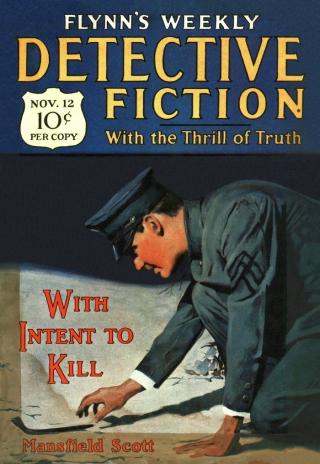
Flynn’s Weekly Detective Fiction. Vol. 28, No. 3, November 12, 1927
- Автор: Alexander R. W., Ames John
- Год: 1927
- Язык: английский
- Год: The Red Star News Company
- Жанр: Другие детективы

Электронная книга - «Flynn’s Weekly Detective Fiction. Vol. 28, No. 3, November 12, 1927». Краткое содержание книги:
“I… I dunno, but I kept gettin’ afraid an’ more afraid that some time it ’ud bum me out, especially since I been havin’ a streak o’ bad luck these last few year. Cows a-dyin’ — m’ best horse a-breaking his leg — that frost o’ two falls ago killin’ m’ corn—”
He paused, did this middle-aged man with a soured, sullen face, and gave a bitter laugh:
“Honest,” he went on, “I come t’ feel so scairy, when that storm started, that I woke Myra and says t’ her we’d better be ready t’ git out if that lightnin’ hit us.
“Yes, sir... yes, sir, boys — an’ it wa’n’t one-two minutes later, so help me, that there comes that crack an’ crash that lit up the whole sky. I… well, when I look out I see why it’s lit up so redlike. The barn was blazin’ — blazin’ right up t’ the east end, at the top where the hayloft is!”
He hesitated again. His laugh, this time, came so bitterly that it stabbed. He turned to the tired-faced, hurt-eyed woman beside him:
“Ain’t that right, Myra?”
“Yes… yes, that’s how it happened, Augustus,” she responded with a sigh, pulling a rather dilapidated wrapper closer about her throat.
“Nope, you can’t beat luck,” stated Borden, seeming to almost take satisfaction in his belief. “You just can’t beat luck, boys!”
One or two of his audience began to cheerfully tell, as men have the habit of doing in all calamities, of other fires they had known — of bigger and better fires, as it were.
Before any single individual could dominate the stage, however, Whitcher Bemis had waddled up with his two hundred and sixty-odd pounds and solemnly confronted Gus:
“No ’nsurance, huh?”
“Why… why, o’ course I got insurance,” Borden almost snarled, “but what in hell good does a’ eight-hundred-dollar insurance do when it comes t’ buildin’ a new barn? My, sheriff, with the price o’ lumber an’ labor at four t’ five a day—”
He threw up his hands and left the answer to the imagination, and Whitcher nodded gravely:
“That’s right, that’s right. Mos’ gen-’rally a feller do hanker t’ build up a burned barn! That’s right, that’s right. Eight hundred dollars wouldn’ go s’ fur! Y’… y’ aim t’ build her up agin, then — that wot y’ mean?”
“Seein’ as I didn’t lose m’ stock I’d sort o’ like t’ put a roof over ’em, with winter comin’ on,” retorted Borden with what was presumed to be deep sarcasm. “On top o’ that, I reckon I got t’ have a place t’ put me some hay an’—”
“Y’ got t’ excuse our Mr. Bemis f’r his lack o’ knowledge when it comes t’ farmin’ an’ sech things. Y’ see, seein’ y’ only been in this neighborhood five-six months, Mr. Borden, y’ don’t know that W’itcher’s a mighty dummed good sheriff.
“That… well, that is, y’ see I mean, when he ain’t a-busy birdin’ ’r troutin’, ’r taken up with this here philat’ly — this here business o’ electin’ postage stamps from furrin countries an’ sech. Ain’t that right, Boyce?”
It was Chet Thomas who had spoken — spoken in his exaggeratedly solicitous drawl. He was indefatigable, he and Boyce Hutchins — indefatigable and fiendishly ingenuous, almost — in running down Bemis stock and boosting that of Ned Hutchins, defeated opposition candidate for the office of sheriff Young Boyce, now, proved that he and his running mate worked in perfect accord.
“Yeah, yeah,” he said, reflectively rubbing his jaw as several titters went through the crowd, “W’itcher’s a plumb cussed dummed good sheriff, when he can spare the time t’ work at it. He’s — why, shucks, he’s right what y ’might call phenom’nal, he is.
“Say… say, Borden, he can do the best dee-tective work y’ ever saw; he can allus find a myst’ry where they almost ain’t. none; he can—”
He broke off suddenly. His face lengthened thoughtfully as he surveyed the ring of amused watchers — and then his eyes lit up and he doubled his right fist and crashed it down into his other palm like a man who is highly excited about having just made a remarkable discovery.
“Dammit… dammit, Chet,” he cried, “but I’ll bet y’ he can find a myst’ry right ’n this here fire!”
They rested on their oars, after that one. Augustus Borden looked questioningly about at the men who had helped him to futilely fight the fire.
Most of them, indeed, also seemed a trifle put out, their faces plainly saying that this was no time to make a jest. They gave their attention, however, to Whitcher Bemis, as they usually did in any crisis.
He, though, went even further in unkindness than the smart young pair of squirts, for he certainly appeared to be deliberately and most unnecessarily hitting a man when he was down.
“Yeah,” he said, pulling out his lip and letting it snap back with a loud plop, “I cal’late y’ sh’u’d ought t’ have a roof over y’r live stock, Borden. Callate it’s plumb — plumb ’mperative, like y’ might put it. Ol’ Gid Loomis hankers t’ have goods he’s got a mortgage on pr’tected, I believe. Loaned y’ two hundred on y’r cattle, didn’ he?”
II
Augustus Borden, consensus of opinion later seemed to have it, had been pretty close to the point of actually attacking Whitcher Bemis. A few of the old timers, however — notably Jeff Moseby and Walt Trowbridge — had stepped in and expertly changed the conversation.
They gravely started in on a discussion of the best type of barn for Borden to build, insisting that the one just burned down had been too big, too unhandy, for modem use, and the owner of the ruins agreed with them.
But the sun was getting well up, by now, and men started drifting away. One fellow, as he walked off, averred that the fire they had witnessed had been as exciting as one they had seen in a news reel down to the Landing last week:
“Noos reel, eh? Pictures, eh? Hmmm… hmmm!”
It was Bemis who had spoken, for the words of the retreating young chap had apparently been heard by him as he had stood there seemingly lost in thought.
He continued, after he had delivered himself, to still appear to be in a mental haze, except that now he was ever so gently caressing his ponderous lower lip as he gazed at the blackened timbers that lay scattered on the ground.
“Pictures, eh?” he said again. “Remin’s me, that do. Feller up here last year, salmon fishin’, sold some pictures — some o’ them kodak photygraphs, that’s all they was — t’ one o’ them Boston daily papers that’s got a page o’ pictures sort o’ called Int’restin’ Happenin’s.
“Tol’ — shucks tol’ me, he did, that any time I saw me somethin’ on-usual t’ snap it with m’ camery ’n’ send it t’ him. Noospaper feller, he were — said he c’d sell ’em f’r me. Got his address some’eres — in m’ desk t’ home.
“Won’er how much they pay? Won’er c’d I — Judas Priest,” he ended up, his eyes widening and shining, “I won’er ’f I c’d git me ’nough t’ buy that there early Bermuda stamp ’r that Internal Revenoo I been wantin’, ’r p’r’aps mebbe—”
His voice trailed off into an unintelligible mumble, at that, and both Mr. and Mrs. Borden, who had lived in the region a mere six or seven months, looked at him as the average person does when they have suddenly concluded that they are in the company of a half-wit.
The natives who had lingered on, though, planted their feet solidly and tried for comfortable positions, for when the sheriff started off on either stamps or birds or trout there was no telling what he would do or say. They waited eagerly — but at least they learned nothing more about philately.