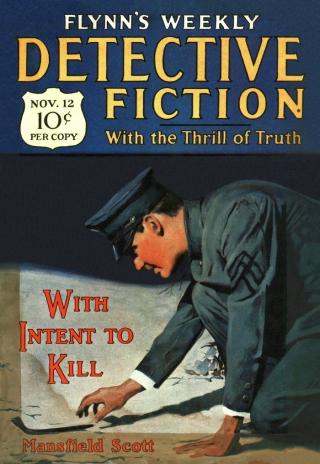
Flynn’s Weekly Detective Fiction. Vol. 28, No. 3, November 12, 1927
- Автор: Alexander R. W., Ames John
- Год: 1927
- Язык: английский
- Год: The Red Star News Company
- Жанр: Другие детективы

Электронная книга - «Flynn’s Weekly Detective Fiction. Vol. 28, No. 3, November 12, 1927». Краткое содержание книги:
“Yeah, I knowed that,” Whitcher gravely nodded, his eyes wide and solemn. “Jest wanted t’ show m’ fr’en’ that there burned barn ’n’ that there path leadin’ t’ it fr’m the house. Y’… y’ know, them same spots w’ere I took me them pictures!”
They idled around, after that, for a good thirty or forty minutes, Whitcher seeming to take a ridiculous sort of interest among the charred pieces of timber that lay scattered about the one portion of wall that was still standing.
He explained this to Mrs. Borden as he was about to leave, although he certainly appeared to be rather ill at ease.
“I… well, I got me a sort o’ hobby, I have,” he said, with much flushing, as he stood in her doorway, and held out his blackened hands with a sheepish laugh. “Like t’ c’lect me ol’ hinges ’n’ pieces o’ iron, the way y’ mebbe heered some o’ them antique bugs do.
“I… shucks, p’r’aps y’ think me sort o’ crazy, but I ’membered that this were a-built ’long time ago, ’n’ that they might be some o’ them hinges—”
He broke off voluntarily, palpably trying to change the subject with a chuckle:
“Say, got a mite o’ kerosene, Mis’ Borden? Han’s be a sight. Like t’ wash ’em off!”
She looked vague and blank, did Myra Borden — vague and blank and yet dazedly worried. Although she had nothing about her throat, her hand went there with the same sort of frightened gesture she had used on the first morning when pulling her wrapper about her. She shook her head negatively, and her voice came after a little gulp:
“No… no, I got gasoline, though, sheriff. Or soap an’ hot water, if you’ll step insi—”
“No kerosene, huh?” Bemis interrupted in a monotonous drawl. “No… no, thanks, Mis’ Borden. On’y like kerosene t’ wash up m’ han’s with w’en I git ’em blacked with burned wood. Thanks… thanks. G’-by!”
“G-good-by, sheriff,” answered the woman, although her voice was a trifle hoarse and her fingers, this time, dug into her throat almost convulsively.
But, when the sheriff of Noel’s Landing had covered about half the distance to his waiting flivver, he suddenly stopped. He and his companion, then, seemed to go into some deep discussion, during which there was much pointing at the barn, at the house itself, even at the path between the two spots.
Finally they must have reached some decision, for they walked back to the dwelling.
“Say, Mis’ Borden,” said Bemis slowly, “tell y’r husban’ w’en he gits back, will y’, that I sh’u’d have me them films back fr’m East Chat’am by to-morrer, all developed ’n’ printed. Tell him — well, tell him I’ll be ’roun’t’ see him with ’em, will y’, ma’am?”
“Ye—”
This tired-faced, hurt-eyed woman, however, couldn’t even complete that single affirmative; she could, only, sink her fingers deeper into her throat and jerkily nod her head.
The keen-eyed man in the city clothes, at that, spoke for the first time. His voice was crisp:
“Very good. Tell Mr. Borden that I’ll be along with Mr. Bemis, too. My name’s Graham — Graham, adjuster for the East Chatham Mutual Insurance Company. Liked to have seen him to-day, but I haven’t the time to wait.
“Still, I’d prefer to see those photographs first, to make sure, although I don’t think there’s any doubt about—”
A kick on the ankle from the sheriff, which was plainly visible to Myra Borden, made him wince and catch his breath. He glared at Whitcher for an instant, but then he turned back to the woman:
“I mean that I don’t think there will be any difficulty about… hmmm, any difficulty about the adjustment, I should have said. Tell Mr. Borden to surely be here, please. Good day, madam!”
She couldn’t even nod her head, now, as Graham and the sheriff walked away.
V
Mr. Bemis had to take a lot more punishment, that Indian summery A.M. That is, it might have been painful to almost any one else, but it slid off the sheriff’s back as water is professed to do from that part of the duck.
It was the women of Noel’s Landing, on this occasion, who got after him. It was, they claimed, a right mean shame for a grown man — although sometimes they didn’t think him grown, a few spitefully averred — to pick on a lone female who was having troubles enough of her own to make both ends meet.
He seemed to forget, they hinted, that women to-day meant something in the vote. It was all right, they stated, to let him go ahead with his fishing and hunting and pesky stamp collecting — they weren’t as fool particular as some of the men folks — but when it came to bothering a woman who was already worried enough, just to fake a few pictures, it was going too far.
Ned Hutchins, they intimated with raised eyebrows, wouldn’t most probably do such things if he were in office. And… well, and it looked as if maybe he were going to be in office, next election.
But Bemis, even with the ladies, had the same answer — more or less — that he had had for the men:
Shucks, he wa’n’t alius thinkin’ o’ votes, he wa’n’t, like mos’ folk seemed t’ think. Judas Priest, no, let Ned Hutchins ponder on them things. W’y, he couldn’t trout now, could he? Wa’n’t no birdin’t’ be did, jest yet, were they?
’N’ these here pictures — well, these here pictures, he were a-hopin’, might ‘low him t’ go ’n’ git hisself some stamps that ’ud enable him t’ git back t’ the peaceful pursuit o’ philat’ly. Shucks… shucks. W’y was they alius a-thinkin’ o’ votes?
Along toward noon, although his amiable face gave no hint of it, he really must have become a trifle fatigued with all this pestering and pestering. Anyway, for one of the very few times in his life he avoided passing the store at the Landing, taking a much longer and roundabout way to flivver to his home on the east shore of Cranberry Lake.
He sat down with a huge sigh of contentment, in his cozy kitchen and living room combined, and dragged the beloved album in which he so neatly kept his cherished collection of stamps.
“Allus soothe a feller’s nerves, y’ do,” he said, perhaps speaking aloud unconsciously as men who have dwelt much alone have the habit of occasionally doing.
For an hour — or a trifle over, rather — the sheriff of Noel’s Landing literally lost himself in the joys of his collection. He gazed at certain rare specimens almost lovingly, in some cases actually rubbing his pudgy fingers over the surfaces with tender affection.
Longingly, too, he would look at various blank spaces on some pages, his face plainly telling that he was wishing he had the wherewithal to purchase the bits of paper that would fill them in.
But, as the clock over the mantel struck one thirty, he closed up his album with a little sigh and carefully replaced it in his desk.
“Sh’u’d ought t’ be ’long ’bout now,” he mused aloud, a slight frown on his brow as he ruminatively rubbed at his ponderously hanging lip that also seemed to so consistently soothe him.
She was. She was, that is, if he had meant Myra Borden. She came in without knocking at the door, did this tired-faced woman from down Hallowell way — came in with a rush, with an hysterical little gasp, with a purplish-red bruise, that had not been there in the morning, showing on a wan cheek.
“Didn’ think he’d go s’ fur ’s t’ strike y’.” said Whitcher, his face softening with pity as he rose to take her arm and assist her to a chair. “Hit y’ w’en y’ kept on insistin’ he sh’u’d ought t’ go ’n’ c’nfess, didn’ he?”