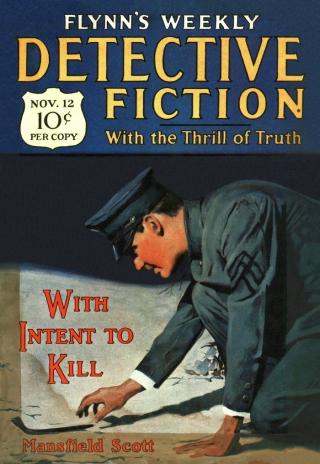
Flynn’s Weekly Detective Fiction. Vol. 28, No. 3, November 12, 1927
- Автор: Alexander R. W., Ames John
- Год: 1927
- Язык: английский
- Год: The Red Star News Company
- Жанр: Другие детективы

Электронная книга - «Flynn’s Weekly Detective Fiction. Vol. 28, No. 3, November 12, 1927». Краткое содержание книги:
Only a few months ago I read in the papers that “the explorer, Robert Brancion, was about to return to France.” There was a long article full of praise of “the famous explorer,” who had been on long expeditions in India, Tibet, and Central Africa. Not wanting to worry papa, I didn’t say anything to him about it.
But one evening I thought I recognized Robert, in the shadow of his gate, watching me go by with gleaming eyes that terrified me. I told papa at once, and then wrote to André. It seemed to me that if André could be with me, I’d have nothing to fear.
His work, moreover, was finished. Papa’s marvelous discovery had been applied in the apparatus his favorite pupil had constructed. Their experiments had been more than satisfactory.
In his first answer, André tried to calm my fears. But when I wrote again, he replied by announcing the result of his researches and said that he was coming to Paris at once.
It was then that this strange drama took place, in which I am the victim or one of the victims, and which I cannot help believing is the work of Robert Brancion.
In the brief case he carried André had his most important papers relating to papa’s discovery and its application. They were calculations, formulas, designs, et cetera. After our first greetings, at the Hall des Pas Perdus, we decided to take the bus that goes by our house.
While we were standing there chatting, I felt a shudder suddenly go over me. It seemed to me that in the crowd of faces about us, I had suddenly met Brancion’s eyes. “Nothing but my imagination,” I thought.
Nevertheless, in the bus I looked anxiously at the faces of all the passengers. Robert was certainly not one of them, and that gave me a sense of relief.
We had passed the Military School and were preparing to get off at the next stop, when I happened to look up mechanically at the window which separated us from the driver’s seat. The driver had turned around, and with his face close to the glass, was looking down at us.
He turned his head away quickly, but I had had time to recognize that metallic glance; they were Robert’s eyes.
This time I was seriously alarmed and gripped André’s arm to tell him what I had seen. But I had hardly opened my mouth when the bus swerved terribly, and made a sharp turn which nearly crushed us against the wall. Everything went dark, and I lost consciousness.
When I came to, I was in this room, where materially I lack nothing, but spiritually I lack everything.
January 15, 19— To-day I have had a piece of great good fortune. I am no longer alone; I have a companion. She is charming. Eighteen years old; named Germaine Praline. I am fond of her.
She tells me that she was in the same bus we were in Tuesday evening. I remember noticing her large eyes, her complexion, and her simple, stylish good taste. It appears that she was with her older sister. She underwent the same sensations I did: shock, fainting, and reawakening in a room not so luxurious as this one but very comfortable.
Of course she doesn’t understand what has happened to her at all, but she resigns herself more easily than I do. The thing that worries her is to be separated from her sister.
As for me, the sound of a human voice and especially her lovely, sympathetic voice, is sweeter than music. I make Germaine talk as much as I can, just for the pleasure of listening to her.
This morning the negro, who is her jailer, too, came into her room and signaled to her to follow him. She hoped that she was going to see her sister and was disappointed to find a stranger; but the delight at escaping from solitude was greater than her disappointment. We get along very well together.
January 16, 19— Germaine works at present in a millinery shop, but she received an excellent education. Her parents died, and she had to go to work.
She is loved by a young man, whom she loves in return and who belongs to the police. She is ardently in hope that her lover will rescue her, and me at the same time. “If you only knew how intelligent he is,” she says, “and how distinguished looking.” I only hope his intelligence will put him on the right track in looking for us!
January 17,19— It is too horrible for me to think about! The hideous offer that man has made me! My head is dizzy, and I can hardly collect my thoughts.
It is Robert Brancion who kidnaped me, and papa and André, too. He came to my prison this morning and boasted of his exploit.
He tries to justify it by saying that he was also working along the lines of papa’s discovery at one time, and that papa merely applied the ideas Brancion developed. Consequently he claims that he is merely taking back his own property when he steals what it has cost papa and André years of labor to create. For the apparatus is actually in his possession now.
That is the most terrible part of it. And he offers to set us all at liberty if I will consent to undergo the radiations of the apparatus and thus forfeit my own freedom of will. What a mocking and incomplete liberty that would be!
Of course I would see my dear ones again, and the light of day. If it only increased the size of my prison, it might at least be better than my present fate.
Germaine will consent to anything to be set free. And Brancion tells me that papa, André, and the other passengers in the bus have already accepted the offer.
I am the only one who is still holding out. The freedom of all the rest depends on me. What shall I do?
Cécile’s manuscript was interrupted at these words, and remained unfinished. No doubt she had eventually accepted this mysterious offer which gave her a “mocking and incomplete liberty,” and had submitted to the radiations of the apparatus.
When he had finished reading, Henri Henry reflected deeply for a long time. Cécile’s diary seemed to confirm his suppositions as to the role played by the “object with a rectangular base,” which was obviously the same as the strange “apparatus” the young girl mentioned so frequently.
At length he said to his friends:
“This Brancion is an egotist and a man of pride above everything else. If he believed that he was rid of us, he would not hesitate to announce Muret’s marvelous invention to the world as his own, and take the glory for it. We must make him think that he is rid of us; I shall see to that myself.”
The next day the Gazette de Paris announced that its “brilliant colleague, Henri Henry,” had been forced to undergo an operation of laparotomy, and had died three hours later.
Chapter XXXV
P-Rays
As soon as the Gazette de Paris had announced the death of Henri Henry, articles began to appear at once in all the Paris papers, detailing his career and expressing the regret of the profession which had lost him.
The reporter’s most brilliant scoops were recalled and Henri himself, reading the articles in the seclusion of Antoine Lisbourdun’s studio, learned of several remarkable exploits in his life of which he had never heard before. His mysterious and tragic end was eloquently regretted, and respectful condolences were offered the young widow.
The latter, reassured by the telegrams in code which Henry sent her every night, read the articles about the living dead man with eager curiosity, and enjoyed the “good press” he was getting.
As one prominent journalist remarked, however, “the first fact about a daily paper is that it must come out every day.” And in order to appear every day, the subjects of information must be infinitely varied. It was inevitable that Henri Henry’s death should be quickly forgotten and replaced by the first novelty that offered any prospect of interest.
This, in fact, was what happened when the Academy of Science received the famous report on the newly discovered P-rays, a report which was destined to overthrow most of the ideas previously held as to “occult” phenomena.