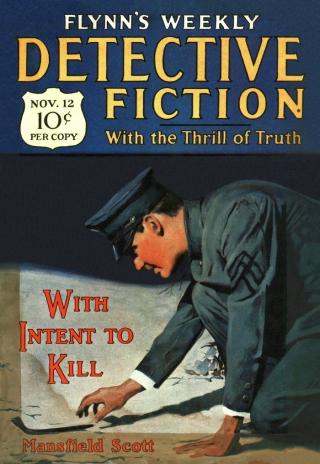
Flynn’s Weekly Detective Fiction. Vol. 28, No. 3, November 12, 1927
- Автор: Alexander R. W., Ames John
- Год: 1927
- Язык: английский
- Год: The Red Star News Company
- Жанр: Другие детективы

Электронная книга - «Flynn’s Weekly Detective Fiction. Vol. 28, No. 3, November 12, 1927». Краткое содержание книги:
An article in the Gazette de Paris explained the matter as follows:
It is commonly recognized to-day that all physical phenomena — light, heat, electricity, et cetera — are in reality the result of movement and are produced by vibrations, traveling like waves through ether, the invisible substance which permeates everything else. If we consider the visible rays of light, we observe that the frequency of the vibrations varies in inverse ratio to the wave-length; that is to say, for example, that red, whose wave-length is the longest of the seven colors of the spectrum, vibrates less rapidly than violet, whose wave-length is the shortest.
This law may also be extended to other radiations, which affect our senses in different ways. Thus, the electric waves which are made use of in wireless telegraphy and are very long, vibrate relatively slowly.
Now, between the rays of light, whose wave lengths are calculated in terms of thousandths of a millimeter, and electrical rays, whose wave length varies from four millimeters to infinity, there is an enormous field which science has barely touched in its studies of the infra-red rays.
What are these various rays whose wavelengths are longer than those of infra-red and shorter than those of electricity?
This was the problem set by the distinguished physicist, Mr. Robert Brancion, who is also, as every one knows, a world traveler, and who has studied the occult sciences of the East as well as the theories of our Western laboratories. After many years he found the solution of the problem, and it is this solution which he explained yesterday before the Academy of Science.
The linking of these words, “Academy of Science,” “distinguished physicist,” and “infra-red rays,” with the words “occult sciences” may seem strange to many readers. It will be understood, however, when it is explained that the rays discovered and studied by Mr. Brancion, whose wave-lengths lie between those of infra-red and those of electricity, though named by Mr. Brancion P-rays, are as a matter of fact, psychic rays.
The tremendous implications of this new concept will be clear to every one. Mr. Brancion, by placing the field of psychic phenomena alongside those of light and electricity as subjects of scientific experiment, has demonstrated that cases of telepathy, thought transmission, suggestion, et cetera, which have been hitherto inexplicable, occur between persons whose psychic rays are strictly identical; that is to say, where the wave-lengths are exactly the same — which, he adds, is extremely rare.
This is the scientific explanation of phenomena known under the name of “occult,” whose apparent supernatural nature has troubled so many minds in the past.
The Academy of Science received Mr. Brancion’s account of his studies at first with a certain skepticism. The clearness and accuracy of this demonstrations, however, eventually overcame this attitude, which was replaced by one of sincere and ardent enthusiasm.
The writer of the article added that he had been informed on good authority that the minister of public instruction had proposed Robert Brancion’s name for the Legion of Honor.
This was followed by an interview with the great man himself, and Brancion’s words were of such a sensational nature that the interview appeared in heavy type.
“Have you searched for a practical application of your discovery?” the reporter had asked.
“Yes, I have invented an apparatus, capable in the first place, of measuring the wavelengths of the P-rays given out by any person willing to take part in the experiment and, secondly, of modifying the characteristic wave-length of that person to any length desired. Thus the latter may, if he wishes, make his own P-ray identical with those of any other individual.
“The two persons who have performed this experiment then enter into permanent mental communication. They are in what I have called ‘psychic resonance’; and just as a musical instrument, which can give forth a certain sound, vibrates when that sound is produced by a different instrument at a little distance from it, so the second person will vibrate in unison when the first gives forth a P-ray; that is to say, when he thinks.
“We have therefore abolished all separation, and attained union in spite of distance, through voluntary and continuous telepathy.”
“Can the possessor of your apparatus put himself in this way in resonance with several individuals at the same time?”
“Certainly. And he can transmit at will certain thoughts to one, and different thoughts to others.”
“What is your apparatus constructed of, and how is it made?”
“You will see that for yourself if you come to the public lecture I am going to give next Tuesday in the main hall at the Sorbonne. There will be questions and answers, and I shall be ready to meet any objections which may be brought forward against my conclusions. The apparatus will be there, and I shall make practical demonstrations.”
In the studio under the roof the three allies, Henry, Brunnel, and Mainfroy, had read Brancion’s interview with intense emotion. In the light of what they had learned from Cécile Muret’s diary, the truth was now unmistakable.
“I thought the news of my death would bring the rascal out of his cautious silence,” said Henry reflectively.
“His pride will be his ruin,” declared Brunnel, and would gladly have expressed a few prime truths on the danger of pride if his companions had permitted.
But Henry continued reflecting out loud:
“What is our next step? We know that the apparatus was invented by Muret, perfected by André Gilbert, and stolen by this scoundrel; shall we denounce him as a thief? We also know that he caused the deaths of the old woman at Saint-Julien-by-the-Sea and the unlucky bus-driver; shall we denounce him as a murderer? Or shall we unmask him in public, since he has the impudence to invite the public to his own triumph?”
“Let’s wait until Tuesday,” suggested Hector. “We can be among the crowd at his lecture and see if there is a chance to take a hand in the performance.”
Chapter XXXVI
The “Object with a Rectangular Base”
Avast crowd was already filing into the main hall at the Sorbonne, the day Brancion was to give his lecture, an hour before the time which had been announced.
The first rows of seats had been reserved for members of the Academy of Science, prominent statesmen, and well known figures of the intellectual and social world. The Minister of Public Instruction, who had promised to come, had sent his excuses at the last moment, saying that he had been taken suddenly ill.
It was whispered, in well-informed quarters, that the minister had received a visit that morning from a mysterious person, and that it was after his conversation with this person that the statesman had decided he was not well.
In spite of his absence, the audience was unusually brilliant. A large number of police supervised the preparations, and tried to prevent the inevitable pushing which takes place when a hundred people wish to get through a door barely large enough for four at the same time. In fact, the police were so numerous that one would have thought orders had been given to guard all the exits.
“You’d think they were trying to arrest a criminal instead of holding a scientific lecture,” said one little man with large spectacles and an umbrella, who found himself uncomfortable under the gaze of so many policemen.
Henri Henry, who was concealed among the crowd at the right hand side of the hall, not far from the platform, and rendered unrecognizable by a false beard, overheard this comment. He could not repress a faintly malicious smile and, turning to Brunnel and Mainfroy, exchanged glances of understanding with them.