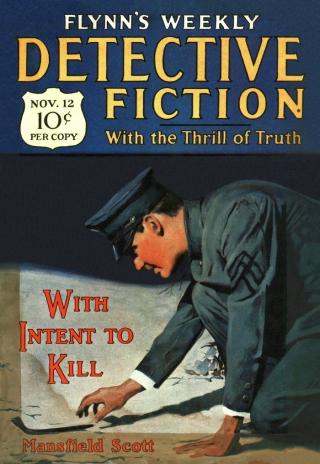
Flynn’s Weekly Detective Fiction. Vol. 28, No. 3, November 12, 1927
- Автор: Alexander R. W., Ames John
- Год: 1927
- Язык: английский
- Год: The Red Star News Company
- Жанр: Другие детективы

Электронная книга - «Flynn’s Weekly Detective Fiction. Vol. 28, No. 3, November 12, 1927». Краткое содержание книги:
Brunnel had had a long conference that same morning with the prefect of police, and Mainfroy was none other than the unknown caller who had seemed to influence the Minister of Public Instruction’s health. Neither of them was surprised, therefore, by the unusual presence of police or the absence of the official.
Not far away from the three men and also near the platform, seven people were sitting together, the passengers and conductor of Bus 519. Professor Muret and his daughter sat side by side, with André Gilbert directly behind them. On his left was Charron, the printer, and on his right the conductor, Chalgrin. The two Praline sisters sat with the scientist and his daughter; Germaine’s hand rested in Cécile’s.
How did it happen that these seven persons, of such different occupations and education, found themselves once more united? This question might perhaps have been answered by Henri Henry, who was keeping a close watch over them.
Suddenly the fluttering of papers and the murmur of conversation in the hall ceased. Two negroes, dressed in livery, had appeared upon the platform, carrying a good-sized box shaped like a small coffin, which appeared to be heavy.
They placed it carefully on the table in the center of the platform, drew out the screws at the corners, and lifted off the lid and sides. Henri Henry murmured in Brunnel’s ear: “The object with a rectangular base.”
The seven escaped victims of Bus 519 had trembled when the box was opened. A realization ran through the whole audience that this was Brandon’s famous “apparatus.” It consisted of a glass case, from which a dozen glass tubes projected. Strange, greenish lights flickered in the tubes and around them. In the walls of the case were several openings large enough for a man to pass his head through them.
A wave of applause swept across the room. Brancion had entered. He was in full dress, and his black beard stood out sharply against the white bosom of his shirt. He glanced over the rows of heads, and his dominating personality at once took command of the audience. In a strong, ringing voice he began his lecture.
But suddenly his voice faltered; he seemed troubled. He had met Muret’s gaze, and the old professor’s eyes expressed such a deep contempt that in spite of his unparalleled effrontery, Robert Brancion was embarrassed.
The presence of those seven persons, whom he had not invited, surprised and alarmed him. He made an instinctive gesture of his hand toward them as if to brush them away. Henry rose halfway from his seat, ready to intervene.
Brancion, however, seemed to have mastered his uneasiness. What did he have to fear from those whose freedom of will he had annihilated? He shrugged his shoulders, smiled scornfully, and continued the explanation of his theory. His embarrassment had been so brief that the public had not been aware of it; Henri Henry settled back in his seat.
The lecturer explained the principles on which he had worked, in a clear, understandable form. The main line of his search and the results obtained had already been suggested in the interview he had given to the Gazette de Paris. He now traced the steps by which he had arrived at his astounding discovery, and even brought up himself the objections that might be made to his reasoning.
The exposition was so logical and precise, and his arguments so firmly dove-tailed that he was given an ovation at the close of the theoretical part of the program. There was a burst of applause, accompanied by a pounding of canes on the floor, and several people stood up in their enthusiasm.
Brancion rested a few minutes before passing to the second part of the program, which was to consist of practical experiments. Henri Henry slipped off the false beard which disguised him, and appeared to be waiting for the proper moment to go into action.
When the acclamations had at length died down, Brancion began the description of his apparatus:
“This glass cage,” he said, “contains in its base several particles of a substance hitherto unknown, which appears to be an element in itself — that is to say, it cannot be broken down by chemical means — and which I brought back with me from Africa. This metal, for it has all the properties of a metal and several others besides, is radioactive. I have named it — as I believe was my privilege — ‘brancium.’ ”
A low murmur of anger interrupted the distinguished scientist’s words at this moment. Professor Muret had risen, and seemed ready to leap upon the platform. His face flushed and his eyes protruding, he opened his mouth, but could not utter any sound except this rumbling of wrath, which drew the curious attention of the crowd.
“The man’s crazy,” said a voice.
“He’s having a fit.”
“Take him out!”
Brancion, however, gazed fixedly at Muret, and made a slight gesture. The old man dropped back into his seat, as if under a control stronger than his own.
When the disturbance caused by this incident had calmed down, the lecturer took up the thread of his speech at the point where it had been broken:
“This ‘brancium,’ as I said, is radioactive, and the rays which it gives out are the P-rays, whose wave-length may be modified, within certain limits, by means of the apparatus which I have constructed. These are the P-rays which we substitute for those emitted by a subject who wishes to transmit his thought to another subject.
“The latter enters into psychic resonance as soon as the ‘brancium’ is released; that is to say, as soon as I have removed the special covering of vegetable tissue, the only substance which is opaque to the brancic rays.
“The twelve glass tubes which you see correspond to twelve radiations of slightly different wave-lengths, which allow me, if I wish, to enter into psychic resonance with twelve different individuals.
“Is there any one present in the audience who would care to come up on the platform and place his head, for a few seconds, in one of the openings, so that one of the tubes may be put in psychic resonance with him?”
It was at this moment that the dramatic event which was later to be the subject of so much discussion, took place.
Before any other member of the audience had had time to answer Brancion’s invitation, Henri Henry had leaped on the platform, and announced:
“I will!”
At the sight of the enemy he believed dead, Brancion’s swarthy face turned pale. Instinctively he glanced about him, as if looking for a means of flight. Then making an effort of will, he controlled his features, and addressing the public, continued:
“Since this gentleman is willing, I shall now perform the experiment I have described to you.” Turning to Henry, he added: “Will you be so kind as to place your head in one of these openings?”
The audience, which was breathless with impatience, waited for “the gentleman who was willing” to stick his head through the hole in the glass. The latter, however, did not seem to be in a hurry.
“I am waiting, sir,” said Brancion.
But Henri Henry, standing erect, his hands in his pockets, and his cane under his arm, declared in a truculent voice, loud enough to be heard throughout the entire auditorium:
“One moment, please. It was announced that the lecture would be. open to the public, and that there would be questions and answers. Now before offering my head for your experiments, I would like to ask one or two questions.”
A booing broke out in the audience and drowned his words. There was a chorus of whistling and insults.
Henry, self-possessed and quiet, waited for the noise to die down. Brancion seemed far more disturbed than the reporter. In a few moments a party began to form which took Henry’s side: “Let him speak. He’s right. There were to be questions and answers.”