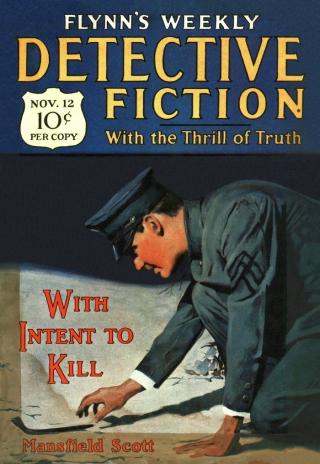
Flynn’s Weekly Detective Fiction. Vol. 28, No. 3, November 12, 1927
- Автор: Alexander R. W., Ames John
- Год: 1927
- Язык: английский
- Год: The Red Star News Company
- Жанр: Другие детективы

Электронная книга - «Flynn’s Weekly Detective Fiction. Vol. 28, No. 3, November 12, 1927». Краткое содержание книги:
“Oh… oh! He hit me so hard! He knocked me down an’ I thought he was goin’ to kill—”
“There, there. Sot down ’n’ rest ’n’ take a mite o’ this,” he said, pouring a tumbler of cool, sweet cider from an earthen pitcher.
She drank it gratefully, and then she rambled out her story — rambled out the story that Bemis had known would not be a particularly pleasant one:
It was not the first beating she had had, she assured him. She had suffered many, many of them during all of the more than twenty years they had been married. She had got most of them, too, for just the same reason she had got this blow to-day.
He was always trying something dishonest, and she was always trying to dissuade him from doing it. This — well, this was only the third time he had set a place on fire, but there were so many other tricks he had done.
He had stolen from stores where he had occasionally worked; he had slyly cheated in every deal into which he had ever entered; he had even descended to breaking into the homes of neighbors, once in awhile, and pilfering such petty things as food.
He had… oh, he had done so much, so much, all through the years, and she came of an honest and upright and God-fearing family, she did, and it nearly killed her to think of it all — had nearly driven her crazy with worry all through those terrible years.
It was too much for her, this time. She knew that Mr. Bemis knew; she hadn’t been fooled by his taking those pictures; she had been certain from the beginning that the Mr. Graham who had called that morning had been some man from the insurance company.
She could see that Augustus at last had jail staring him in the face, and she didn’t want Mr. Bemis or any of the other kind neighbors to think that she had had anything to do with it.
She didn’t care what became of her — she didn’t know, God help her, what was going to become of her — but she’d just come to the end with all this dishonesty, with all those beatings, with… with—
Whitcher Bemis let her go on and on until she had hysterically sobbed herself into a state of exhaustion. Then, with genuinely moist eyes and gentle voice, he promised her that he would see that she found some pleasant means of occupation where life would be kinder to her.
VI
The sheriff of Noel’s Landing kept his word to Myra Borden — and in doing so, ironically, he temporarily annoyed various and sundry of his adherents. He would not divulge how he had first become suspicious of Gus Borden, in fact, until he had found the wife of the man who was now in the East Chatham jail a congenial position as housekeeper to an aged and comfortably fixed couple. And when he finally did spill his story, he… well, politics is politics, after all, as has been so constantly declaimed by so many humans.
He chose a Wednesday evening chicken supper down at the Landing church, where he knew beyond the vestige of a doubt every woman for miles around would be in attendance.
“Cal’late I got a lot o’ you ladies right — oh, sort o’ right down ’n me f’r a spell, didn’ I?” he asked genially as they started to remove the dishes.
“Awful sorry, I were, but I couldn’t help it. A ne’ssary evil, y’ might call it, ’n order t’ do ult’mate good. Do ult’mate good f’r one o’ what some fellers still designates ’s the gentler sex, too, at that!”
Mr. Bemis paused, for a moment, paused and beamed at his audience and winked one eye slowly. It drew a laugh, this did — drew it, mostly, from precisely those from whom he desired it most. The ladies.
“Yep,” he went on, “I reckon I might ’a’ seemed a mite hard ’n Myra Borden, but I knowed it were the on’y thing t’ do so’s t’ git her t’ up ’n’ c’nfess ’n’ furnish the rest o’ the ev’dence I needed t’ go with m’ own b’liefs.
“Be f’r her ult’mate good, like I said, though I guess she must ’a’ suffered some w’en I were a takin’ them pictures, ’n’ a askin’ fool questions, ’n’ a mentionin’ that kerosene ’n’ — aw, ’n’ three-four more things ’r so. Reckon — reckon she’s purty nigh more conten’ed now ’an she has been ’n years, hey?”
“Thanks to you she is, Whitcher,” came in Mrs. Eli Price strongly, with the decisive tone she used when addressing a meeting of the Ladies Aid Society.
“Thanks… thanks!”
The, sheriff of Noel’s Landing received and acknowledged the compliment with becoming blushes.
“Yep, it seemed the on’y thing t’ do,” he continued, “ ’specially after I’d made me ’nquiries, the day o’ the fire, ’n’ went ’n’ discovered me the life he’d led her down t’ Hallowell.
“Yep, I sure figgered that poor woman ’ud crack under the strain, sort o’, like y’ might put it, w’en she realized that her Gus were a facin’ jail at last. I—”
“But how did you know — we mean how did you first come to suspect anything about him setting the fire himself?”
It was not a male who asked this question; it was, instead, a rather excited young girl — a girl who wouldn’t reach the voting age, possibly, for another couple of years.
Whitcher Bemis allowed his thumb and index finger to go to his great lip, and he pulled it out and let it go back softly. He spoke with a certain tender reminiscence:
“One o’ y’r gentler sex, agin, comes t’ be sort o’ responsible. Had a grammy once, I did, w’en I were a little shaver. She had one o’ these here axioms — one o’ them proverbs — she usta keep a sayin’ ’n’ a sayin’ t’ me: ‘W’itcher,’ she say, ‘allus remember t’ give a minute regard t’ detail with a’ apparent absence o’ zeal!’ ”
He hesitated for the mere fraction of a second, coughing slightly, brushing a hand across his eyes.
“Ain’t never went ’n’ f’rgot them words, I ain’t, ’n’ w’en I see a couple o’ bits o’ excelsior ’n the path leadin’ fr’m Borden’s house t’ his barn, that mornin’ o’ the fire, suthin’ come t’ me that ’ud been puzzlin’ me a heap — suthin’ I’d stored me up ’n w’ot I term m’ card cat’logue brain.
“It was that one day ’bout a week back, y’ see, I’d meeted Borden ’n the road, ’n’ they was a strong smell o’ kerosene comin’ from his truck. Glanced ’nside w’en he went past, I did, ’n’ see two five-gallon cans o’ the stuff. Well, I thinks, w’ot ’n all sin does a man that burns wood f’r cookin’ ’n’ gasoline f’r lightin’ his lamps want with ten gallons o’ kerosene?”
Bemis, again, hesitated for a mere flash of a second in order to allow an admiring gasp to go through the crowd — and then he went on with a hearty chuckle:
“Yessir, I sure got t’ han’ it t’ the ladies, ain’t I every way? Judas Priest, yep, ’f it hadn’ been f’r m’ grammy, ’n’ thinkin’ o’ that proverb, I’d never ’a’ foun’ me out a thing ’bout there bein’ not a drop o’ kerosene ’n the house right after the fire!”
Briefly, the applause that came made it a darn good bet that Ned Hutchins wouldn’t get a single female vote from Noel’s Landing, at least, when election came around.
The Lifted Veil
by Walter Archer Frost
Ruggles’s dubious past, buried and hidden under ten years of straight living, comes to life again.