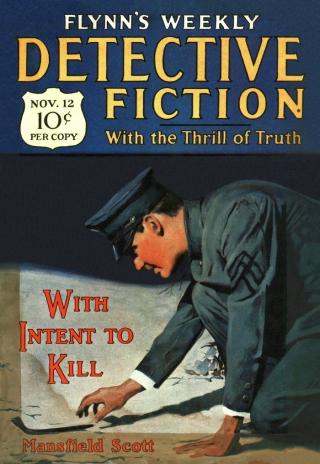
Flynn’s Weekly Detective Fiction. Vol. 28, No. 3, November 12, 1927
- Автор: Alexander R. W., Ames John
- Год: 1927
- Язык: английский
- Год: The Red Star News Company
- Жанр: Другие детективы

Электронная книга - «Flynn’s Weekly Detective Fiction. Vol. 28, No. 3, November 12, 1927». Краткое содержание книги:
Having devoured innumerable novels in secret, my imagination, in spite of my precocious scientific training, was thoroughly romantic. And I supposed that papa and André, like the alchemists in the past, were trying to make gold. But their ambition was much greater than that of the alchemists! And their discovery was more extraordinary and more marvelous than that of the transformation of metals would have been!
But I must come back to Brancion.
When we landed in Paris, papa and I felt lost in the roar and tumult of the city, and looking for an apartment seemed almost an impossible task. For several days we wandered around in different parts of town on the left bank, where papa enjoyed the comparative quiet.
Finally we settled on a place in the Avenue de Suffren, and as we were coming out, after having signed the lease, a man with a thick beard bumped into us, apologized, and then looked at us in astonishment.
“Professor!”
“Robert!”
It was Brancion who had stumbled on us. By chance — which he said was providential — it happened that he was living in the same neighborhood, in an old house dating from the fifteenth century, and which I have heard is an architectural marvel.
His former pupil quickly won papa over completely; though this wasn’t hard, as he had already been well disposed toward him. In a little while Brancion was a daily visitor at the apartment. As he was very rich, he tried to gain at least a sort of benevolent neutrality out of me by overwhelming me with presents.
Papa, who couldn’t conceive of any bad intentions in any one he liked, couldn’t get along without him. But I felt an instinctive and unreasoned distrust toward him which the future justified.
I shall never forget the terrible evening when his baseness was revealed, in a scene which was horrible for me. André had come to Paris to spend a few days. He brought with him a model on a reduced scale of the wonderful apparatus papa had conceived and he had worked out.
They were shut up together in the study until dinner-time. When they came out, they seemed very pleased. André’s handsome face was lighted up with a smile, and when his eyes met mine, I discovered an intense expression of tenderness in them. At that time I was only sixteen, but I was tall and quite matured. My mirror told me that I was not homely, and that I could hope to be loved.
Was it possible that this dazzling young man, whom I had always thought of purely as a scientist, could be in love with me? When I asked myself that question, a feeling of happiness stirred in my heart; and my eyes, instead of avoiding André’s, turned toward him to find again that light which had moved me so deeply.
After dinner I said that I should like to hear some music. It seemed to me that only music would be appropriate to the mood I felt rising in me. Papa, of course, always yielded to my whims, so he agreed and we all three went to a concert hall on the left bank where the best music is played by a marvelous orchestra.
But we were so unsophisticated in Paris that we didn’t know the hall was closed for the season. We joked about our ignorance, and started back home on foot.
From the sidewalk in front of the house we noticed that the windows in the study were lighted. “You forgot to put out the light again,” I said to papa teasingly. Our surprise turned into fear, however, when we came upstairs and found the door to the apartment standing open. It was fortunate for us that André was with us. He bounded toward the study door and entered, a revolver in his hand.
“So it’s you, you sneak thief!” he cried.
Papa and I were both fixed with horror at what we saw.
Robert Brancion, motionless before the threat of the revolver, stood with trembling hands and anxious eyes, beside the bookcase, which had been broken open. There were slivers of glass on the floor.
On the table the small model, which he had stolen from the bookcase, had been taken apart, and each piece carefully wrapped in tissue paper. There could be no doubt that the scoundrel was getting ready to carry them off with him.
Papa trembled with indignation and grief.
André began to speak slowly in a dry, clipped tone.
“I could take my choice,” he said, “between turning you over to the police and putting a bullet in your head. But I haven’t forgotten that we used to be friends. So here are your orders.”
Brancion made a gesture of rebellion. But André went on:
“Here are your orders! You are rich; there is no necessity for you to stay in France, and you are going to leave the country at once. I forbid you ever to come back, and to forestall any notion you might have of returning, you are going to write and sign what I dictate. Sit down at that table, take a sheet of paper and a pen.”
Brancion obeyed. The shining barrel of the revolver, aimed steadily at his breast, checked any desire for resistance. After thinking a few moments, André dictated:
“I hereby confess that on this date I effected an illegal entrance into the apartment of Professor Muret, at 76 Avenue de Suffren; that I broke open his bookcase and the drawers of his desk; that the purpose of my action was to commit theft.
“Now the date and your signature.”
“I refuse to sign that,” said Brancion in a low, hoarse voice.
“Very well then,” said André. “You can choose between the police and the. revolver.”
Brancion growled like a wild beast caught in a trap. Then he dated and signed the paper.
“Am I free now?” he asked.
“You are free. But if, day after to-morrow, you have not started for abroad, or if you ever come back, this paper will at once be put in the hands of the police.”
His head down, Brancion walked heavily out of the room, trembling with rage.
When he had left, André asked:
“Did I do right, sir.”
“You acted well, my boy,” papa answered.
Then turning toward me, he said.
“Let’s forget this scoundrel who betrayed my confidence, and talk of something else. André has asked me for your hand this evening, and—”
Dear papa didn’t like to beat about the bush. André, who had turned crimson, tried to signal to him to drop the matter for the time, but he went calmly on.
“—and I said ‘Yes,’ provided of course that you are willing. What is your answer?”
I gave André a teasing glance.
“A young girl,” I murmured, “must obey her father.”
“That means she agrees!” exclaimed papa. “And I’m very happy for you both, my children. As soon as André finishes the work he is starting now, you shall be married. You are still too young at present, Cécile, and André must devote all his time and money to the task he has undertaken.”
He took both our hands and concluded:
“It will not be more than four or five years.”
At this I felt suddenly disappointed. I had already been picturing myself as André’s wife, and here I was being told to wait four or five years!
But I see now that under all his eccentricity papa was more wise than I realized. I was much too young then to appreciate André’s loyalty and fineness and distinction. It is only now that I love him as he deserves to be loved, and as he loves me.
I learned later that the four or five years were essential for André to carry out papa’s great invention, which Brancion had wanted to steal.
For a long time after that, we had no news of Brancion. A sign: House For Sale, was hung out over his door, and that reassured us that he had really gone.