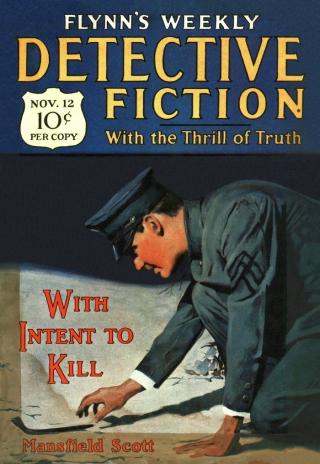
Flynn’s Weekly Detective Fiction. Vol. 28, No. 3, November 12, 1927
- Автор: Alexander R. W., Ames John
- Год: 1927
- Язык: английский
- Год: The Red Star News Company
- Жанр: Другие детективы

Электронная книга - «Flynn’s Weekly Detective Fiction. Vol. 28, No. 3, November 12, 1927». Краткое содержание книги:
“The rascal has put in some modem improvements,” said Mainfroy, “at least as far as the lighting is concerned.”
“And also for opening the door,” answered Brunnel, pointing to a long stone tube built solidly into the wall. Attached to it was an electric wire, which ended in a switch.
“He’s replaced the old flint with an electric spark.”
“Look out!” interrupted Henri Henry. “Drop!”
He had thrown himself flat on his stomach and his two companions followed his example. They were none too soon. A man had just appeared at the opposite end of the room, and six shots reverberated in rapid succession within the closed walls. The bullets whistled over the prostrate bodies.
“That’s the guard,” murmured Henry. “Hard luck for him. You take him, Brunnel. You’re the marksman.”
Brunnel sighted his man carefully and fired. The negro fell.
“Case of legitimate self-defense,” said Mainfroy as they rose from the floor.
“Oh, I haven’t killed him,” the ex-commissioner assured, hurrying toward the man he had just brought down. After examining him, he added:
“He has a ball in the thigh and has fainted. The shock of our coming in must have contributed as much as the wound to the fainting. At any rate, he can’t do us any harm.”
“That’s all we want,” said Henry. “Now let’s look for the ‘object with a rectangular base!’ ”
Four luxuriously furnished rooms opened off the subterranean vestibule. Small windows, near the ceiling and heavily barred, let in a dim light. A white wall could be vaguely seen rising beyond the windows, so that any prisoners kept here would be completely isolated from the street. The doors of these rooms, hung on the inside with sumptuous tapestries, were equipped on the outside with enormous locks.
“The ideal prison,” murmured Hector.
But among all the rare and precious works of art which furnished the four rooms, there was nothing corresponding to the “object with a rectangular base,” which the reporter was seeking.
A long, careful search brought no result and Henry felt a cold rage spread through his veins.
“The scoundrel!” he exclaimed. “Did he get wind of what we were up to? It looks as if he were making fun of us by letting us get in here, after he had taken away this mysterious thing I’m looking for without even knowing what it is!”
Chapter XXXII
Three Musketeers and a Helper
Aided by Brunnel and Mainfroy, he set to work turning over and examining the furniture. In vain. Then they sounded the walls with their canes, from one end of subterranean quarters to the other, hoping to find a fifth secret room. In vain.
At length Henri Henry, moved by a new idea, approached the wounded slave lying upon the floor, to whom he had paid no attention until now.
“Another African,” grumbled Brunnel.
“And dumb,” added Mainfroy, who guessed the journalist’s intention, had opened the wounded man’s mouth to pour a few drops of brandy down his throat, and had seen that his tongue, too, was cut down to a stump.
The negro gave a long sigh, opened his eyes, and looked about him in terror.
“If you refuse to answer, or if you lie,” said Henry showing him his revolver, “I shall kill you.”
The wrinkled black face contracted in fear.
“Is there another room besides these four?”
“No,” the negro shook his head.
“Good. Did your master take something away from here this morning?”
“Yes.”
“A box?”
“Yes.”
“About as long as that and as wide as that?”
While speaking Henry spread his arms apart to indicate the approximate dimensions of the object he was hunting.
“Yes.”
“That settles it,” said the reporter bitterly. “We’re out of luck.”
“Why not simply denounce this Brancion to the police?” asked Brunnel, returning to an idea that was dear to him.
“No, I want to be the first to understand this sinister enigma, and I will be!” answered Henry vigorously. “But we must get out of here now — empty-handed, too, damn it!”
“Not entirely,” interjected Mainfroy, with his usual calm.
“What do you mean?”
“I found this between two cushions on one of the divans.”
He handed the reporter a dainty little notebook bound in Florentine leather, adding:
“You were hypnotized by the idea of looking exclusively for the ‘object with a rectangular base,’ and that kept you from noticing anything else. I merely acted as though I were making an ordinary search, and as a result found this notebook, which I think will have some interest for us since the first lines indicate that it is a diary kept by Cécile Muret during her captivity.”
Henry took the notebook eagerly.
“I congratulate myself now,” he said, “on having brought along as valuable a man as you are, Mr. Mainfroy.”
And Brunnel, with a note of pride in his voice, exclaimed:
“He’s the result of my training!”
Mainfroy did not point out the exaggeration in this, but contented himself with a smile.
After a moment’s reflection, Henry continued:
“When we get home, we can read Cécile Muret’s diary at our leisure. For the present our problem is to get away from here in safety.”
The exit was made as easily as the entrance, thanks to the electric attachment which had been added to the fifteenth century mechanism. The journalist had merely to turn the switch; the explosion followed, then the movable part of the stone steps swung open.
When they came out once more into the fresh air and sunlight, the three men experienced an immediate feeling of security. Without admitting it to themselves, they had been subject, as long as they were locked in the subterranean prison, to an indefinible uneasiness.
The slave was awaiting them by the door. “Nothing new?” Henry asked him.
“No.”
“All right. We’re leaving now.”
The journalist handed the padlock keys to the negro. The latter opened the door, and then stretched out both hands in supplication to Henry.
“You want us to take you with us?”
“Yes.”
“Good! Come along.”
Chapter XXXIII
An Astounding Attack
Flanked by Brunnel, Mainfroy, and the faithful negro, Henri Henry left the courtyard of Brancion’s house and covered the short distance to the building where the supposed Antoine Lisbourdun had rented his studio. As they approached, they noticed a young woman at the door, who came toward them.
When she was still a little way from them, Hector Mainfroy realized with astonishment that it was Germaine Praline.
She was as pale as a corpse, and her large eyes shone in her white face with a feverish gleam. She was advancing toward them with the stiff movements of an automaton or a somnambulist, and like a somnambulist, too, she seemed to look about her without seeing.
The four men stopped, speechless, as if fascinated with horror at this strange apparition.
Hector was the first to recover himself, and stepped forward to the young girl, who had also stopped and was watching him with that expressionless stare which made him shudder.
“What are you doing here, Germaine?” he asked gently.
Germaine did not answer. She did not even seem to have heard the question her fiancé had asked. She was obviously struggling against some internal force. Her mouth contracted, her nose grew taut. At length in a voice which was devoid of any life, a voice which seemed to come from beyond the tomb, she said:
“Which of you is named Henri Henry?”
On hearing his name spoken, the journalist stepped forward.