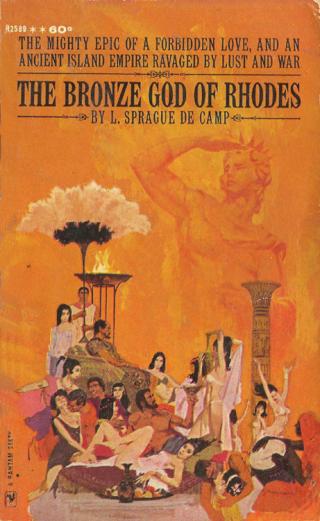
The Bronze God of Rhodes
- Автор: Де Камп Лайон Спрэг
- Год: 1963
- Язык: английский
- Год: Bantam Books
- Жанр: Научная фантастика

Электронная книга - «The Bronze God of Rhodes». Краткое содержание книги:
From the sea in thousands of ships they came, the brutal legions of Antigonos, a giant lusting for the power of Alexander the Great. For endless weeks and months they battered at the tiny island city, smashing it with monstrous weapons, crushing it with the terrible weight of their numbers.
Among the handful of grim defenders was one man who fought for a dream, a vision of a great statue that would stand above the highest towers as a monument to his city's grandeur.
He was Chares, soldier, adventurer, a man tormented by passion, a wanderer in strange, deadly lands—an artist who lived to see his incredible dream become one of the seven wonders of the world.
"Could you not go after the thieves in one of your ships?"
"My dear Python," said Tauros, "I should love to oblige you. But my orders are to watch for hostile fleets and protect the coastal shipping. It would cost me my commission to go haring off after a pair of petty sneak thieves. Why do you not present the king with the remaining garments and say nothing about the theft of the robe?"
"He would find out, fear not. And the robe is the most important item in this wardrobe. I could present the robe without the hat, shirt, and shoes, but not the other things without the robe. Besides, the omens are bad."
I thought, the Ptolemaios would certainly find out about it after Python had shouted the news of the theft in a voice that must have carried all over Tamiathis.
"Very well, then," said Tauros. "Let us gather our wits and take counsel as to how to retrieve your loss."
When we were gathered in the cabin under the wavering yellow light of a lamp, Commandant Tauros explained: "You will find many things strange in Egypt. For instance, many native Egyptians so lack appreciation of Greek civilization" —he cast an ironic glance at Onas—"that they plot to throw us out of the land. They form secret societies of liberation, and all that nonsense."
Onas said: "We had practice under the Persians, sir. It even worked for a time." He referred to the revolt of the Egyptians from the rule of the Persian king, Artaxerxes Memnon, whereby they achieved an independence which they precariously maintained for sixty years.
Said Tauros: "Well, let us not get into political argument. As I was about to say, many thieves and brigands take advantage of this situation. They cover their robberies by calling themselves liberators of the downtrodden Egyptian race. Believing this, the ordinary Egyptians will not inform on these rascals. Some thieves have formed virtual criminal kingdoms—invisible but covering great tracts of Egypt. Some, I suspect, have seized control of genuinely patriotic movements. They fight private wars, draw up treaties, and allot territories as if they were legitimate governments."
"Amazing!" said Python.
"Not so amazing, sir," said Onas, "when you consider how much longer we have been civilized than—ahem—than some other folk. However, Captain, I can tell you that Semken is no Koptian. I know a Memphite accent when I hear one." He turned to me. "Chares, ask Azarias whither these men said they were bound."
I repeated the question in Punic. Azarias replied: "Now that I think, they did not say. They were to drop me at Bousiris and go on—whither, I know not."
When this had been translated, I said: "You see, sir, the man Semken claims to be of Koptos but speaks the speech of Memphis, and avoids telling where he is going. I should guess that his hideout were in Memphis. That's a large city, is it not, Onas?"
"One of the world's greatest," said the Egyptian.
"Very well," said Python. "You, O Chares, are hereby charged with the recovery of Demetrios' robe. Pick the men to go with you—not too many—and make all arrangements. But do not come back without that garment."
"I will find it, sir," I said. "I shall need money, though."
"You shall have enough for your needs." Python smiled a weak, conciliatory smile. "I am sorry I lost my temper just now. Do not be angry with me. But we must have that robe back at all costs. The fate of our city depends upon it."
BOOK VI — MANETHôS
When Onas and I put the proposal to him, Berosos showed an unflattering reluctance to come on our robe hunt.
"Why ask you me?" he said. We stood on the quay of Tamiathis, yawning from lack of sleep, early the morning after the fatal discovery. "No catchpole, I. In this cloudless clime you can find the North Star as well as I. Useless at either running or fighting am I, and I speak not the speech of the land. I should be of no use save for crocodile bait. Ask Mys instead."
Said I: "We asked you because we like you; you are our friend. But if the journey really affrights you—"
"Wait," said Onas. "Berosos, do you remember my speaking of my cousin Manethôs?"
"The one who knows the names of all the old kings?"
"Aye. Well, this is what we shall do. We shall stop at Sebennytos and ask my cousin, who is a priest of Thôth there, for help in tracking down our quarry. Far more than this Greek government, the Egyptian priesthoods know what goes on in the land. Thus shall you have an opportunity to learn the ancient lore of my people: their kings and gods, their myths and magic."
Berosos' expression of distaste had changed. He said: "Oh, that is different. When shall we start?"
Dikaiarchos of Messana strode up with a broad-brimmed hat on his head, exclaiming: "O Chares! What is this about your going to Memphis whilst the ship lies here out of water?"
I told the geographer of our mission. "Indeed?" he said. "May I accompany you?"
"You, sir? Why?"
"To see the country. That's what I came to Egypt for."
"Well—ah—the chase may be rugged for one of your years, sir, and the quarry may bite when cornered, like the mouse in the story of King Agesilaos."
"Ha! Do you fear my senility?" Dikaiarchos seized me around the waist between his two large knobby hands and hoisted me into the air. Then he dropped me, saying:
"When you can do that to me, my fair young friend, it will be time to twit me on my age. As for the thieves' resisting—"
He suddenly brought forth a long, gleaming, horseman's sword from under his cloak. "I can use this paring knife, also. In fact, I pinked some pirates with it yesterday."
"You are of course welcome to come," I said.
I spent the morning in rushing about for gear and supplies, and obtained an audience with Tauros while the barber shaved his jowls. The commandant said:
"If you will but wait an hour, Master Chares, I will find a map and write a letter to the strategoi through whose provinces you will pass. Meanwhile, have you bought mosquito nets?"
"What are they, sir?"
"The Egyptians, when they sleep, first rig little tents of linen gauze above themselves to keep off the mosquitoes, which are a terrible pest in the Delta."
"That I have discovered," said I, scratching. "I shall be back at noon, then."
When next I saw Tauros, he was studying a map spread out on a table in his study. He said: "Each nomos or province has a Macedonian strategos, in charge of military matters, and a monarch, usually an Egyptian, commanding civil ones. You will normally work through the strategos. We are in the Diospolite Nomos, or the Province of the Sanctuary, as the Egyptians call it. The strategos is a good friend of mine, but as Little Diospolis lies out of your way, you are not likely to meet him.
"You will go up the Phatnitic branch, thus, until you reach this fork. Let me see. The capitals of the Hermopolite and Mendesian provinces lie far from the Phatnitic branch. However, you should find the strategos of the Sebennytan Province in Sebennytos. His name is Neon; a good enough sort.
"At Bousiris you will find the strategos Thorax, whom I do not know. The capital of the next province on your left lies far to the east, but you can find a minor official in Leontopolis in case of need. Then you will come to Athribis, but I do not know who is the strategos of the Athribite Province. After Athribis, the next provincial capital you will pass is Memphis itself. The stragegos is Alkman of Beroia, a famous warrior and a Macedonian of Macedonians."
"What is he like?"
"I have not seen him for many years. He it was who stood by the Ptolemaios when Perdikkas' elephants overthrew the wall at the Fort of Camels, and all the other Ptolemaians fled, and the Ptolemaios himself speared the first elephant as it lumbered through the breach."
Besides Onas, Berosos, Dikaiarchos, and myself, two other persons set forth with us: Dikaiarchos' slave Sambas, and Azarias, who merely wished a ride as far as his home.