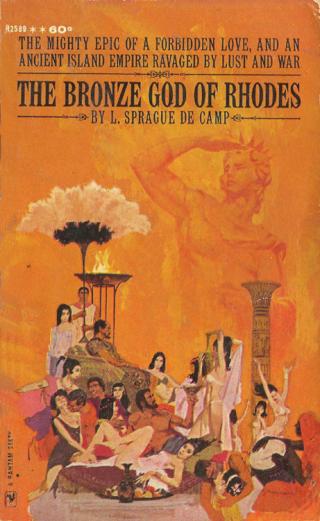
The Bronze God of Rhodes
- Автор: Де Камп Лайон Спрэг
- Год: 1963
- Язык: английский
- Год: Bantam Books
- Жанр: Научная фантастика

Электронная книга - «The Bronze God of Rhodes». Краткое содержание книги:
From the sea in thousands of ships they came, the brutal legions of Antigonos, a giant lusting for the power of Alexander the Great. For endless weeks and months they battered at the tiny island city, smashing it with monstrous weapons, crushing it with the terrible weight of their numbers.
Among the handful of grim defenders was one man who fought for a dream, a vision of a great statue that would stand above the highest towers as a monument to his city's grandeur.
He was Chares, soldier, adventurer, a man tormented by passion, a wanderer in strange, deadly lands—an artist who lived to see his incredible dream become one of the seven wonders of the world.
"Quickly the wizard tore the book from the hands of the mummy, which crumbled into dust as he did so. Hastily he unrolled the book and began to recite its cantrips. Our rushlights flickered, and the darkness deepened. A sense of gloom and horror descended upon me. And then—oh, my masters, what a memory is this!—there came upon us some presence from the nighted gulfs beyond the grave. A living darkness folded the wizard in its batlike wings; he screamed and was no more. How I escaped the demon's claws I know not; they found me wandering in the desert, screaming mad. Even now, years later, I fear to sleep lest I dream of this awful event."
I shuddered with the rest. If a liar, Semken was a most artistic one.
As the sun set redly before us, Python ordered the anchors dropped lest we run aground in the darkness. I spent the pleasantest night since the start of our voyage, since the air was mild and the ship barely moved.
The next morning I observed Alexis in converse with Captain Python. They walked the deck together; the Tarsian seemed to be wheedling the captain, who long frowned and tossed his head in the negative. But at last Alexis' grin showed that Python had yielded.
Itching to know what went forward, I fell in with them. "Sir," I said, "we used almost half our darts in yesterday's fight. Ought we not to obtain some more at Alexandria?"
"Yes, yes, I suppose so," said Python. "Remind me of it when we get there."
"When will that be, sir?"
"We shall reach Tamiathis by noon, and there we shall lay up for repairs. I do not care to have this leaky old basket sink under me in the middle of Alexandria's harbor."
"And then, sir?"
"We shall be several days in Tamiathis. Then, if the omens let us sail at once, Alexandria is less than two days' sail, with reasonable winds."
Alexis of Tarsos said: "Pray then, Captain, may we see that of which we spoke now, before we reach port and leave you?"
"Oh, very well. Fetch your comrade."
"What's this?" I said.
The guileless Python spoke: "This man has talked me into showing him the royal robes."
"If he, a stranger, may see them, then surely I may also."
"Well—ah—I do not know. I cannot admit everybody—"
"Not all at once, sir, but surely common justice entitles your own warriors ..."
In the end Python gave in once more. I fetched the catapult crew aft to Python's cabin. As soon as the other passengers, the archers, the marines, and the sailors saw that something was afoot, they hastened aft also. Soon there was a jostling crowd on the deck, which pushed and shouted until the marine officer and I beat and cursed them into line, filing into the cabin and out again.
When most of the crew had been through the cabin, I fell into line behind Azarias. When the Judaean saw the garments, he uttered a guttural exclamation and reached out as if to try the goods with his fingers.
"Hands off, fellow!" snapped Python.
"What, sir?" said the weaver, but in his native tongue. I translated; Azarias had wished to determine if the quality of the robe was as fine as it seemed, as he was in the business.
The suit consisted of a white linen shirt with a purple stripe, a silken, sleeved robe of Persian cut, a purple felt hat, and high felt boots. All were bright with gold. The robe was pale blue, with a purple border and astronomical symbols worked in golden thread and spangles. The hat had a band in the form of a golden laurel wreath. Certainly Demetrios would have presented a godlike spectacle in this ornate array.
We killed time as the ship plodded westward. While Onas taught Egyptian checkers to Dikaiarchos the geographer, and others engaged in other pastimes, Azarias attached himself to me. He seemed a nice little man, and I was glad to practice my rusty Phoenician. When I told him of my art and of my plans for the world's finest colossus, he said:
"Ouai, young sir, how sad for you! How I grieve!"
"By the gods, why?"
"Because the only true god, the lord Iao, has forbidden the making of graven images. I fear it will go hard with you in the next world."
"He may have forbidden you, but I have heard nothing of this. Anyway, what makes you think that your god is the only one?"
"He himself has said so, through his holy books and the mouths of his prophets."
"Well, the god I worship has approved my plan for his statue and will guard and guide me to its completion, for the glory of the god and of beautiful Rhodes. It's too bad that you and Theodoros have no language in common, for there would be hot theological argument."
"Why, what is his view of sacred matters?"
"Whereas you believe in no gods but Iao, he carries this skepticism to its logical conclusion and believes in no gods at all. The difference seems slight to me."
"Mock not the lord Iao. I had an uncle ..." Azarias went into a long tale of the calamities that befell this uncle as a result of flouting the singular rules of eating that the Judaean religion imposes upon its followers. The uncle's wife had run off with a Nabataean smuggler; his daughter had become a belly dancer in an Egyptian tavern in Gaza; and sickness and poverty dogged his path.
In the afternoon we reached the Phatnitic mouth of the Nile and turned into its broad stream. We passed two of Ptolemaios' black-hulled triremes, anchored in the shallows with gilded wooden statues of Alexander shining on their sterns. Then, twenty or more furlongs from the mouth, we came to Tamiathis, standing in a sandy waste on the eastern shore of the river.
Tamiathis lies on a narrow neck of land, with the Nile in front and the reedy borders of Lake Tanis behind. Basically a fishing village, it has grown to something more because of Ptolemaios' building a small naval station with a slip for minor repairs. Furthermore, here travelers for Memphis and points south leave the coastal ships and take to river boats.
Three fat-bellied merchantmen were tied up to the, crumbling quay. Fishing smacks and river boats clustered along the waterfront. Loafers slept in the sunshine; mangy dogs fought over scraps of offal; a barber shaved the scalp of a customer.
The Halia pulled up to one end of the quay. Using Onas as interpreter, Python shouted orders and threats at the masters of the light craft until they made space for the trireme. We drew in our oars and tied up.
A gleaming Ptolemaic officer and two Greek civilians climbed aboard and went to Python. "I am Tauros, commadant of the port," said the officer, "and these are Chief Customs Inspector Pelias and his assistant. Pray assemble your crew and passengers."
The trumpeter blew; the rowers, smelling strongly of sweat, filed up on deck. Commandant Tauros raised his voice:
"O strangers! You are entering the domains of Ptolemaios son of Lagos, king of Egypt and the surrounding lands!"
King? I thought. The Ptolemaios must have heard of Antigonos' assumption of royal rank and done likewise.
"Before you go ashore," continued the commandant, "you must show your baggage to the assistant customs inspector and pay the import tax that he levies. When you go ashore, behave as a guest in the house of another."
"He means," put in Python, "that if we catch any of you abandoned rascals fighting with the natives, we will hang you from the yardarm."
"Another thing," said Tauros. "Do not kill any animals while you are in Egypt. Many animals are sacred to the Egyptians, different ones in different parts of the land. The cat, the dog, the bull, the hawk, and the ibis are sacred everywhere. Be particularly careful not to harm a cat—not, that is, unless you wish to be torn to bits by a frenzied mob. Also, Egyptians deem it extremely uncouth to relieve oneself in the street, so it is better not to do so."
The commandant and the chief customs inspector turned aside to plunge into a wrangle with Python and Sapher. My crew and I went ashore to trudge the dusty streets with sand in our shoes and to sit in a tavern, drink beer, and scratch fleabites.