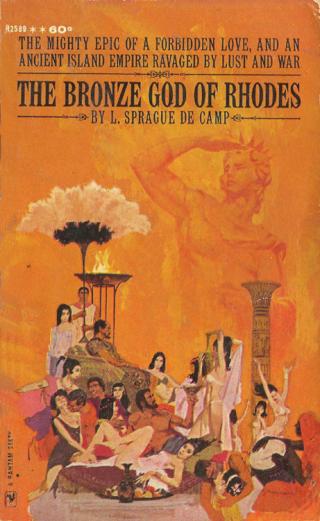
The Bronze God of Rhodes
- Автор: Де Камп Лайон Спрэг
- Год: 1963
- Язык: английский
- Год: Bantam Books
- Жанр: Научная фантастика

Электронная книга - «The Bronze God of Rhodes». Краткое содержание книги:
From the sea in thousands of ships they came, the brutal legions of Antigonos, a giant lusting for the power of Alexander the Great. For endless weeks and months they battered at the tiny island city, smashing it with monstrous weapons, crushing it with the terrible weight of their numbers.
Among the handful of grim defenders was one man who fought for a dream, a vision of a great statue that would stand above the highest towers as a monument to his city's grandeur.
He was Chares, soldier, adventurer, a man tormented by passion, a wanderer in strange, deadly lands—an artist who lived to see his incredible dream become one of the seven wonders of the world.
"Not Tryphon?"
"His father Anax, I believe. Why, know you Tryphon? A shrewd competitor, by all accounts."
Later, over Azarias' sweet Judaean wine, I asked: "Why did you and the priest so plainly dislike each other if you had never met?"
"Those wicked animal worshipers!" said the weaver with vehemence. "They hate us because we will not bow down to their false gods. Since we bring no offerings to their bestial demons, they strive to turn the people against us, to seduce away our youth to their abominable rites, to infect them with their barbarous superstitions, and to persecute and abuse us in every way they can. They hope to drive us back to Judaea. But we are not primitive tribesmen to be herded hither and yon at will. We are a holy race of ancient lineage, to whom the lord Iao has given the one true religion. If any would profit from knowing us, let him learn righteousness from our teachers and our sacred books. We are here lawfully, by invitation of the king, and by the rod of Moses here we will stay!"
His attitude seemed to me self-conceited, especially as everyone knows that the Hellenes alone have developed civilization to its highest form. But as Azarias was my host it would not have been seemly to dispute him. Instead, I asked:
"How did you come to settle in Bousiris?"
"Fifteen years ago, the Ptolemaios overran Judaea and captured our holy city of Jerusalem. Many of our people were carried off by his soldiers. One of these was my brother Ioudas. After these captives had slaved miserably for a time, an embassy of our leading men persuaded the Ptolemaios that these were a people worth befriending: stout warriors, diligent workers, and virtuous citizens, not tricky traders or dissolute weaklings like some other folk.
"Accordingly, the Ptolemaios bought up all the Judaean slaves in Egypt and freed them. He also invited more to settle in this land, to increase its wealth by their industry and its moral tone by their example. My brother wrote, urging me to remove hither, as my father's family was large and his business could not support all of us. Now there are over thirty Judaean families in Sebennytos."
"How do you get along with the Egyptians?"
"Not ill, save when those devils in the beast temples stir them up against us by their lies and calumnies."
Whatever the curious laws that govern the preparation of Judaean food and drink, I must say that the dinner was good. Even I, who normally care but Utile for my food, stuffed myself to the ears and sat groaning afterwards, while Azarias bantered with Onas in Egyptian and with Berosos in Syrian. As we were leaving, the Judaean reiterated:
"Forget not: If I can do aught to help you in time of need, call upon me forthwith. Azarias ben-Moses spurns not his benefactors."
We found Manethôs and Dikaiarchos lounging in the Hathor over a jug of beer and talking learnedly of eras and dynasties. The next morning, when we had hoisted sail and breasted the flood to southward, I asked Manethôs :
"What lies between you and the Judaean weaver, that you should hate each other before you had exchanged a word?"
"Judaeans!" Manethôs spat over the side of the boat. "You know not what we Egyptians have suffered from these pestilent sand dwellers. Twice have they overrun us; twice have we driven them out; and now your Greek king is bringing them in for a third time."
"What's that? I have never heard of the Judaeans as conquerors."
Said Manethôs : "I will tell you. First, when Toutimaios was king of Egypt, a horde of these godless Asiatics invaded the land, calling themselves Hyksos or 'Shepherds.' After a cruel and unrighteous rule of five hundred years these nomads were driven out by King Amosis. For four centuries thereafter all went well.
"Then King Amenophthis was advised by a seer that he should please the gods by cleansing the temples of the horde of cripples, blind men, and lepers that swarmed about them, begging for alms. The king accordingly gathered all these unfortunates and put them to forced labor. This, however, accomplished little, most of them being too feeble for heavy work.
"Amenophthis therefore sent them to the city of Avaris, which the Shepherds had built during their rule and which now stood empty. Here a renegade Egyptian priest named Osarseph obtained the leadership of the beggars. This Osarseph changed his name to Moses and intrigued with the Shepherds in Syria. At his urging, the latter again swept over the land, committing outrages and abominations like the burning of cities and the slaughter of sacred animals.
"King Amenophthis withdrew to Ethiopia without fighting, as he had been warned by the same seer that these polluted foreigners would rule the land for thirteen years. When the time was up, returned the king from the Southland and drove out both the Shepherds and the beggars. And from the Shepherds and the Egyptian beggars the Judaeans of today are descended. I can show you the passages in our ancient records where these things are set forth.
"Now the Ptolemaios would bring these people back in. I will not speak of Greek rule over our holy land, for it is plain that the gods desire the Egyptians to be ruled—for a time—by barbarians. But I will speak about bringing in whole tribes of foreigners to do things that Egyptians can do just as well. If the king want soldiers, why brings he in Hellenes and Syrians and the like when we have a class of sturdy warriors, like Onas here, rusting away in idleness? If he want workers in wool and leather and metal, why import Judaeans when for thousands of years Egypt has led the world in artistic taste and delicacy of workmanship?"
I shrugged, for it was a difficult argument to answer. "Perhaps he doesn't trust the Egyptians, knowing what happened to the Shepherd kings. Anyway, this Azarias seemed personally harmless."
"About Azarias' personal qualities I neither know nor care," said Manethôs . "He is in the vanguard of another invasion, the most deadly of all. Hellenes and Phoenicians and Babylonians we can put up with, but Judaeans threaten our very existence."
"How?"
"The other people of whom I spoke worship their gods and suffer us to worship ours undisturbed. But Judaeans openly sneer at our ancient religion; they even have the insolence to say that, our gods exist not. Should such an atheistic heresy become widespread, the gods might turn off the Ior—that is, the Nile—in their anger and destroy us as punishment."
"What's that about the Nile?" said Dikaiarchos. "A favorite sport among learned Hellenes is to argue the cause of the rise and fall of this river. Is it true that in Ethiopia are two bottomless fountains, rising from the tops of conical mountains, one of which flows north to become the Nile while the other flows south into the lands of the headless men and the goat-pans?"
Manethôs allowed himself a rare smile. "I fear that some naughty compatriot of mine made up that tale to befool foreigners. The best opinion amongst our learned priests is that beyond Ethiopia to the south lies a lofty land of mountains and lakes, swarming with pygmies and elephants, where rain falls in summer only. The streams from these rains, coming together, form the Nile."
"Rain in summer?" said Dikaiarchos. "I have heard of such a thing in the far northern lands, but it seems almost too bizarre for belief."
"No stranger is it than the statements of you foreigners that in your lands rivers flow, east, west, and south as well as northward. To us, north is the only direction in which a proper river can flow."
Dikaiarchos laughed. "Well, if you will believe in my south-flowing streams, I'll believe in your summer rains."
I said: "O Manethôs , has your bird-headed god revealed anything to help us in our search?"
"Nay, not yet. True, he did visit me last night, but only to counsel me on personal matters."
Onas grinned. "Not in peace with his wife does Manethôs dwell. That is why he was so eager to come with us."