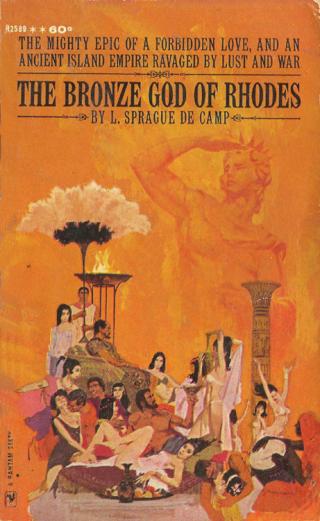
The Bronze God of Rhodes
- Автор: Де Камп Лайон Спрэг
- Год: 1963
- Язык: английский
- Год: Bantam Books
- Жанр: Научная фантастика

Электронная книга - «The Bronze God of Rhodes». Краткое содержание книги:
From the sea in thousands of ships they came, the brutal legions of Antigonos, a giant lusting for the power of Alexander the Great. For endless weeks and months they battered at the tiny island city, smashing it with monstrous weapons, crushing it with the terrible weight of their numbers.
Among the handful of grim defenders was one man who fought for a dream, a vision of a great statue that would stand above the highest towers as a monument to his city's grandeur.
He was Chares, soldier, adventurer, a man tormented by passion, a wanderer in strange, deadly lands—an artist who lived to see his incredible dream become one of the seven wonders of the world.
"Why, our cat has died."
I almost burst into a raucous laugh. But my guardian spirit, together with a warning frown from Onas, caused me to clap a hand to my mouth. However, enough of the laugh had started on its way to cause Manethôs to give me a cold, hard look, like that of a cobra rearing to strike at a mouse.
"Something I ate," I said. "Pray accept my condolences."
The priest grunted and turned to Onas. The two conversed in Egyptian while I sipped my wine and prowled about the chamber, scrutinizing the painted reliefs of gods and men and beasts, and combinations thereof, on the wall. After an hour of this I was becoming bored when Manethôs spoke:
"The ibis-headed man, O Chares, is Thôth, the god of wisdom, whom I serve. Some of your Greek priests identify him with their Hermes."
"Indeed?" I said.
Onas spoke: "Excuse us for ignoring you, old fellow, but Manethôs has been telling me all that has befallen Uncle Sethos and Aunt Meritra and Cousin Tetephren and so on. My parents, thanks to the gods, still live, and I am fain to visit them on the morrow. Dwell they in a village, an hour's ride to the west."
"Herakles! You can't do that!" I exclaimed. "The trail of the thieves would grow cold while we waited."
Onas frowned. "Would you, after a long absence from Rhodes, fail to visit your parents if you touched there on a voyage? I cannot believe that you would be so wicked."
"No, but we must put first things first. We cannot risk our entire mission for a familial reunion."
"I shall not be gone above half a day, and I will go, whether you give me leave or not."
"As your superior officer, I forbid itl"
"Stop me if you can!"
"By the Dog, I will!"
We were both on our feet, and our shouts echoed through the silences of the temple. I had never before quarreled with the easygoing Onas, but this I deemed a matter of principle.
"Allow me to speak," said Manethôs . "You do, forsooth, have cause to push on in haste to Memphis. There will you either recover your stolen raiment or you will not. In either case you will then return down the river, in less haste than you went up it. Why not on your return stop long enough for Onas to make his visit? A day more or less will not matter then."
Shamefaced, Onas and I agreed to this plan. Manethôs resumed: "My cousin has told me of your quest and besought my aid in tracking down the thieves. Meseems the best way to do that were to go with you to Memphis, where I have connections among the priesthoods."
"That is too good of you, sir."
"Not entirely. I, too, have a mission, which your journey will enable me to accomplish. I wish to take the mummy of our cat to Memphis for burial in the holy cemetery of the cats there."
"Agreed with pleasure," I said. "When will you be ready?"
"Tomorrow morning. I must arrange with the high priest, my uncle, for leave from my duties. I will also pray to the wise Thôth to set our feet on the veritable path to success. Perhaps he will advise me in a dream."
Onas and Manethôs came aboard the Hathor at noon the next day. Manethôs wore a linen robe and headcloth, and shoes of papyrus. He carried a copper statue of a cat, twice life-size and weighing, I judged, five to ten pounds, I said:
"Have I misunderstood you, sir? I thought you were to bring the mummy of your cat on the journey."
"The mummy is in this," he said, tapping the ruddy copper.
"How did you get it into the statue?"
"Through the hole in the bottom, ere the base was riveted on." Manethôs set the statue in the corner of the cabin, whence it stared at us with a supercilious expression. The statue even included a pair of earrings in the cat's ears as I have seen on living cats in Egypt.
After the Sebennytan cousins came a free servant from the temple of Thôth, staggering under Manethôs ' baggage. The servant, Phiôps, settled down on the boat to stay. These additions crowded the Hathor and brought expostulations from Horos. I was not sorry, however, to have another pair of strong hands aboard, as Dikaiarchos had made it plain that he did not wish others than himself to give orders to his slave.
Manethôs nodded gravely to Berosos and Dikaiarchos as I presented them. When I added, "And this is Azarias of Bousiris," however, something curious happened. Manethôs , his face blank, said:
"A Judaean?"
"Why, yes."
"Oh," said the priest, and turned away to see to the stowage of his gear.
Azarias, likewise, had failed to acknowledge the introduction. He glared with tight lips at the priest, as at a mortal foe.
"Do you know him?" I said to Azarias in Phoenician.
"Ouph, nay! Nor do I wish to," said the weaver. "But let us speak of another matter. We shall reach my city within the hour. I pray you, in the name of the lord Iao, to let me feast you and your fellow soldiers, the Egyptian and the Babylonian, at my house. It is the least I can do for your saving my life."
"I thank you, but I fear we have lost so much time in Sebennytos that we must press on ..."
However, the little man pleaded so earnestly that I gave in. Then another thought struck me. I asked:
"How will you guest a group of foreigners, not of your religion, without violating your complex rules of eating?"
"Na, fear not. It is not the company that our laws restrict, but the manner of preparing the victuals."
Between Sebennytos and Bousiris, Azarias and Manethôs ignored each other in a way that not even the dullest could fail to mark. We reached Bousiris while the afternoon sun still shone with Egyptian splendor.
First I sought out Thorax, the strategos of the Province of the Protector. His clerk said, "Wait," and went into the adjoining room, whence came the sound of snores. The snores ceased, and soon the clerk beckoned.
"What do you want?" growled Thorax, sitting on the edge of a couch and rubbing reddened eyes.
I showed Tauros' letter and spoke my piece.
"Oh, ordure!" muttered the strategos, glancing over the letter. "I know nothing of any such malefactors. If people cannot keep better watch over their property, they deserve to lose it. Try the deputy strategos at Leontopolis, or Hybrias at Athribis. Now leave me, my good man, for I am exceedingly busy."
Nettled, I went out, not doubting that the snores resumed as soon as I had gone. After I rejoined my comrades, Azarias led us to his house, whence came the clatter of looms.
As we entered, the noise of the looms desisted and a swarm of Judaeans flung themselves upon my fellow traveler. So swiftly flew the talk that, what of the peculiar accent wherewith these folk speak Phoenician, I could no longer follow. Azarias, arms flying, told of the attack on the Anath and of his subsequent rescue. His family burst into tears and wails when he told of his danger and screamed with joy at his deliverance. When he identified us as his saviors, they threw themselves upon us and kissed our hands, to my no small embarrassment.
Azarias' household included his wife, a short dumpy woman; three daughters and two sons, ranging in age from about five to fifteen; an apprentice; and several free servants. He showed us about, explaining the technical details of his looms. He had three of these for linen, two for wool, and one for silk. I suppose his family had developed the habit of shouting at one another to be heard over the clatter that arose when all these machines were in use at once. Pointing to the loom for silk, he said:
"This is a new thing, and not sure am I that it will gain me a profit. Any fool can weave wool, but for silk new ways are needed. We must tune the tension of our warp threads with utmost care, for silken threads yield less than those of wool. I learnt the art from a cousin in Jerusalem, who learnt it from a weaver in Sidon, who learnt it from a silk weaver of Kôs."