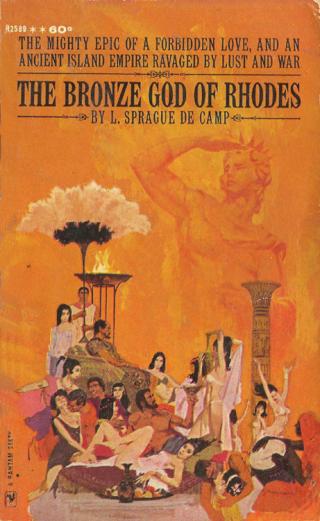
The Bronze God of Rhodes
- Автор: Де Камп Лайон Спрэг
- Год: 1963
- Язык: английский
- Год: Bantam Books
- Жанр: Научная фантастика

Электронная книга - «The Bronze God of Rhodes». Краткое содержание книги:
From the sea in thousands of ships they came, the brutal legions of Antigonos, a giant lusting for the power of Alexander the Great. For endless weeks and months they battered at the tiny island city, smashing it with monstrous weapons, crushing it with the terrible weight of their numbers.
Among the handful of grim defenders was one man who fought for a dream, a vision of a great statue that would stand above the highest towers as a monument to his city's grandeur.
He was Chares, soldier, adventurer, a man tormented by passion, a wanderer in strange, deadly lands—an artist who lived to see his incredible dream become one of the seven wonders of the world.
What with one thing and another, we did not get off until midafternoon. Whenever I had all my voyagers assembled, somebody would think of one more article that we needed; then, when I had collected all the supplies for the journey, I found that one or another of my passengers had wandered off. After Onas did this twice, I forgot my good resolutions and berated him before all.
At last Horos, our boatman, and his son Zazamanx pushed our boat out into the stream. She was a twenty-cubit craft of small sycamore planks sewn together, with places for four oarsmen and a small cabin.
The boatmen stepped the mast and hoisted the sail. Zazamanx took his place on the broad, flat, duckbill-shaped overhang at the bow, peering down into the water, while Horos carried a paddle aft, thrust it into a notch in the high, recurved transom, and steered with it.
Horos was a stooped, gnarled, gap-toothed man, active as a monkey despite his evident age. His son was a big, solidly built, silent youth.
Horos knew a little Greek from doing business with the Hellenes of the naval station. He grinned at me, patted the boat's planks, and said:
"Fine boat, no?"
"It looks good to me. What do you call it?"
"Hathor. Best boat on river. You give me more money for riding in such fine boat. Much money."
I turned to Onas. "You made the arrangements for this voyage. Tell this knave he shall have what we agreed upon and not more."
There ensued a crackle of Egyptian dialogue, punctuated by hearty laughter. I gathered that the two were trading jocular insults.
Zazamanx called, "Seka!" from the bow. He picked up a rusty spear and poised it, staring down into the dark waters.
"Crocodile," said Horos to my question.
"Istar!" said Berosos. "Mean you that we bathed in the river with those things yesterday?"
"You were not devoured, were you?" said Onas.
Dikaiarchos: "I thought animals were sacred, yet Zazamanx would have taken a spear to this reptile."
"Crocodiles are sacred only in the Province of the Lower Palm Tree," explained Onas. "Elsewhere we slay them when we can."
"I could never live in Egypt," said I. "I could never remember what beast may be killed in which region."
I watched the boatmen's management of their craft with keen interest. The brisk etesian wind wafted us southward. Horos kept near the banks to avoid the swifter current of midstream, swerving out when Zazamanx called to beware of a shoal, and sometimes angling across the broad flood to take advantage of slack water on the far side.
Like the other branches of the lower Nile, the Phatnitic branch pursues a serpentine course. Now and then the river twisted about until, no matter how far around the sail was braced, it no longer served us. Then Horos and Zazamanx lowered it, put out two of the oars, and pulled with low grunts until the bend was passed.
The first time that he resumed his seat in the stern after one of these bouts, Horos said: "Hard work. Hot day. You pay me for whole trip now, yes?"
"Oh, be quiet!" I said.
The old man chuckled as if my rebuff were an excellent joke.
The banks of the Nile wafted slowly past: a reedy marsh, a palm grove, a village, then another marsh. Flocks of birds rose whirring from the marshes or winged, crying, overhead on their way south. The annual flood of the Nile was receding, though some low-lying fields still lay under sheets of water.
In fields which the falling water had laid bare, sturdy nut-brown peasants waded up to their calves in black mud, sowing this year's wheat. Women, stripped like the men to loin cloths or altogether naked, wielded heavy hoes. Now and then we passed a field in which naked boys chased animals back and forth with switches: now a flock of sheep, then a drove of pigs.
"Why are they doing that?" I asked Onas. "They'll run all the meat off their beasts."
"The animals tread the seed into the earth. In this soft mud such a scheme is easier than plowing."
All day we wound around bend after bend. Betimes we passed another duckbill-stemmed boat, whose occupants traded gossip with our boatmen in shouts across the water. When night came, we tied up near a village, ate our frugal meal, rigged our tents of gauze, and slept.
Next morning the marshes became fewer. Now and then a canal opened into the river on one side or the other. During the afternoon we reached Iseion, on the west bank. I should like to have studied the architecture of the majestic temple of Isis that rose against the skyline, but the urgency of my mission forbade. We pushed on to Sebennytos.
Onas' city came into view on our right, larger than Iseion, its walls of mud brick showing black against the red of the setting sun. Onas and I walked up the slope from the river to the gate. There lounged a single guard, wearing a helmet of crocodile skin. His huge wicker shield and bronze-pointed spear reposed against the wall.
We passed on into the city, a place of narrow dark streets and strong smells. I found General Neon in a crumbling mud-brick palace that had belonged to some forgotten governor of Persian times.
The strategos, a little round man, read the letter from Tauros, telling who we were and urging Ptolemaios' officials to give us every possible aid and succor.
"Wait," said Neon. He stepped into another room, whence came the buzz of speech. Soon he came back.
"I should be glad to help, my good sir," he said. "But I have just spoken to my spy, and he has seen no such folk as you describe in his rounds of the taverns. I imagine they stopped at Iseion, where the police are more lax, and passed by here without halting. Better luck upriver, perhaps."
Next Onas led me to the open place where stood the temple of Thôth. The lotus-topped capitals of its propylon rose black against the western sky, which was darkening from gold to apple-green to deep blue, while in the east the first stars shone like gems on a blue-black cloth. On either hand stone sphinxes brooded, and a bat wheeled and dipped overhead. To a Hellene the sight of an Egyptian temple speaks of ancient lore and occult wisdom, of mysterious rites and knowledge of forbidden things. Onas said:
"In the olden days you as a Hellene had not been admitted into the sacred precinct, let alone into the temple itself. However, things have changed."
He spoke to the man at the entrance, who walked off with leisurely strides. Soon another man appeared, looking ghostly in his white linen robe in the dusk. So quietly did he glide up that I started at the sight of him.
"Ha, Manethôs!" said Onas.
The other replied in kind, and the two touched noses. There was a swift exchange of speech. The white-robed man said to me in fluent though strongly accented Greek:
"Rejoice, O Chares! May the gods of Egypt ever watch over the friend of my kinsman." He made a ritualistic gesture. "Fain would I entertain you in proper fashion, but my house and I are in mourning. Still, will you step this way? First, however, must I ask you to leave your cloak with the porter, as wool may not be brought into the temple."
Manethôs led us into a small anteroom of the temple opening on the court. It was lit by lamps of curious shape that gave off a rancid smell of castor oil. Manethôs clapped his hands; a man brought small cups of wine for Onas and me. Manethôs did not drink. Now that I had a better look at him, I saw that he was a little younger than Onas and myself—that is, in his early twenties—and as tall as Onas though more slender of form. Manethôs ' youthful appearance, however, conflicted with an extreme gravity of manner, suitable for a man of twice his age. His entire head, including his eyebrows, was shaven.
"What is the cause of your bereavement, sir?" I asked.