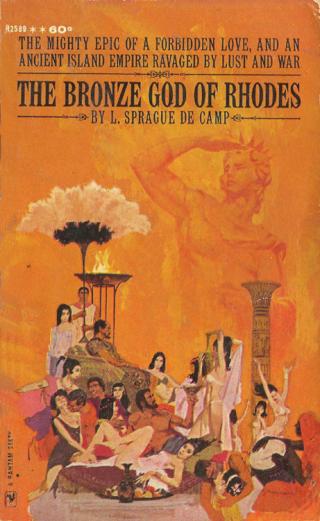
The Bronze God of Rhodes
- Автор: Де Камп Лайон Спрэг
- Год: 1963
- Язык: английский
- Год: Bantam Books
- Жанр: Научная фантастика

Электронная книга - «The Bronze God of Rhodes». Краткое содержание книги:
From the sea in thousands of ships they came, the brutal legions of Antigonos, a giant lusting for the power of Alexander the Great. For endless weeks and months they battered at the tiny island city, smashing it with monstrous weapons, crushing it with the terrible weight of their numbers.
Among the handful of grim defenders was one man who fought for a dream, a vision of a great statue that would stand above the highest towers as a monument to his city's grandeur.
He was Chares, soldier, adventurer, a man tormented by passion, a wanderer in strange, deadly lands—an artist who lived to see his incredible dream become one of the seven wonders of the world.
"A merchantman I see—a large one, methinks—with smaller craft about it. Nought else can I see."
"Beshrew me," said Onas, becoming cheerfully animated again at the prospect of a fight, "if the merchantman have not grounded and if those small craft be not the pirates of the Pasture!"
I went aft to tell Python. He came forward at once and watched as the grounded merchantman slowly grew to our gaze. Soon we could all see the big roundship, heeled over, with the small craft of the Egyptians circling about it. The sun blinked on pinpoints of metal.
"Right you are, Onas," said Berosos. "There are ten or twelve boats. Some stand back and shoot arrows at those on the merchantman, while others close with it and strive to clamber up the sides. Archers in the basket at the merchantman's masthead shoot down at the attackers."
A faint sound of shouting came to our ears. I asked Python: "Shall I prepare the catapult for action, sir?"
"Oh?" he said. "Do you think we should try to rescue them?"
"Why, could Rhodians do otherwise?"
"I do not know. I have a mission to carry out and must not risk it. We leak, and another grounding would finish us. But—Berosos, what would you do?"
"The less fighting I see, the happier I am," said the Babylonian with a lugubrious countenance.
Python chewed a fingernail. Then he went aft. I could see him asking his other officers their opinions while the soothsayer scanned the empty sky for birds and the placid sea for fish. Then Python commanded the sail to be furled and the oars to be put out, but took so long that at last I went aft and spoke boldly:
"Captain, if we don't aid that ship soon, they will be beyond help."
Python gave a kind of shudder. "Prepare the catapult." This time Python posted two lookouts on the bow. We brought up our darts from the storeroom.
With short, gentle strokes we nosed inshore. We had an advantage over the merchantman, for a big roundship fully laden has more draft than a trireme.
Berosos called ranges: "Fifteen plethra— Fourteen plethra—"
I trotted back and forth along the deck, pointing out targets to Python. At last we were lined up and at the right distance.
"Shoot!"
The dart struck one of the attacking craft. As one man, the Egyptians leaped into the water and began swimming ashore, though the boat, being made of tarred bundles of reeds, did not seem fatally damaged.
We crept closer, dropping dart after dart among the attackers. Some became panicky and began to swim or paddle shoreward. Others were made of stouter stuff. Several boats paddled towards us "while men in their waists shot arrows of reed at us. They were tall dark men with long black hair, naked but for strips of dirty linen about their loins, and they yammered and gabbled and screeched like a cageful of monkeys.
Python swung our bow and headed into the cluster of boats from which the arrows came. Most of them scuttled out of the way, like water beetles when one steps into a pool, but one we caught on our ram. The boat was tossed on its back, and its screaming occupants were thrown into the water. They struck out for shore while our archers picked them off.
The boats that had remained around the merchantman now drew off, also. At first they stood off at a bowshot's distance, but a few darts sent them scuttling out of range of the catapult. There they remained in a sullen line, bobbing on the gentle swells, in water too shallow for us to pursue them.
We pulled alongside the merchantman. Python called down: "This is the Halia, of Rhodes. I am Python of Kallithea, commanding. Who are you?"
A stout, broad-shouldered ox of a man with a long black beard, a dented helmet, and a bloody sword, called back: "Thank the gods for beautiful Rhodes! I am Sapher of Sidon, master of the Anath. Can you pull us off?"
A group of men crowded up behind the Sidonian: six sailors and eight passengers, most of them wounded but all armed with swords, spears, and improvised clubs. Three men lay dead on the bloodstained deck: a passenger, a sailor, and a pirate, the last still clutching his copper-bladed hatchet. Two sailors with bows clambered down the mast from the fighting top.
"I will look at your ship first," said Python.
He climbed down the ladder to the deck of the Anath. He and Sapher walked about the slanting deck, talking in animated undertones. Then they vanished into the hold, from which a straggle of women, children, and slaves emerged. When the two captains reappeared, they had plainly come to a private agreement.
We made lines fast to the Anath. But though our rowers strained at their oars and stirred the clear, shallow water into muddy foam, they could not budge the merchantman. They pulled straight, and they pulled from side to side. After an hour of this they became too fatigued to pull strongly.
"We cannot get you off, my friend," Python called over the water.
"Then I am ruined!" The Phoenician burst into tears and pleaded. Python agreed to one more try, but this did no good either.
At last Sapher called: "Can you then take off my people and goods?"
"We shall see. I am coming aboard," said Python.
We backed up to the Anath, and again our captain went aboard the trader. I suppose they struck another bargain, for soon Sapher's sailors began passing cargo up to our deck: jars of Byblian wine, sacks of Syrian wool, and bars of Kilikian iron. The largest element in his cargo, a shipment of Lebanese timber, he had to abandon, because the Halia lacked room for anything so bulky.
The passengers climbed up another ladder, while our boatswain waited at the top to collect passage money from them. One, an elderly Hellene with a bloody bandage around his head, seemed familiar. When his eye lighted upon me with a look of recognition, I cried:
"Apelles!"
For it was indeed the great painter. We embraced.
"I didn't know you with that rag on your face," I said. "What do you mean, a man of your age, getting involved in brawls with vulgar brigands?"
"Chares, when a man comes at you with an ax to dash your brains out, you hit him with whatever you have. How come you here?"
When I had seen Apelles settled in a corner of the forecastle deck, I told him of our mission. He said: "I have heard of Demetrios' attack on Rhodes; a pity. As for me, having painted all the notables in my part of the world, I thought I would have a try at Alexandria, whither many eminent persons have removed in recent years."
"Why not paint the Ptolemaios himself?"
"I shall do better to keep out of his way. He and I fell out many years ago."
"Oh? Tell me, sir!"
Said Apelles: "Well—ah—it is not exactly the kind of thing one talks about. However, it was while the divine Alexander was campaigning in Asia Minor and I was painting his portrait. The Ptolemaios was one of Alexander's Companions. Also, there was a young lady named Pankaspê, a victim of war's upheavals, who had found favor with the king. When I finished his portrait, the Alexander liked it so well that he sent Pankaspê to me with orders to paint her nude.
"Enter Eros. Word came to the ears of the king that his painter had fallen madly in love with the lady, and, in truth, I trembled so at the sight of her glorious form that I could scarcely hold a brush steady. The Alexander called me in and asked if this tale were true. Not knowing whether he would have my head for it, I stammered an assent.
" 'Then take her, friend,' quoth he. 'It will make you happy, and in the long run she, too, will be happier than with me. I have no time to cultivate the art of pleasing women. Now be off with you. I am preparing to march.'
"So Pankaspê and I have dwelt together in harmony ever since. She was the model for my 'Aphrodite Rising from the Sea' and for many other paintings. I even wedded her legally a few years back."