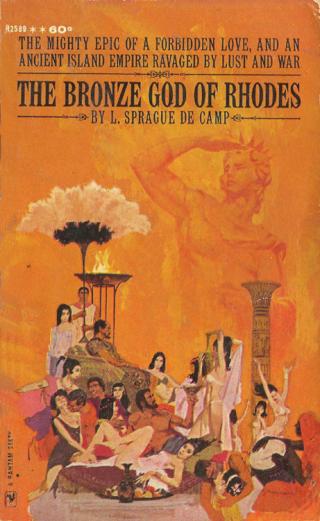
The Bronze God of Rhodes
- Автор: Де Камп Лайон Спрэг
- Год: 1963
- Язык: английский
- Год: Bantam Books
- Жанр: Научная фантастика

Электронная книга - «The Bronze God of Rhodes». Краткое содержание книги:
From the sea in thousands of ships they came, the brutal legions of Antigonos, a giant lusting for the power of Alexander the Great. For endless weeks and months they battered at the tiny island city, smashing it with monstrous weapons, crushing it with the terrible weight of their numbers.
Among the handful of grim defenders was one man who fought for a dream, a vision of a great statue that would stand above the highest towers as a monument to his city's grandeur.
He was Chares, soldier, adventurer, a man tormented by passion, a wanderer in strange, deadly lands—an artist who lived to see his incredible dream become one of the seven wonders of the world.
Half a ten-day later the ships came back, a squadron at a time, slipping past Demetrios' patrols at night when the wind favored them. Their hulls had been painted a piratical blue-gray before they set out, to make them less visible; even the gilded statues of Helios-Apollon on their sterns, which identified them as Rhodian, had been coated with this drab color. We gave them a whooping reception.
Damophilos' three triremes had sailed to Karpathos, halfway to Crete. There they had destroyed many of Demetrios' ships, while from the crews Damophilos impressed the best men into the Rhodian forces and sold the rest.
Menedemos, commanding three triemiolias, went to Patara in Lykia. Here he found an Antigonian trireme at anchor while its crew took its ease on shore. Menedemos burnt the trireme and captured several merchantmen. As he was preparing to return to Rhodes with his booty, an unsuspecting Antigonian quadrireme rowed into the river mouth. With a leonine pounce, Menedemos captured this powerful warship also, before its many deck fighters could get into their armor.
The quadrireme had come from Kilikia, bearing letters and money for Demetrios. It also carried a personal gift: a set of royal garments which the oldest of Demetrios' several wives, the lady Phila, had prepared for him with her own hands. There was also furniture decked with gold and ivory, and letters from Phila to her husband.
These robes were borne into the city in triumph. I recall a lively argument about them in Evios' tavern. Gobryas the Persian said:
"If it were up to me, I would publicly burn them. Thus should I show my contempt for the foe and gain great honor."
"They're too pretty for that," I said. "And if the Demetrios spares our art, I am not inclined to destroy his. I would hang them in a temple—say, the temple of Helios-Apollon."
"Oh, you and your art!" said Phaon. "Let's set up a scarecrow on the South Wall and hang these robes upon it. That would infuriate this proud popinjay!"
"That is the trouble," said Berosos. "Wroth already with us he is, so why make him angrier? Fain would I give him the garments back with a polite letter of apology."
We all hooted at this suggestion, though looking back I can see that it had much sense. Giskon, now a platoon leader in the Foreign Regiment, said: "At least we should sell these gauds back to him, to get something for our trouble in capturing them."
"Harken to the moneygrubbing Phoenician!" cried Onas. "Were I a true Egyptian wizard and not a mere lapidary, I could work a powerful spell on these garments, to bring down Demetrios with thirty-six fevers, itches, and other ills."
And so it went. Somebody wanted to auction off the garments; somebody else, to offer them as a prize to the bravest Rhodian soldier. The Council, which had custody of the raiment, said nothing.
Our third squadron, under Amyntas, had cruised along the Ionian islands. Here they sank many ships bringing materials to Demetrios and captured many others. Our harbors, from which most traders had long since fled, grew crowded again as in peacetime.
This last sortie affected my work. Reporting to Bias one day, I found him in talk with a small man of about his own age.
"O Chares," said Bias, "this is Polemon of Athens, one of the engineers captured by Amyntas. He's your new assistant."
"Oh?" said I.
"Yes. He is said to be famous as a catapult designer, but we'll see. You watch him to see he don't bugger our designs to get even."
The Athenian gave me a mocking smile. "I am sure, my dear fellow, that a technician as experienced as yourself would have no trouble in detecting my knavish tricks."
I flushed. Bias said: "Don't let him scare you, son. He knows his only chance of getting free again is to do right by us."
So I went to work with Polemon. In truth, I found it far less difficult than I had feared. Polemon really cared little about my youth, or about my inexperience, or even about which side he fought on. He was as devoted to his art of military ordnance as I was to sculpture. He would argue passionately for hours as to whether the trough of a catapult should be a digit longer or shorter, or whether there should be sixteen or eighteen notches in the rack. How fortunate for Rhodes that Amyntas had captured not only Polemon but also ten other engineers, equally famous and dedicated, on their way to join Demetrios!
Early in Pyanepsion, one morning, I was summoned to the Town Hall. Here I found a meeting of notables. These included President Damoteles; the Council; Kallias, municipal architect and general of artillery; Damophilos, now admiral in Exekestos' place; and Captain Python. Bias, too, had been summoned.
"Rejoice, O Chares!" said Admiral Damophilos. "We have decided to give Demetrios' fancy robes to the Ptolemaios, in hope of persuading him to send us more help. We wonder if we should put you and your catapult crew aboard the Halia, which will bear this gift."
I gave a broad grin of delight. Here was a chance not only to get away from the grind of the siege but also to see the wonders of Egypt—especially those in the fields of sculpture and architecture—of which Onas had told me.
Bias, however, was of another mind. He rasped: "Look, gentlemen, I slave to make these men into artillerymen. Out of Phaon's whole battery, half are half-wits and fumble-fingers. A couple of pieces have got pretty good crews, thanks to me beating them over the head for two years. Finally I get one real crew that can hit the side of a mountain two tries out of three—and then, by Herakles, you send 'em off on some chase after gryphon's eggs, just when they're most needed here! It don't make sense."
President Damoteles: "O Bias, we appreciate your work.
But today nearly all of Demetrios' large warships carry catapults. With our small fleet we dare not give the foe any advantage. We could be wiped out in an hour's engagement, whereas Demetrios can lose a score of ships and never feel it."
"But a couple of this crew are engineers, too," said Bias. "Are you trying to cripple our war production?"
Captain Python broke in: "Excuse me, but as I shall command the ship for this voyage, I know what I need. With all our newly captured engineers, you can spare a couple of Rhodians."
"But why this particular team?" persisted Bias. "I've got a couple of others you could have, and welcome."
"This crew has special virtues, my good Bias," said Python.
Python of Kallithea had captained the Euryalê in the previous actions; in fact, there had been criticism of his handling of the triemiolia in the nocturnal raid down the coast. His critics said that as a result of his hesitation to close with the pirates, his ship had not done the half of the damage wrought by the Halia. Now, with the Euryalê laid up for repairs and the Halia masterless since the promotion of Damophilos, Python had been given the latter ship. He was a tall, light-haired man with a long, narrow face, a bulging forehead, jutting ears, and a tremendous nose. Whatever his ability as a naval tactician, he was the most affable of all our ship's captains.
Python continued: "Berosos the Babylonian is a keen-eyed astronomer who can help with navigation, for we shall have to cross the open sea. Onas can interpret, should we make a landfall where no Greek is spoken. Chares is a sculptor, and the Ptolemaios has a weakness for artists and intellectuals."
Bias screwed up his wrinkled, mottled face. "I don't know about them foreigners. How do you know they won't desert as soon as they touch Egypt?"
Damoteles looked at me. "What say you, O Chares?"
I said: "Onas I am sure of, sir. His wife and child remain here, and he is a devoted family man. Berosos I am less certain of, though I believe he is in love with a local girl—let me see—I think it's the younger daughter of Thales the cobbler."