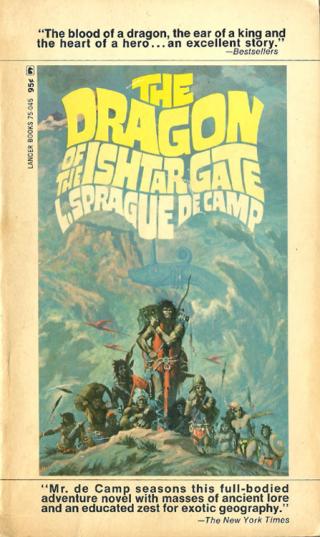
The Dragon of the Ishtar Gate
- Автор: Де Камп Лайон Спрэг
- Год: 1968
- Язык: английский
- Год: Lancer Books
- Жанр: Научная фантастика

Электронная книга - «The Dragon of the Ishtar Gate». Краткое содержание книги:
Dragon is probably closest in mood to de Camp's fantasy novels, while Bronze God and Arrows are closer to his science fiction, with their description of engineering problems, and personality clashes among researchers and engineers. Dragon also reflects de Camp's then-recent acquaintance with the Conan stories and other works of Robert E. Howard. Bessas, the huge Persian nobleman, is not only a close match for Conan in physique, but his mood swings, fixation on his mother, and tendency to toss of verses, seems a reflection of Howard himself. (Fortunately, his poems reflect de Camp's verbal dexterity and wit, not Howard's melancholy.)
"This hussy here?"
"Aye, my lord. So, says the shaykh, there was nought to do but cut his throat."
"Ha!" snarled Astes. "Nought to do but cut his throat, eh? Who does he think he is, to go cutting people's throats? The satrap? But let us get on. with the current case. Say unto him: These Nubians, from the Fifty-League Oasis west of the Second Cataract, aver that, two moons ago, the Banu Khalaf rode out of the desert and fell upon the Nubians who dwelt in the oasis. Many they slew, for the Nubians were taken unawares and adread at the sight of the camels, which they had never seen before. Hence they could not fight so stoutly as is their wont. Of those who failed to escape, the Arabs put all the men to the sword and made slaves of the women and children. How answers he?"
There ensued a long dialogue between Kothar and Shaykh Zayd. At last the Syrian said:
"Shaykh Zayd replies as follows: O great governor, protector of the poor, lion of righteousness, camel of the province—"
"Yes, yes, omit all that. Get to the answer."
"Well, sir, he says that he did but carry out Your Highness' commands."
"What! By the beams of Mah, is he mad? I never commanded him to go about enslaving and murdering the Great King's subjects."
"The shaykh explains thus: Last year he was driven out of his grazing grounds in the land of Midian by a band of treacherous, murderous, bloodthirsty villains called Lihy-anites. So, finding no other neighbors weak enough to overcome and despoil of their lands, he led the Banu Khalaf into Egypt.
"In Midian the tribe had eked out its living by hiring out to merchants, to carry their goods on its camels. Since he found that the camel was almost unknown in Egypt, the shaykh has sought for some part of the land of Khem where he could use his beasts to advantage. His gods, he says, revealed to him that the trade routes running south from Swenet offered die best possibilities, as they pass through difficult desert country and are now plied only by a few hardy farers on asses or afoot.
"During his travels he learnt that, ere he began to ply these routes, he must needs get leave from the satrap. Wherefore he waited upon Your Excellency."
"All true," said Astes. "But what has it to do with his seizure of the Fifty-League Oasis?"
"We are coming to that, sir. Receiving Your Highness' gracious permission, he sought out oases along the routes in question. As a successful caravan business depends upon control of the oases, he says that you must have meant him to seize these oases, else why would you have sent him forth? To perish in the desert?"
Astes again turned dangerously red but merely said: "Continue."
"Discovering that the Fifty-League Oasis was inhabited by a handful of wretched, stinking, cowardly Nubian peasants—"
"Liar! Thief! Murderer!" howled the Nubians until quieted by shouts from the satrap.
"—the Banu Khalaf naturally took control of the oasis, as the gods plainly meant such a natural feature to be under the rule of those best fitted to use it. As for enslaving the surviving Nubae, that is but just, as they lost the battle; whereas, had they been as good men as the Banu Khalaf, they would either have defeated them or died fighting. And now, says Shaykh Zayd, how can Your Excellency eat bread and salt with a man, and entice him to this isle with promises of rewards, and then treacherously seize him and try him, as if he were a mere slave or peasant?"
"He accuses me?" screamed Astes. "To the House of the Lie with him! Throw the insolent scoundrel into a cell, and his daughter, too! I will dispose of this case later, when I have thought up a fitting punishment for their villainy." Still fuming, he turned to Bessas' company. "Now, you other people. What do you want, you great lout?"
"Did you speak to me, sir?" said Bessas, raising his bushy brows.
"Certes! Whom thought you that I spoke to?"
Bessas bit his lips with anger but, calmly enough, told of his mission. "I have here a letter from the Great King, signed by Artabanus, asking the help of all satraps. I also have a letter to Your Highness from the lord Achaemenes, asking that we be sped on our way to Meroê—"
"Bugger Achaemenes'" cried Astes. "You may not go."
"Not go to Meroê, my lord?"
"No, not go to Meroê. You would have to reach the Kushite outpost of Napata, and there have been raids and forays all along the bend of the Nile around Napata. It is a virtual undeclared war. If you go blundering about there, you will be slain either by mistake by our own troops or as Persian spies by the wild Kushites, and I shall be blamed."
"But, sir, the Great King commanded me—"
"The Great King knows not how things are in Kushia. You may either settle down here until order is restored, or return whence you came."
"But, my lord, I have another letter from the Great King to the king of Kush—"
"It is I who decide here, and I have decided that you shall not go. Dare you to question my decision, sirrah?"
"Nay, but—"
"No buts or ifs, you hairy barbarian! What My Lordship asserts, so shall it be! The audience is ended; you may go."
Astes swept out, leaving Bessas and his fellow travelers gaping.
Myron was sitting with Kothar in the tavern of Yeb, sipping a cup of heavy wine sweetened with date sirup and playing tjau. Bessas came in with one of the Judaean soldiers, whom he presented to the players:
"This is my friend, Deputy Captain Yehosha, whom I asked to have a drink with us."
The Judaean was a man of Bessas' age, shorter by half a head but fully as broad and brawny, with a large hooked nose and a flowing black beard. Both he and Bessas had evidently been drinking for some time already. Yehosha clapped Myron heavily on the back, saying:
"Who wins? Oh, I see, you do. You will have no chance, Master Kothar, so long as you leave your dogs scattered about the board in irregular groups, whilst your foe gathers his into a solid phalanx." He spoke fluent Aramaic, though with an odd accent.
"I resign," said Kothar glumly. "The spiritual forces fight against me today."
Myron drank. "I merely apply the lesson I learnt when I was trained as a hoplites in Miletos, long ago, namely: that a force of well-armored spearmen can repel any other troops in the world while they keep their formation—as the Athenians proved at Marathon."
"You Hellenes never cease boasting of that little border skirmish," said Bessas. "At that, the Athenians would have been smashed like a plover's egg beneath a horse's hoof if Darius' silly generals had not misused the world's best cavalry by making them fight on foot."
Myron said: "Why not tell Xerxes to challenge the Athenians to a return match, with everybody mounted this time? I can just hear the clatter of armored Athenians falling off their nags." He turned to Yehosha. "Didn't I see you at the palace this morning?"
"Aye; your servant had charge of the Nubae." The Judaean grinned. "How like you our little wasp of a satrap?"
"My dear sir, I have encountered many governors and other officials, but never one like this. Is he always in such a rage?"
"Usually." Yehosha lowered his voice. "Astes has three reasons for being wroth just now. One: he is fain to be a hero, so he tried to lead a squadron in person on the Kushite frontier, a fortnight ago; got ambushed and lost half his force. Two: he especially hates all large, tall men like Master Bessas. And three: he is exasperated by the case of the Fifty-League Oasis, because neither plaintiff nor defendant has any wealth that the satrap can extort in return for a favorable judgment. These poor Nubians-own nought but a few iron hoes, while the Arabs have only a few hundred mangy camels, which have no value here because the Egyptians fear the beasts."
With a faraway look, Bessas muttered: "On the northern frontiers, if a man spoke to me as has this unmannerly little knave, I'd break his neck."