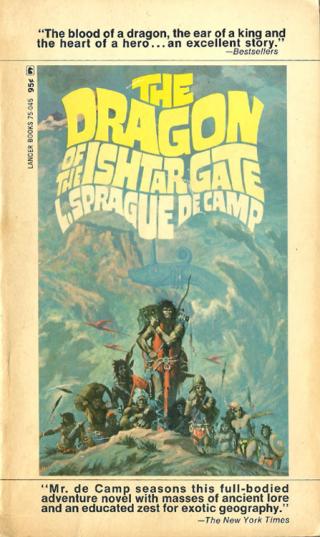
The Dragon of the Ishtar Gate
- Автор: Де Камп Лайон Спрэг
- Год: 1968
- Язык: английский
- Год: Lancer Books
- Жанр: Научная фантастика

Электронная книга - «The Dragon of the Ishtar Gate». Краткое содержание книги:
Dragon is probably closest in mood to de Camp's fantasy novels, while Bronze God and Arrows are closer to his science fiction, with their description of engineering problems, and personality clashes among researchers and engineers. Dragon also reflects de Camp's then-recent acquaintance with the Conan stories and other works of Robert E. Howard. Bessas, the huge Persian nobleman, is not only a close match for Conan in physique, but his mood swings, fixation on his mother, and tendency to toss of verses, seems a reflection of Howard himself. (Fortunately, his poems reflect de Camp's verbal dexterity and wit, not Howard's melancholy.)
Kothar smiled maliciously. "Even a fool, when he keeps his peace, is accounted wise, and he who shuts his mouth is esteemed a man of sound judgment."
"Take a look at your sword, too, Kothar," said Bessas.
The Syrian's smile vanished. "Oh, but good my lord! I had no intention of going on this foray. I am quite un-suited to such nocturnal desperatisms."
"Natheless, you shall come, if only for your command of the Khemite speech. I would not have us fall into some ambush and then try to work out tactics with friend Tjay by sign language."
Kothar paled, sank to his knees, and kissed the hem of Bessas' tunic. "Spare your slave! I will do whatever you command, but not this! You know not what you ask!"
"What do I ask of you?"
"It is not the knives of rival robbers, or the spears of the guardians, or the staves of the priests that I fear, but the sinister supernatural influences that hover over the City of the Dead. You cannot sense them, but to my occult insight they appear as plain as if they were a vast black cloud of bats, sweeping back and forth over that fell necropolis. I feel them; they call to my souclass="underline" Come, Kothar bar-Malko, come within reach of our claws!"
The man seemed so genuinely terrified that Myron, whose sympathies were easily touched, might have let him off. Besides, despite his skepticism about spooks, he felt his own viscera crawl with fear at the Syrian's words. But Bessas was inexorable.
"You care not if these demons bear off my soul and Myron's to some unknown hell!" he growled. "My fravashi likes this enterprise neither, but I know my duty. Well, useless though you be with a sword, you still know more spells and other magical antics than the rest of us. So you shall come along and recite manthras to hold your fiendly hosts at bay, whilst Myron and I cope with mundane threats from the material plane."
A swarm of small boats, each flying a single papyrus sail, ferried passengers from Opet to the City of the Dead. As the Nile was at ebb, Bessas, Myron, and Kothar had to jump out into ankle-deep water, wade ashore, and walk over a long stretch of half-dried mud before reaching the bank of the river. After scrambling up a low bluff by a narrow sandy path, they found themselves above the high-water mark of the river.
Ahead, a broad plain spread out before them, dotted with temples, shrines, palaces, and hundreds of huts of temple servants. Plots of cultivation lay amidst the buildings, but the winter's crops had long since been harvested, leaving brown stubble. About a league away, black against a sky still banded with vermilion and gold and emerald from the departed sun, rose the ramparts of the Libyan desert.
Other visitors also came and went. Egyptians, most of them boys, swarmed around with torches to sell and asses to rent. Kothar, snapping: "Ennen! Ruek!" at them, strode through and on across the plain.
The sky darkened; bats whirred overhead. The buffs and browns of daylight darkened to purples and grays. Pilgrims lighted their torches, making orange splashes in the twilight. The Bactrian and his companions crossed a rickety bridge that spanned a small arm of the Nile, now but a dried-up moat lined with black mud cracked into polygonal patterns. The two colossal seated statues of the third Amenhotep, faintly washed with the silvery sheen of the rising moon, towered up on their left against the awakening stars.
"The priests inform me," said Kothar, "that to see the City of the Dead in its greatest glory we should have come here a few centuries back, when wealth was to hand for the upkeep of all these establishments. Now, because of the rapacity of the Persian officials—so they say—some of the temples are reduced to a mere handful of priests, and some have been abandoned to the lizard, the jackal, and the stone-stealing peasant. This distresses the priests full sore."
Myron murmured: "While I love great art of whatever nation, I imagine that the common people whose substance was squeezed out of them to build these fine god-houses might feel a bit differently."
Kothar: "Of course, to a scoffing unbeliev—Yai!" A bat, swooping close past his head, caused him to leap and yelp. "Being doomed to this rash undertaking, I strive to pass it off bravely. But this is hard, because only I understand the full depth of the peril into which we are rushing. You, who comprehend such matters not, can afford to be fearless."
They walked along the path that led to the great mortuary temple of Queen Hatshepsut, a vast, severely symmetrical pile of monumental stairways and endless colonnades. Behind the temple towered a jagged cliff, whose sharp spires soared a hundred cubits above the plain. People, cloaked against the chill of the desert night, passed them coming and going. Egyptian pilgrims, foreign sightseers, and shaven priests flitted by like ghosts. Voices were hushed as the darkness deepened. The torches looked like a surging swarm of orange fireflies.
"By the time we reach this tomb," said Myron, "my feet will be so sore that I could not flee from a toddling babe, let alone from a man or a demon."
"Keep your voice down," said Bessas. "Some know the Syrian speech. 'Tis but a furlong farther."
The temple of Hatshepsut no longer boasted a corps of resident priests. The properties on which the temple relied for support had disappeared by alienation and confiscation centuries before. Sightseers prowled about the deserted fane, which still stood in good repair. A pair of voluble Hellenes were energetically scratching their names in the limestone of one of the square pillars. One scratched with the point of a dagger while the other held a torch.
"That is the sort of thing that incenses the priests," said Kothar. "If those saucy knaves do not live to rue their insolence towards the great queen's ghost, I shall be much astonished."
He led his companions to the right. At the northern extremity of the mortuary temple, where the sides of the half bowl in which the temple stood began to slope up sharply, a voice hissed out of the darkness.
Kothar whispered introductions. "This is Tjay," he said. "He will lead us to the top of the cliff, where his men await."
"Do you mean we shall scale that?" said Myron, almost in a squeak, as he pointed to the cliff.
"Certes; it would not do to take the well-traveled road to the Valley of Kings. This is a mountain path, known to few. Let us be on our way."
Bessas spoke quietly to Myron: "If you are not used to mountaineering, keep behind me, watch what I do, and don't look down. I have done enough climbing in the mountains of Gandara to have the hang of it."
The climb, though not quite so dreadful as Myron had feared, was bad enough for one not used to it. At the top he panted: "Let me—let me catch my breath. Now I know what Pindaros means by the term 'age always hateful.'"
Four more shadows shimmered into view in the moonlight. Kothar explained: "These are Tjay's men. Two others have gone to the temple of Seti to raise a disturbance and draw the guards thither. Come along."
"You mean—you mean we are not there yet?"
"Gods, no! The tomb is another half-league."
The Valley of Kings was a wide-spreading complex of troughs, ravines, and bays. Myron panted, slipped, and stumbled behind his companions over knife-edged ridges and up and down slopes fit only for goats. Kothar, walking in front of him, stopped so suddenly that Myron bumped into him. The Syrian squealed and seized Myron's arm with frenetic force. The guide was trembling.
"What is it?" said Myron.
"Do you see?" Kothar pointed across the rock hills. "It is the cobra goddess Mertseger, who guards the tombs of the dead. She lies in wait for us!"
Myron peered. Was it a trick of the moonlight, or did a long, dark, serpentine shape indeed sprawl across the landscape? Were those a pair of low-hanging stars, or the eyes of the divine serpent?