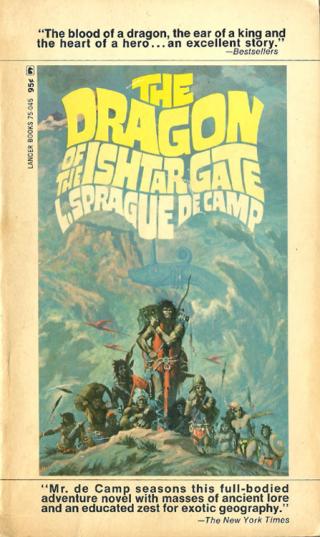
The Dragon of the Ishtar Gate
- Автор: Де Камп Лайон Спрэг
- Год: 1968
- Язык: английский
- Год: Lancer Books
- Жанр: Научная фантастика

Электронная книга - «The Dragon of the Ishtar Gate». Краткое содержание книги:
Dragon is probably closest in mood to de Camp's fantasy novels, while Bronze God and Arrows are closer to his science fiction, with their description of engineering problems, and personality clashes among researchers and engineers. Dragon also reflects de Camp's then-recent acquaintance with the Conan stories and other works of Robert E. Howard. Bessas, the huge Persian nobleman, is not only a close match for Conan in physique, but his mood swings, fixation on his mother, and tendency to toss of verses, seems a reflection of Howard himself. (Fortunately, his poems reflect de Camp's verbal dexterity and wit, not Howard's melancholy.)
"Many feel as you do." The Judaean smote his broad chest, so that the bronzen scales jangled. "Hoy! The great Yahveh must be wroth with us, to send us such governors. The one before this was drunk all the time, and the one before him slept all the time. This one is not only arrogant and ill-tempered, but also has his hand in everybody's purse. Truly we get the dregs of the Persian Court."
Bessas said: "I suppose the king cannot find good men who will take such an out-of-the-way post. This rascal is doubtless the brother-in-law of some member of the Council of Seven, who must be taken care of somehow—preferably far from Persepolis."
"Tell me," said Myron, "how came a garrison of Judaeans to be stationed here, so far from their native land?"
Yehosha replied: "It started long ago, when a king named Psamatik ruled Egypt. Some say he invaded Judaea, seized thousands of our folk, and settled them here as a shield against the Kushites. But we have been here for generations, so that the Isle of the Elephant is home to us."
"Is that what Yeb means?"
"Aye; though whether because the beast once roamed hereabouts, or because the Kushites fetch ivory hither to trade, I know not."
Myron asked about the sirrush, showing his sketches. Yehosha stroked his beard and said:
"I cannot aver that such a beast has come within our ken. True, many strange creatures are said to dwell in the south. There is the man-eating bull, whose eyes flash fire and whose horns move like the ears of a dog. There are serpents so vast that they coil about elephants, crush them to death, and swallow them whole. One must approach hills warily, lest a hill turn out to be one of these reptiles coiled up and sleeping off its last repast of elephants and hippopotami.
"To the southwest, in the land of the Eaters, live men with dogs' heads—"
"The land of whom?" interrupted Bessas.
"The Eaters, they call them; cannibals. Along the shores of the Red Sea, at certain times of year, swarms of winged serpents fly up the dry river valleys and would overrun Egypt, were it not for the ibises that gather there to devour these vermin. But I cannot truthfully say that I know your Babylonian cat-lizard."
"We must go on, natheless," said Bessas. "The Great King has so commanded. If Astes gainsays us, we shall have to evade him."
"Easier said than done," said Yehosha. "Astes, for all the paint on his face, is a shrewd and energetic man. His patrols scour the roads, inquiring into everything. The satrap ofttimes rides out with them to keep them up to the mark."
Myron said: "When will these border disturbances subside?"
"Not soon, if ever. No fixed border has ever been drawn. The region of the Nile bend forms a zone of raiding and counterraiding, to the ruin and destruction of the folk who dwell there. We raid as far as the Napatan reach of the Nile, whilst their war parties have pierced as far north as Buhen. Two years ago they overran that fortress and slew or carried off every mortal therein."
"Why don't the Persians and Kushites draw up a boundary, marked by monuments as in Hellas?"
"Because the Kushites will not admit our—that is, the Persians'—right to rule Egypt, let alone the satrapy of Kushia. Because their kings once ruled the land of Khem, they "assert they still should righteously do so. Even less will they acknowledge Persian rule over northern Kush, which their kings ruled until Darius' soldiers drove them out—or the gold mines of Kush, after which the Persians lust as a sailor home from the sea lusts after a wench.
"So, you see, you are not likely to get to Napata now, especially as you are not after booty of the sort that the satrap could get his claws into. Your chances were better if you were outfitting a slave-catching foray, or seeking the treasure of Takarta."
"What treasure?" asked Myron.
"Takarta, the last king to rule Kush from Napata. When the Persians captured his palace, their general was furious—my father, who fought in that campaign, told me how he raved—at failing to find the private hoard of the king. So the tale has grown up that Takarta, for all the haste of his flight, bore off his nest egg. It is fabled to have included the True Anthrax."
"Eh? What is that?" said Kothar suddenly, coming out of his meditations.
"You know, the gem that darkens when danger—"
"Yes, yes, I know the jewel's mystic properties. But how came the Kushite kings to possess it?"
"It is said that the Anthrax belonged to Egyptian kings who reigned before the Kushites conquered Khem. The Kushite kings seized it and, when driven out by the Assyrians, took it with them. But I think these are all mere fables. Belike some Persian rankers got to Takarta's treasure chest first, stuffed the baubles into their pantaloons, and held their tongues."
Kothar said: "Could we now go to the satrap and change our story, saying that we were really in pursuit of slaves or treasure?"
"Not with Astes! Being a very suspicious man, he would probably sentence the lot of you to the granite quarries."
Myron unfolded the sheet of parchment on which he had drawn a map of Egypt, saying: "If this be the disturbed frontier zone, why could we not go around it, to east or west? Neither Kush nor Kushia extends indefinitely into the desert."
Yehosha frowned at the sketch. "He'akh! There is, forsooth, the western route that passes through the Fifty-League Oasis, over which the Banu Khalaf and the Nubae quarrel. But that route is a horse killer, so widely spaced are the water holes. And if you miss one well, you are dead."
Myron burst out: "I have it! We'll hire Zayd to get us to Meroê with his camels. The money we pay him will enable him in turn to pay off Astes and the Nubae, so they should not object, and we shall avoid the fighting zone."
Bessas: "The very thing! See, Yehosha, what a wise lieutenant I have?"
Yehosha said: "A clever scheme. Be sure to take with you not only the shaykh but also his daughter Salimat."
"What's this? On such a hurried enterprise as ours, women are an encumbrance. They cause strife amongst the men, who vie for their favor. Why should we be burdened with one?"
"Because she is the real head of the clan, having wit for two. Zayd is a fine old fellow in his way, aside from the fact that he has never learnt that it is wrong to rob and murder. He has good friends amongst the Judaeans of Yeb, for we children of Shem must stick together in far lands. But the daughter is the real force of the twain."
Bessas shook his head. "I still like not that plan. But let's have a song. Know you The Lousy King of Lydia?"
"Aye, though I cannot remember all the words. How goes it?" The two deep bass voices rolled out:
The next day, they persuaded Astes to let them see the prisoners. The old shaykh listened with grave courtesy to Bessas' proposal and looked at his daughter. "What think you, my dear?"
Salimat was a rather small, slight girl, quick as a cat and lithe as an eel. Although nearly as swart as a Nubian, she had delicately aquiline features that would have graced a Greek vase. In the courtroom, these features had been hidden by a blue veil, but one end of this veil had now been unfastened so that it hung down to one side.
Besides the veil, Salimat wore a robe consisting of two long strips of cloth, fastened at shoulders and ankles but otherwise loose. Thus, whereas Salimat appeared fully clad from the front or the back, she was virtually nude from the side.
"How many men and beasts now comprise your company, Captain Bessas?" she asked. When Kothar had translated the question and the reply, she thought briefly and said: "A score of camels should carry fodder and water enough to get you all to Meroê. For that, we shall need five or six of our men."