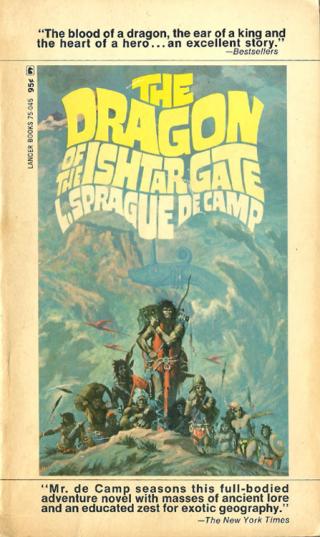
The Dragon of the Ishtar Gate
- Автор: Де Камп Лайон Спрэг
- Год: 1968
- Язык: английский
- Год: Lancer Books
- Жанр: Научная фантастика

Электронная книга - «The Dragon of the Ishtar Gate». Краткое содержание книги:
Dragon is probably closest in mood to de Camp's fantasy novels, while Bronze God and Arrows are closer to his science fiction, with their description of engineering problems, and personality clashes among researchers and engineers. Dragon also reflects de Camp's then-recent acquaintance with the Conan stories and other works of Robert E. Howard. Bessas, the huge Persian nobleman, is not only a close match for Conan in physique, but his mood swings, fixation on his mother, and tendency to toss of verses, seems a reflection of Howard himself. (Fortunately, his poems reflect de Camp's verbal dexterity and wit, not Howard's melancholy.)
Bessas slapped his thigh. "As I feel now, I should welcome a battle with the whole of Meroê. When—"
He wheeled, staring down the road. Along the track came faintly the sound of drums. "Puerma!" he exclaimed.
Meroê came to languid life. The sleeping soldiers awoke, yawned, and picked up their spears and shields. Others joined them. People issued from the gate, first in a trickle and then in a stream.
The guardsmen cleared the road for the approaching army. They ran up and down the sandy track, screaming at the citizens and beating them back with the shafts of their spears. Once the quick tempers of the Kushites erupted into a brawl. There was an instant of yelling. Spearheads flashed in the glare, and a dead man was dragged out of the press for his family to wail over.
The other Kushites lined up on both sides of the road. There were mop-headed men and women with tribal scars on cheeks and the kilt of Kush about their loins. There were swarms of naked black children. Bessas and his party elbowed their way to the front, ignoring the scowls of the Kushites and the movement of the men's hands towards the daggers strapped to their upper arms.
The drumming became louder. A cloud of dust appeared down the road. Out of it issued a group of whifflers with staves to clear the way. Then came a squad of drummers, madly beating complex rhythms on deep, narrow drums. The vultures flew up from their feast and flapped in circles, croaking indignantly.
After the drummers ambled General Puerma on an ass. Although the ass was one of the big white Egyptian breed, it was hardly large enough to carry the general, whose bare feet scarcely cleared the road. For Puerma was a large man, tall and rather fat, so that he must have come close to Bessas' weight. He wore a towering headdress made of a lion's mane, a cuirass of silver scales, and a kilt embroidered with gold thread. One man led the ass while another trotted alongside, holding a parasol over the general's head.
The Meroites screamed "Puerma! Puerma!" The general smiled blandly, but his smile vanished as he stared hard at Bessas and his companions before riding on.
After the general came men carrying loot. There were bags of gold dust. There were tusks, hides, horns, and plumes. A man carried a basket full of dubious brown objects.
Then came captives. Each bore a forked wooden pole about four feet long. The captive's neck was clasped in the fork of the pole and held in place by rawhide lashings, while his wrists were lashed to the long end of the fork. To avoid exhaustion, each prisoner rested the end of his pole on the shoulder of the captive in front of him.
The captives were mostly men, although there were some women and children. They were of many types. There were slender, bearded, hook-nosed, light-brown highlanders; there were squat, thick-thewed, inky-black men with full lips and slanting eyes. Some were as tall as Bessas, but thin as storks; others were equally tall but mightily muscled. Some had the lower middle front teeth missing, while some bore tribal cicatrice patterns on shoulders or buttocks. Most were completely naked, and many bore partly healed wounds. Kushites with whips and bludgeons hustled them along.
After several hundred captives had passed, the soldiers appeared. These were a column of lean, raisin-colored men, wearing the skins of lions, leopards, and other beasts, with bunches of ostrich plumes nodding from their topknots. Many had their bodies painted with vermilion and chalk. In some, the right half of the body bore one pigment and the left the other; others flaunted gaudier patterns.
Each bore a spear—sometimes with an iron head and sometimes with a head of sharpened antelope horn—and a shield of elephant, rhinoceros, or hippopotamus hide. In addition, most carried additional weapons, such as a longbow made of a palm rib, a knobbed wooden club, or a bundle of javelins. There was no uniformity in their equipment.
Gold abounded among them. It gleamed from rings, earrings, armlets, torques, and anklets. It jingled in chains and in strings of amulets. Myron remembered Yehosha's remark about the gold mines of Kush.
Puerma's soldiers did not march. They straggled, shaking their weapons and uttering boastful shouts. Whenever one sighted a woman he knew, he shouted a few words and made sexual motions, raising raucous laughs.
Sweat ran down the soldiers' bare chests. Choking clouds of dust arose. Myron, though not finicky, found the massed odor overpowering.
Following several thousand soldiers came slaves bearing food and equipment, though this was scanty by the standards of more northerly lands. Beside Myron, Bessas remarked:
"Do not make the mistake of thinking these fellows, even if they look primitive and disorderly, are not warlike. Many times they have held their own in battle with the Persians. Some of my military friends who have faced their screaming charges are not eager to do so again."
In the main square of Meroê, officers strove to beat and kick their men into some semblance of a hollow square, while outside the mass of soldiers others rushed about beating back the common people, trying to keep them from mingling with the warriors. But their struggle was hopeless. As soon as the officials had passed, the masses began to stir, chatter, and mingle like any crowds. Every soldier had a tale of deeds of dought that he wanted to tell.
Myron, standing on tiptoe, could barely see over the mop heads before him. Bessas and Zayd, towering over the throng, watched impassively, while the stumpy Skhâ danced and wriggled about, seeking a view. Kothar, unconcerned with these earthly events, gazed at the distant sky.
A trumpet sounded. Suddenly even Skhâ could see, for thousands of Kushites around the square were throwing themselves prone. The king had come out of his palace.
"You had better get down, too, if you are fain to keep your heads," said the low but penetrating voice of Kothar. Myron folded up on the ground, but not before he had obtained a good look at the king, who stood less than fifty paces away.
Saas-herqa, King of the Two Lands, was a slight, ineffectual-looking man. Myron would have guessed that he was in his thirties. His skin was lighter than that of most Kushites. On each of the king's brown cheeks was cut a pair of zigzag tribal scars, like twin serpents.
The king's personal presence, however, was dwarfed by the magnificence of his attire. For his regalia was copied after that of the Egyptian kings of the great days of the Egyptian Empire. From his head rose a great golden tiara, fronted with the head of the lion god Apizemek, of whom the king was the incarnation. Golden horns rose from the sides, and golden wings covered the monarch's ears. Round his neck spread a golden gorget agleam with jewels. A jeweled baldric supported a sword with a jeweled hilt. The king's kilt and the high-crossed lacings of his tasseled sandals glistened with golden thread. He made a gesture with a small golden battle-ax, and the prostrate thousands rose.
Behind King Saas-herqa stood his fat queen, wearing art ornate crown of golden horns, wings, and a rearing cobra. Like the king, she was nude above the waist save for ornaments. Instead of a kilt she wore about her massive hips an ankle-length skirt, embroidered with golden wings and flowers.
Beside the queen stood an elderly man in plain white linen and a tall hat like the Persian cidaris. Though as dark as most Kushites, he was taller, with strongly aquiline features. These, together with his bald head and wattles, gave him a vulturine appearance. In response to Myron's whispered question, Kothar replied:
"That is Osorkon, high priest of Amon of Meroê. He and Puerma are the mightiest men in the kingdom."